Top 10 Best AI Powered Deployment Tools In The World 2026

Table of Contents
The difference between a successful artificial intelligence initiative and an expensive experiment often comes down to deployment. Building a model is only half the battle; getting it into production, monitoring its performance, and scaling it reliably is where real value is created. As of 2026, the landscape of AI-powered deployment tools has matured significantly, with platforms that now handle everything from serverless inference to complex multi-model orchestration. To build this ranking, we looked at several key factors: breadth of model support, production scalability, ecosystem integration (especially with cloud and data platforms), operational maturity (including monitoring and governance), and real-world adoption across industries. We weighed criteria like total cost of ownership, flexibility for custom workflows, and the strength of each tool's community or vendor support. The result is a list of ten platforms that represent the best options for deploying AI in production today, from hyperscaler giants to specialized open-source frameworks.
The Top 10 Best AI Powered Deployment Tools In The World 2026:
1. Google Cloud Vertex AI
Vertex AI stands as Google Cloud's unified AI and ML deployment platform, and it claims the top spot for good reason. It supports over 100 foundation models and provides managed endpoints for both real-time and batch inference. The platform integrates tightly with BigQuery, GKE, and Dataflow, creating a seamless pipeline from data ingestion to model deployment. In 2024, Google Cloud's overall division generated $37.4 billion in revenue, a figure that underscores the scale of infrastructure backing Vertex AI.
What sets Vertex AI apart in 2026 is its mature MLOps capabilities. It includes a feature store, built-in pipelines, and automated monitoring for drift and skew. The platform also offers strong responsible-AI tooling, which is increasingly critical for regulated industries. For organizations that need to deploy large language models alongside traditional ML models, Vertex AI provides a unified console with enterprise-grade governance. Its global infrastructure and multi-model support make it the most comprehensive choice for large-scale AI deployment in the current market.
2. Amazon SageMaker

Amazon SageMaker is AWS's fully managed platform for building, training, and deploying AI models. It is used by tens of thousands of customers, and AWS reported net sales exceeding $100 billion in 2024, with SageMaker serving as the flagship ML service within that ecosystem. The platform supports real-time endpoints, serverless inference, asynchronous inference, and edge deployment through SageMaker Neo.
One of SageMaker's strongest assets is its breadth. It includes built-in experiment tracking, a feature store, a model registry, and automatic scaling. For organizations already standardized on AWS, the integration with CloudWatch, IAM, and CI/CD services is seamless. Industry reports from 2025 and 2026 consistently place SageMaker among the top MLOps platforms for production-grade deployment at scale. However, the learning curve can be steep, and AWS lock-in is a real consideration. These trade-offs place SageMaker just behind Vertex AI, but it remains an exceptional choice for enterprises deeply embedded in the AWS ecosystem.
3. Microsoft Azure Machine Learning
Microsoft Azure Machine Learning offers a managed MLOps and deployment service with online and batch endpoints, plus Kubernetes-based inference through Azure Kubernetes Service (AKS). The platform is tightly coupled with Azure OpenAI Service and Microsoft Fabric, enabling organizations to deploy both custom ML models and large language models under a unified governance framework. Azure's Intelligent Cloud segment generated over $70 billion in revenue in 2024, reflecting the scale of the underlying infrastructure.
Gartner and other analysts have repeatedly placed Microsoft in the leader quadrant for cloud AI platforms through 2024 and 2025, citing enterprise security, compliance, and hybrid capabilities. Azure Machine Learning is particularly attractive to Microsoft-centric organizations that rely on Active Directory, Power BI, and the broader Microsoft ecosystem. It ranks third because, while it is a top-tier enterprise deployment stack, it lags slightly behind Google and AWS in user experience and multi-cloud flexibility. For organizations committed to the Microsoft stack, however, it is an excellent choice.
4. Databricks Lakehouse AI (incl. Model Serving)
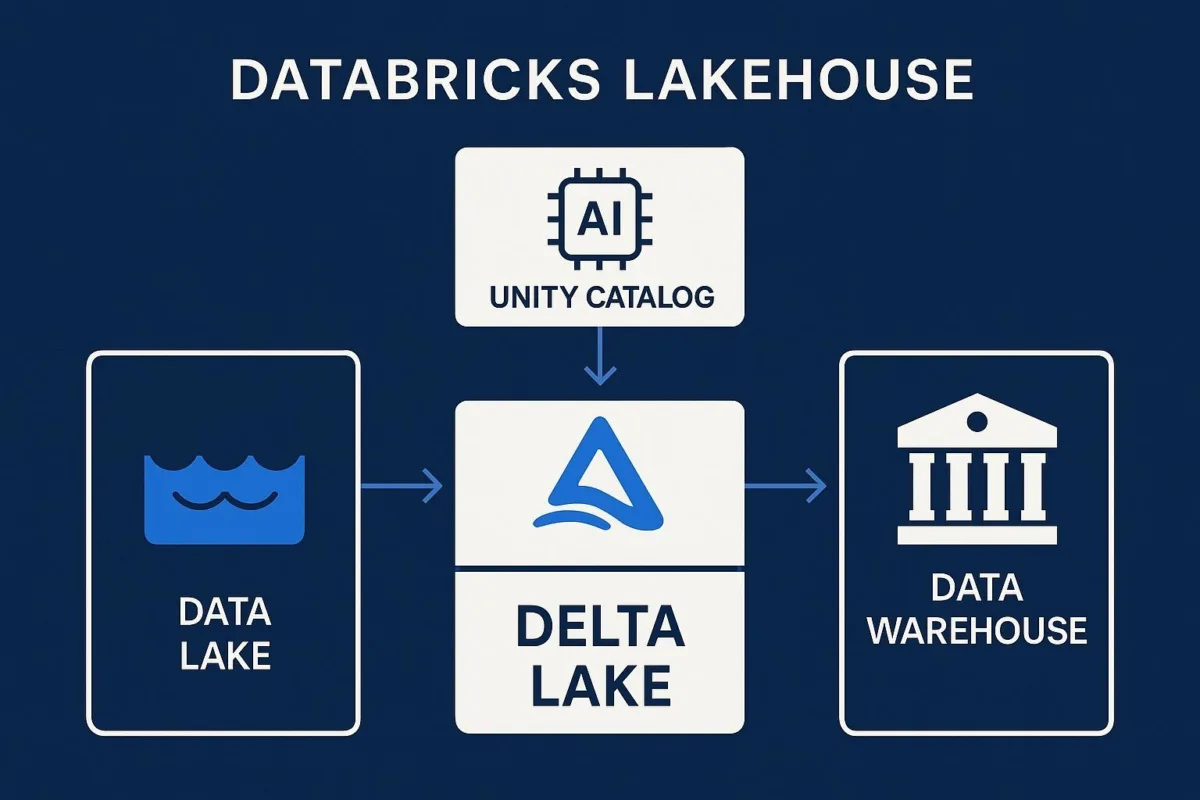
Databricks Lakehouse AI builds on the company's lakehouse platform to provide integrated training, experimentation, and serverless model deployment directly on lakehouse data. With more than 10,000 customers and a valuation exceeding $40 billion as of 2024, Databricks has established itself as a major force in the AI infrastructure space. Its Model Serving feature supports real-time REST endpoints, model monitoring, and native integration with the Feature Store and Unity Catalog for governance.
Many MLOps comparisons from 2024 and 2025 highlight Databricks for its ability to unify data engineering, analytics, and AI deployment on a single platform. This reduces data movement and tool sprawl, which are common pain points in large organizations. Databricks also offers optimized serving for popular LLMs, making it a strong choice for generative AI workloads. It ranks fourth because it is exceptionally powerful for organizations already on Databricks, but it is less of a general-purpose cloud platform than the top three.
5. Kubernetes + Kubeflow / KServe
The open-source combination of Kubernetes for container orchestration and Kubeflow or KServe for ML model serving remains a de-facto standard for self-managed AI deployments. Kubernetes runs the majority of containerized workloads globally, and KServe provides model servers with autoscaling, traffic splitting, and standardized inference protocols. Kubeflow adds pipelines, notebooks, and metadata tracking on top of this foundation.
This stack is widely documented in MLOps tool surveys from 2024 through 2026 as the most flexible and portable option available. Organizations that want full control and the ability to deploy across multi-cloud or on-premises environments often choose this combination. It ranks fifth because of its ubiquity and power for sophisticated teams. However, it sits below fully managed clouds due to higher operational complexity and the need for strong in-house platform engineering. For teams with the expertise, it is unmatched in flexibility.
6. Red Hat OpenShift AI
Red Hat OpenShift AI layers model development and deployment capabilities on top of the OpenShift Kubernetes platform, which is already used by thousands of enterprises. As of 2026, it is positioned as a core AI platform for hybrid cloud environments. The platform offers managed GPU scheduling, model serving components, and integration with Open Data Hub, along with enterprise-grade security and governance aligned with Red Hat's ecosystem.
A 2026 Red Hat overview emphasizes the platform's role in speeding AI innovation with a flexible platform that offers a reliable AI ecosystem and a consistent user experience across data centers and clouds. This makes OpenShift AI a leading choice for regulated industries and organizations standardizing on OpenShift. It ranks sixth because it is less of a turnkey SaaS experience than the big three cloud-native AI platforms, but for hybrid and multi-cloud deployments, it is a robust and reliable option.
7. MLflow + MLflow Models
MLflow is one of the most widely adopted open-source MLOps frameworks, backed by the Linux Foundation and used by thousands of organizations. It provides experiment tracking, a model registry, and a standard model packaging format known as MLflow Models. This format can be deployed to diverse targets, including local environments, Docker containers, Kubernetes, and cloud services.
In 2026 educational material on responsible AI deployment, MLflow is frequently cited as a core tool for tracking models and managing the lifecycle when deploying AI in production. Because it is open source and framework-agnostic, it serves as a glue layer for many deployment stacks, enabling reproducible deployments and rollbacks. It ranks seventh because it is a critical building block for AI deployment architectures. On its own, however, it is more of a framework than a fully managed deployment platform.
8. Domino Data Lab Enterprise MLOps Platform
Domino Data Lab focuses on regulated, model-intensive enterprises, particularly in financial services, pharmaceuticals, and insurance. The platform provides centralized model management, reproducible environments, and controlled deployment pathways. It supports on-premises, private cloud, and hybrid deployments, and it integrates with Kubernetes and major clouds. This gives data science teams self-service workspaces while maintaining IT-grade governance.
Analysts in recent MLOps evaluations highlight Domino for strong auditability, role-based access control, and support for large data science teams. It is used by multiple Global 2000 enterprises and is often cited in analyst reports as a leader in enterprise MLOps. It ranks eighth because it is a top-tier choice in specific enterprise segments, but its narrower target market and higher total cost place it below the broader, more universal platforms above.
9. Tecton Feature Platform + Model Deployment Integrations
Tecton is a feature platform focused on production ML, offering real-time feature serving, transformation, and monitoring that directly feeds deployed models in tools like SageMaker, Vertex AI, and Kubernetes. The company has raised over $100 million in funding and is used by large tech and fintech companies for real-time ML workloads. By guaranteeing low-latency, consistent features between training and inference, Tecton significantly reduces prediction errors and operational bugs in production AI systems.
Many 2024 and 2025 case studies and MLOps guides cite Tecton as a key component in high-scale recommendation, fraud detection, and personalization deployments. It ranks ninth because it is not a full deployment platform by itself. However, it is a best-in-class deployment-adjacent tool that is critical for robust, real-time AI services. For organizations that need to serve features at millisecond latency, Tecton is an essential addition to their stack.
10. Seldon Core / Seldon Deploy
Seldon Core is an open-source framework for deploying machine learning models on Kubernetes, offering advanced routing, canary releases, and A/B testing. Its enterprise counterpart, Seldon Deploy, adds management and governance capabilities. The open-source core has accumulated millions of Docker pulls, and Seldon is used in production by Fortune 100 companies and large enterprises.
Seldon supports custom inference graphs, explainability components, and monitoring integrations, making it attractive for complex production deployments. In many MLOps tool roundups, Seldon is highlighted as a leading specialized model-serving solution, particularly for organizations that want a vendor focused solely on deployment. It ranks tenth because it is highly capable in its niche but more specialized and less end-to-end than the top general-purpose AI deployment platforms. For teams that need fine-grained control over model serving, Seldon is a powerful choice.
Related Posts



0 Comments
Join the discussion and share your thoughts
No Comments Yet
Be the first to share your thoughts on this article!