Top 10 Best AI Documentation Tools In The World 2026

Table of Contents
In 2026, the best AI documentation tools are no longer just about formatting text. They are about maintaining truth across codebases that change daily, answering questions with grounded citations, and serving both human readers and AI agents equally. The market has matured rapidly since the first wave of large language model integrations in late 2022, and the tools that lead today share a common trait: they solve the maintenance problem, not just the creation problem.
Documentation has always been the part of software development that teams promise to fix next quarter. But the shift toward continuous delivery and weekly shipping cycles has made stale documentation a critical bottleneck. According to industry estimates, roughly 65 percent of teams that ship weekly find their documentation outdated within approximately 12 weeks. The tools on this list address that directly, using AI to detect drift, suggest updates, and keep documentation synchronized with live codebases.
Our ranking draws on market data, user sentiment, feature analysis, and adoption metrics from the first half of 2026. We evaluated each platform on its ability to maintain accuracy over time, its integration depth with development workflows, its support for both human and AI-agent readers, and its overall value for teams of different sizes. What follows is the definitive list of the ten best AI documentation tools in the world right now.
Our Selection Process
We evaluated more than two dozen documentation platforms that have added AI capabilities since 2023. Our criteria focused on four areas: maintenance effectiveness (how well the tool keeps documentation current as code changes), AI accuracy (grounded answers with citations rather than hallucinated content), workflow integration (how naturally the tool fits into existing development pipelines), and scalability (performance for teams ranging from five-person startups to enterprise organizations with thousands of contributors). We weighted maintenance features most heavily because documentation decay remains the industry's most persistent problem. Rankings also reflect real user reviews, adoption rates among developer-first companies, and third-party analysis from sources including happysupport.ai, neuroflash.com, and buildmvpfast.com.
The Top 10 Best AI Documentation Tools In 2026:
1. Mintlify
Mintlify has established itself as the clear leader in AI-powered documentation, particularly for developer portals and API documentation. The platform is built with a dual-purpose architecture that optimizes content for both human readers and AI agents, a design choice that has proven prescient as more teams deploy AI-driven developer tools that need to consume documentation programmatically.
The platform's standout feature is its ability to stay synchronized with codebases automatically. When a developer pushes changes to an API endpoint, Mintlify detects the update and adjusts the relevant documentation without manual intervention. Its AI-powered search goes beyond keyword matching, understanding the intent behind developer queries and surfacing the most relevant sections even when the search terms do not appear verbatim in the documentation.
Mintlify offers three pricing tiers: Free, Growth, and Enterprise. The Free tier is generous enough for small projects and early-stage startups, while the Enterprise tier includes advanced features like custom domains, SSO integration, and dedicated support. For API-first companies shipping frequent updates, Mintlify's automatic synchronization alone can save engineering teams dozens of hours per month that would otherwise be spent on manual documentation maintenance.
2. Document360 with Eddy AI
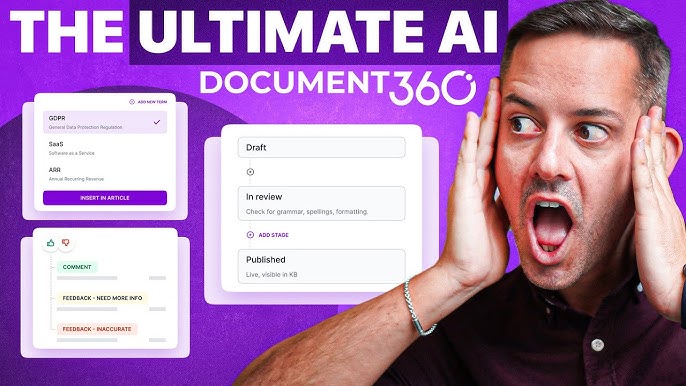
Document360, launched in 2017 by Kovai.co based in Chennai, India, has evolved from a straightforward knowledge base platform into an enterprise-grade documentation system with the addition of Eddy AI in 2024. The platform is used by organizations including Microsoft and McDonald's, which speaks to its reliability at scale and its ability to handle complex, multilingual documentation environments.
Eddy AI provides grounded answers with citations, meaning every response the AI generates includes references to the specific documentation articles it drew from. This is critical for enterprise teams that cannot afford hallucinated or inaccurate information in customer-facing help centers. The platform supports advanced versioning, approval workflows, and strong multilingual capabilities that make it suitable for global organizations serving customers in multiple languages.
Pricing starts at $199 per month for the Standard plan and reaches $800 or more per month for the Enterprise tier. The main limitation is that Document360 requires human oversight to keep articles current. Unlike some competitors that automatically detect content drift, Document360 relies on its AI to assist human editors rather than autonomously updating documentation. For teams with dedicated technical writing staff, this is a feature rather than a bug. For lean engineering teams, it may require more process discipline.
3. GitBook Assistant
GitBook has long been a favorite among product teams for its clean visual editor and structured documentation approach. The addition of GitBook Assistant, an AI layer that answers questions directly within documentation or embedded in products, has pushed the platform into the top tier of AI documentation tools for 2026.
The Assistant can surface relevant information from across the entire documentation base, understanding natural language questions and returning precise answers with context. This reduces support tickets significantly because users can find answers without leaving the product experience. For SaaS companies that embed documentation directly into their applications, GitBook Assistant provides a seamless self-service experience that keeps users engaged rather than frustrated.
GitBook is particularly strong for product documentation sites where the audience expects instant, context-aware responses. The Enterprise tier adds advanced AI features including custom training on proprietary content and usage analytics that help teams identify which documentation sections need improvement. Teams already using GitBook will find the AI Assistant integrates naturally without disrupting existing workflows.
4. Fern Docs
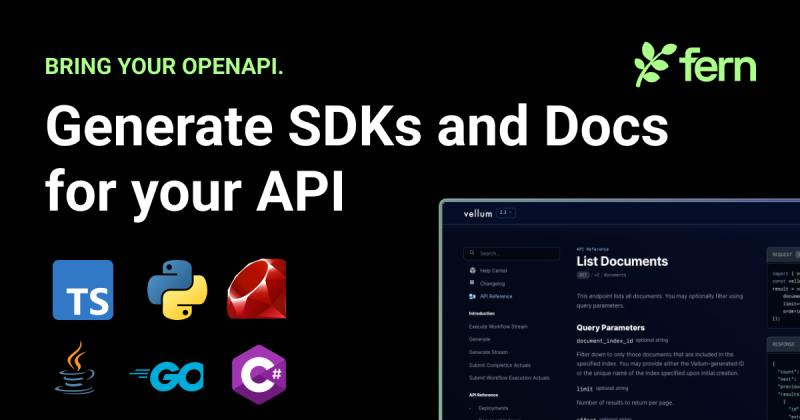
Fern Docs has carved out a specialized niche for API companies and docs-as-code teams that need structured, agent-friendly documentation. The platform generates documentation directly from API specifications, which ensures that the published documentation always matches the actual API behavior. This specification-driven approach eliminates the most common source of documentation errors: human transcription mistakes.
Fern's AI features include smart search that understands API terminology, code example generation in multiple programming languages, and automated update suggestions when APIs change. For teams that publish frequent API updates, Fern reduces the documentation maintenance burden by automatically detecting changes in OpenAPI or similar specifications and proposing corresponding documentation updates.
The platform offers Hobby, Pro, and Enterprise plans, with AI credits allocated based on the tier. The Pro tier is rated as the sweet spot for most teams, providing sufficient AI capabilities for teams shipping weekly or biweekly API updates. Fern is less suited for general knowledge base or help center use cases, but for API-first companies, it is arguably the most efficient tool available.
5. Swimm

Swimm approaches documentation from a fundamentally different angle than most tools on this list. The platform focuses on documentation maintenance rather than creation, a distinction that its makers argue is roughly ten times more valuable for teams that ship weekly. The logic is straightforward: creating documentation is relatively easy, but keeping it accurate as code changes is where most teams fail.
Swimm connects directly to code repositories and automatically detects when documentation becomes outdated as code changes. It creates "code-coupled" documentation that stays synchronized with the actual codebase, using AI to suggest updates when it detects drift. For engineering teams practicing continuous delivery, this maintenance-native approach means documentation quality does not degrade between major releases.
The platform is best suited for engineering teams that ship frequently and have the discipline to review AI-suggested updates as part of their regular pull request workflow. Swimm does not try to be a general-purpose knowledge base. It is a specialized tool for keeping technical documentation accurate in high-velocity development environments.
6. ReadMe AI Agent
ReadMe has been a standard platform for public API documentation for years, and its AI Agent extends that foundation with intelligent, context-aware responses. The AI Agent is available on eligible ReadMe Pro plans and provides natural language query understanding that helps developers navigate complex API references without needing to understand the documentation's structure in advance.
When a developer asks a question in natural language, the AI Agent returns relevant endpoint information, code examples, and troubleshooting guidance. This reduces the learning curve for new API consumers and speeds up integration time. The tool integrates deeply with existing ReadMe documentation workflows, meaning teams already on the platform do not need to migrate or learn a new system.
ReadMe's strength is its focus on developer experience. The platform has refined its documentation presentation over years of serving API companies, and the AI Agent layer builds on that foundation rather than replacing it. For teams that have already standardized on ReadMe, activating the AI Agent is a natural next step rather than a platform change.
7. Confluence with Atlassian Intelligence
Confluence, launched by Atlassian in Sydney, Australia in 2004, remains one of the most widely deployed documentation platforms in the enterprise world with more than 60,000 organizations using it. The addition of Atlassian Intelligence in 2023 and the agentic Rovo layer in 2024 has brought modern AI capabilities to a platform that many large organizations already rely on for internal documentation.
Atlassian Intelligence provides AI-powered content generation, summarization, and search across existing Confluence documentation. For enterprise SaaS teams already embedded in the Atlassian ecosystem with Jira, Bitbucket, and Confluence already in place, the AI features unlock value from existing organizational knowledge without requiring a platform switch. The AI can summarize long pages, generate draft documentation from meeting notes, and answer questions based on the full Confluence instance.
AI features are included in the Premium tier at $11.55 per user per month and the Enterprise tier. The main consideration is that Confluence's AI capabilities are strongest for internal documentation and knowledge management. For customer-facing help centers or public API documentation, specialized tools like Mintlify or Document360 may be more appropriate. But for internal enterprise knowledge, Confluence with Atlassian Intelligence is a powerful combination.
8. Notion AI

Notion, founded in 2013 by Ivan Zhao in San Francisco, has grown to over 100 million users globally. The platform launched its AI capabilities in November 2022, making it one of the first major workspace products to integrate large language models directly into the user experience. Notion AI includes writing assistance, summarization, Q&A, and content generation features that work across the platform's flexible document structure.
Notion AI is best suited for early-stage SaaS teams already running on Notion who want to add AI-powered capabilities to their internal wikis and documentation. The tool excels at helping teams transition from scattered notes in multiple locations to structured documentation, using AI to suggest organization and surface connections between related content. The Q&A feature allows team members to ask questions about the documentation and receive answers grounded in the actual content.
AI costs $10 per user per month on top of standard plan pricing, which includes Plus, Business, and Enterprise tiers. For small teams that have already adopted Notion as their primary workspace, the AI add-on is a cost-effective way to improve documentation quality. The limitation is that Notion is not designed as a dedicated documentation platform for customer-facing content. Teams that outgrow Notion's documentation capabilities typically migrate to a specialized help center platform while keeping Notion for internal knowledge management.
9. Promptless
Promptless is a newer entrant that has quickly gained attention for its maintenance-first approach to AI documentation. The platform connects directly to code repositories, detects relevant changes, and automatically proposes documentation updates as pull requests. This means documentation updates follow the same review process as code changes, integrating naturally into existing development workflows rather than creating a separate documentation maintenance cycle.
The platform's approach addresses the critical problem that 65 percent of weekly-shipping teams face: documentation becoming outdated within approximately 12 weeks. By making documentation updates part of the standard pull request workflow, Promptless ensures that documentation accuracy is maintained continuously rather than addressed in periodic cleanup sessions.
Promptless uses custom pricing, which reflects its specialized focus and smaller customer base compared to established players. It has a smaller catalog of integrations and fewer features than platforms like Mintlify or Document360, but for engineering-driven SaaS teams that want documentation to follow the same discipline as code, its focused approach is compelling. The trade-off is that teams need to be comfortable with a less mature platform and a more limited feature set.
10. Archbee AI
Archbee rounds out the top ten with a flexible mixed documentation approach that balances internal knowledge bases and external product documentation in a single platform. Its AI features include intelligent search, automated content suggestions, and AI-powered answers that draw from both internal and public documentation without requiring separate instances.
For small-to-medium businesses that want to maintain product documentation and internal knowledge without managing multiple tools, Archbee provides a unified solution. The AI-powered search works across both internal and external content, surfacing the right information regardless of whether it was intended for customers or employees. This reduces context switching and helps teams maintain a single source of truth.
Archbee is particularly suited for SMBs that have outgrown simple wikis but are not ready for enterprise platforms with steep learning curves and high per-user costs. The platform balances capability with accessibility, offering AI features that improve documentation quality without requiring dedicated technical writing staff.
The right documentation tool depends on your team's specific needs, but several factors apply across most use cases. First, consider maintenance automation. The best tools in 2026 detect when documentation becomes outdated and either update it automatically or propose changes for human review. Manual documentation maintenance is not sustainable for teams shipping more than once per month.
Second, evaluate grounded AI responses. The tools that provide citations with their AI answers are significantly more trustworthy than those that generate responses without attribution. For customer-facing documentation, hallucinated information can damage trust and increase support volume. For internal documentation, it can lead to costly mistakes.
Third, consider workflow integration. Tools that connect directly to code repositories and fit into existing development processes will see higher adoption than tools that require separate maintenance cycles. The documentation tools that succeed in practice are the ones that developers do not have to think about separately from their code work.
Finally, match the tool to your audience. API-first companies need tools like Mintlify or Fern that handle specification-driven documentation. Enterprise organizations with existing Atlassian investments will find value in Confluence with Atlassian Intelligence. Early-stage startups may prefer Notion AI for its flexibility and low barrier to entry. The best tool is the one your team will actually use consistently.
Related Posts




1 Comment
Join the discussion and share your thoughts