Top 10 Biggest Shipbuilding Companies In India 2026


Table of Contents
India's shipbuilding sector enters 2026 with more momentum than it has carried in decades. The top 10 biggest shipbuilding companies in India now span a listed defence giant worth nearly ₹1 lakh crore, a state yard that delivered the country's first indigenous aircraft carrier, and a cluster of private builders positioning for a wave of new orders. Government policy targets a place among the world's top 10 shipbuilding nations by 2030 and top five by 2047, with new yard clusters planned at Dighi, Jaigarh, Dabhol, Vijaydurg and Nandgaon.
Our ranking weighs market capitalization of listed shipbuilders against 2025-26 data, alongside the scale and strategic weight of state-run defence yards. The order reflects both financial heft and shipbuilding capability.
How We Ranked These
Market capitalization of listed shipbuilders formed the primary financial measure, using 2025-26 figures: Mazagon Dock at roughly ₹99,762 crore, Cochin Shipyard at about ₹40,115 crore and Swan Defence at approximately ₹9,799 crore. For unlisted and state-run yards, we weighed infrastructure scale, naval order books, strategic importance to the Ministry of Defence and historical output. Private-sector capacity and specialised product niches served as tiebreakers further down the list.
The Top 10 Biggest Shipbuilding Companies In India 2026:
1. Mazagon Dock Shipbuilders Limited (MDL)
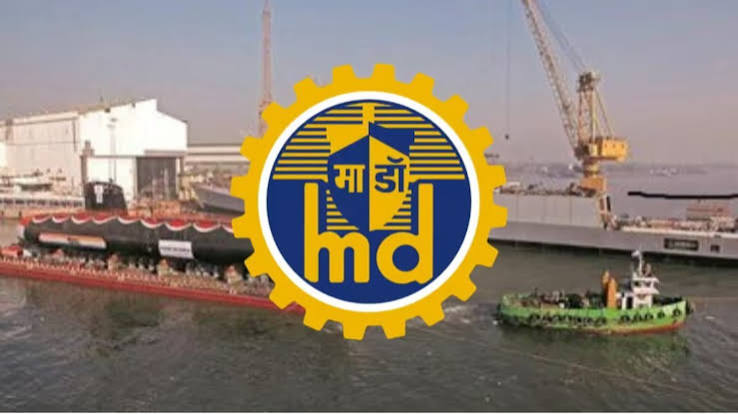
No Indian yard comes close to Mazagon Dock on market value. The Mumbai-based, government-majority shipbuilder carried a market capitalization of approximately ₹99,762 crore in 2025-26, making it India's largest listed shipbuilder by a wide margin.
MDL's real distinction sits underwater. It is the only Indian yard to have constructed conventional submarines, having built the Scorpène-class Kalvari boats for the Indian Navy. Add destroyers, frigates and corvettes to that record and you get a defence order book that few Asian yards of comparable size can match. The company's pipeline of naval vessels and submarines underpins its valuation as much as its current revenue does.
For investors tracking India's defence manufacturing push, MDL functions as the sector's bellwether. Its share price has historically moved on submarine contract announcements and naval modernisation timelines rather than commercial shipbuilding cycles.
2. Cochin Shipyard Limited (CSL)
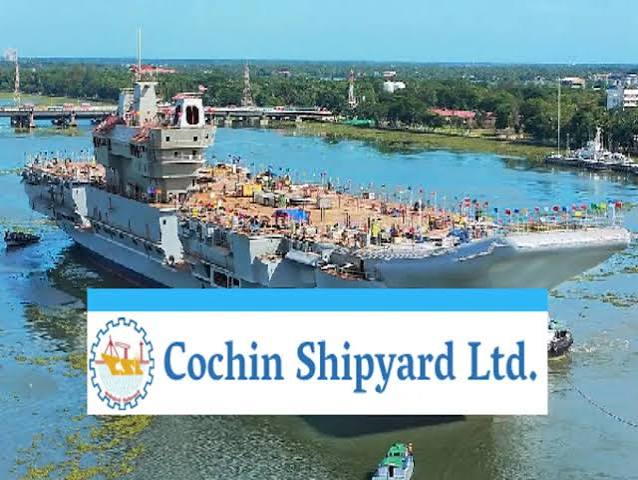
Cochin Shipyard holds India's most visible shipbuilding trophy: INS Vikrant, the country's first indigenously designed and built aircraft carrier. That single project cemented the Kochi yard's reputation internationally.
By physical infrastructure, CSL ranks as India's largest public-sector shipyard. Its market capitalization of roughly ₹40,115 crore in 2025-26 places it a clear second among listed builders. The commercial side of the business builds tankers, bulk carriers and offshore support vessels, while a substantial ship-repair operation keeps dock utilisation high between new-build contracts.
What separates CSL from pure defence yards is its order book mix. Hybrid and electric vessel contracts are growing, alongside defence projects, giving the yard exposure to the global push for lower-emission shipping. That diversification matters as European buyers tighten emissions rules on vessels calling at their ports.
3. Garden Reach Shipbuilders & Engineers Limited (GRSE)

Kolkata's Garden Reach Shipbuilders & Engineers completes India's state-run defence shipbuilding trio. The listed PSU builds warships for the Indian Navy and Coast Guard, with stealth frigates under Project 17A and anti-submarine warfare shallow water craft among its flagship programmes.
GRSE's export record sets it apart from its peers. The yard has delivered vessels to neighbouring countries, a rare achievement for an Indian defence shipbuilder and one that supports the government's wider defence export ambitions. Diversification into engineering services adds a revenue stream that pure shipbuilding yards lack.
Analysts consistently place GRSE among India's top three state-run shipyards by order book value. Its multi-year naval pipeline gives revenue visibility that commercial yards, exposed to freight cycles, simply don't have.
4. Hindustan Shipyard Limited (HSL)
Founded in 1941, Hindustan Shipyard is India's oldest shipbuilding yard and operates under the Ministry of Defence in Visakhapatnam. Age aside, its strategic value comes from location and capability: it sits on India's east coast and handles submarine refits and repairs, work that requires clearances and expertise few yards possess.
HSL builds naval vessels and commercial ships, and it is expanding into larger naval construction programmes. Submarine refit capability is the yard's quiet advantage. India's submarine fleet requires periodic medium refits, and domestic capacity for that work reduces dependence on foreign yards.
The shipyard's long history has included financial struggles, and modernisation remains a work in progress. Even so, its position as the oldest and most strategically located defence yard on the east coast keeps it firmly in the top five.
5. Swan Defence and Heavy Industries
The former Pipavav Shipyard, later Reliance Naval and Engineering, now trades as Swan Defence and Heavy Industries. Located at Pipavav in Gujarat, the yard holds one of India's largest dry docks, infrastructure capable of building very large vessels that most domestic yards cannot accommodate.
A market capitalization of approximately ₹9,799 crore in 2025-26 makes it the third-largest listed shipbuilder in the country, despite the company still working through a turnaround phase. The gap between Swan's infrastructure potential and its current output is the central question for anyone watching the stock.
Its positioning targets both defence and commercial orders. If the yard converts its dry-dock capacity into a steady order book, the valuation case strengthens considerably. Execution, not capability, is the variable to track.
6. Goa Shipyard Limited (GSL)

Goa Shipyard occupies a specialised lane within the Ministry of Defence PSU structure: offshore patrol vessels, fast patrol vessels and mine countermeasure vessels for the Navy and Coast Guard. That product focus has delivered consistent profitability and steady order book growth, a combination not every defence yard manages.
Export orders have added a new dimension. GSL has secured contracts from foreign navies, building on the reputation of its patrol vessel designs. The yard is also expanding into larger platforms, a move that would push it beyond its traditional vessel classes.
For a mid-sized PSU, GSL's order flow punches above its weight. Specialisation, rather than scale, is the strategy here.
7. Larsen & Toubro (L&T) Shipyard

The Hazira yard in Gujarat gives Larsen & Toubro the title of India's largest private-sector shipyard. Operated within L&T's heavy engineering business, it builds specialised commercial and defence vessels, including floating platforms and specialised craft that demand precision engineering rather than sheer volume.
Parent-company scale is the differentiator. L&T ranks as India's largest engineering conglomerate, and that balance sheet supports capital investment in shipbuilding capacity that standalone yards struggle to fund. The company has publicly positioned shipbuilding as part of its defence and heavy engineering growth strategy.
As India pushes to expand domestic shipbuilding capacity, L&T's private capital and engineering depth make it a central player in that effort. Watch for defence contracts to drive the yard's order book through 2026 and beyond.
8. International Joint Ventures (Sembcorp Marine India and Affiliates)

Foreign shipbuilders operating or partnering in Indian yards bring technology transfer and global order books into the domestic sector. Sembcorp Marine, now part of Singapore's Seatrium group, has been linked to Indian operations, and similar joint venture arrangements are expanding the country's capacity for larger, more complex vessels.
These JV-linked operations matter for the government's 2030 target. Building advanced vessels requires design expertise and process know-how that Indian yards are still developing. International partners shorten that learning curve.
The ranking position reflects growing output and strategic role rather than a single dominant company. As more foreign builders establish Indian partnerships, this segment of the market should expand.
9. Chowgule & Company (Chowgule Shipyard, Goa)

Founded in 1916, Chowgule is among India's oldest private shipbuilding groups. The Goa-based yard builds barges, tugs and specialised commercial vessels, serving inland and coastal shipping markets with a steady output that has continued for more than a century.
Heritage is not the only argument for inclusion. Chowgule's track record in commercial vessel construction is consistent, and its barges serve India's inland waterway transport sector, which the government has been developing through projects like the Sagarmala programme and national waterway expansion.
Smaller yards like this one rarely make headlines, but they supply the workhorse vessels that keep cargo moving along India's coasts and rivers.
10. Tebma Shipyards and Bharati Shipyard

Regional private yards round out the top 10. Tebma Shipyards, with operations in Chennai and Bengaluru, and Bharati Shipyard at Ratnagiri in Maharashtra both produce offshore support vessels, tugs and specialised craft for commercial and defence buyers.
Neither matches the PSU giants on scale. Their value lies in specialised niches: offshore support vessels for the oil and gas sector, tugs for port operations and custom craft for specific clients. Bharati Shipyard has a long history in the sector, though it has weathered financial restructuring in the past decade.
Together, these yards add meaningful capacity to India's shipbuilding base. In a sector where the top three listed companies dominate market value, the regional private builders keep the commercial segment competitive and supply chain depth intact.
India's shipbuilding industry remains anchored by defence. The five state-run yards in this list, MDL, CSL, GRSE, HSL and GSL, account for the bulk of capability and market value. Mazagon Dock's ₹99,762 crore valuation alone exceeds the next two listed builders combined.
The private sector's role is growing but uneven. L&T brings conglomerate-scale capital, Swan Defence holds infrastructure waiting to be fully used, and smaller yards like Chowgule and Tebma serve steady commercial niches. International joint ventures add the technology layer the sector needs to move up the global rankings.
Related Posts




0 Comments
Join the discussion and share your thoughts
No Comments Yet
Be the first to share your thoughts on this article!