Top 10 Best AI Companies In China 2026

Table of Contents
China's artificial intelligence sector entered 2026 with unusual momentum. ByteDance's Doubao assistant passed 345 million monthly active users in March, Alibaba's Qwen models crossed 700 million cumulative downloads, and Zhipu AI became the first of the "Six AI Tigers" to list publicly. The companies below represent the most consequential players in that market, ranked by a mix of user scale, capital raised, model performance, and strategic importance to China's domestic compute supply chain.
How We Ranked These
We weighed four factors: consumer and enterprise adoption (monthly active users, token consumption, download figures), financial strength (funding rounds, market capitalization, capital expenditure), model capability as measured by third-party benchmarks and industry usage rankings, and strategic positioning within China's response to U.S. export controls. Publicly reported figures from company disclosures, analyst research, and government advisories carried the most weight. Where companies competed closely on one metric, we deferred to the breadth of their overall AI footprint.
Here Are The Top 10 Best AI Companies In China 2026:
1. ByteDance (Doubao)
ByteDance built the most-used AI chatbot in China by doing what it does best: pushing distribution through an audience that already numbers in the hundreds of millions. Doubao reached 345 million monthly active users as of March 2026 and has held more than 200 million daily active users since early 2026, a gap over the nearest competitor that has widened rather than narrowed.
The product cadence has been aggressive. ByteDance shipped Doubao-Seed 2.0 in February 2026 and followed with Doubao-Seed 2.1 in June, both designed around what the company calls the "agent era" of AI, where models execute multi-step tasks instead of simply answering prompts. That framing matters in a market where Alibaba's Qwen sits at 166 million MAU and DeepSeek at 127 million. ByteDance's lead in consumer AI is now measured in multiples, not percentages.
2. Alibaba (Qwen)
If ByteDance owns China's consumer AI market, Alibaba owns its infrastructure layer. Alibaba Cloud, the Qwen model family, and a growing line of proprietary AI chips give the company the broadest publicly traded exposure to Chinese AI expansion available to investors.
Qwen's open-source ecosystem is the company's sharpest weapon. The model family passed 700 million downloads as of January 13, 2026, making it one of the most-downloaded open-source AI models in the world. On the financial side, AI Cloud revenue climbed 45% year over year to more than $7 billion. Alibaba raised roughly $10 billion in new capital, directing 60% toward global computing infrastructure and 40% toward hyperscale AI data centers, storage, databases, and high-performance networking. The company has also committed to expanding its operated global data-center capacity past 20 gigawatts by 2032.
3. Zhipu AI (Z.ai)

Zhipu AI's public listing on the Hong Kong Stock Exchange on January 8, 2026 raised about $560 million and made it the first of China's "Six AI Tigers" to test public markets. The market's answer was emphatic: the stock surged roughly 1,500% after listing, briefly pushing Zhipu's valuation past $160 billion in June before settling above $100 billion by July. The company is now pursuing a further $4 billion secondary share sale.
Zhipu grew out of Tsinghua University research and markets itself internationally as Z.ai. Its GLM model family and Ying video generator form the core product line, and TIME named it among the top 10 most influential AI companies of 2026. The valuation trajectory raises an obvious question about whether public enthusiasm has outrun commercial traction, but for now Zhipu has more capital to work with than any of its Tiger peers.
4. Baidu
Baidu's transformation from search engine to AI operator is further along than most observers expected. The company released ERNIE 5.0 in late 2025, a natively omni-modal model with 2.4 trillion parameters that jointly models text, images, audio, and video. Roughly 70% of Baidu search results now surface as AI-generated rich media.
The autonomous driving arm has quietly become a genuine operational business. Baidu's robotaxi service hit 250,000 weekly rides, matching Alphabet's Waymo on that metric. Core AI-powered business revenue reached RMB 11.3 billion in Q4, up 48% year over year, while AI Cloud Infrastructure revenue rose 50% year over year to $1.1 billion in Q2. Baidu is no longer a search company with an AI division. It's an AI company with a legacy search business attached.
5. DeepSeek
DeepSeek's influence extends well beyond its 127 million monthly active users. The company leads the world on open-source AI models, where the underlying code remains visible and modifiable, a position that has drawn attention from the Trump administration as it pushes for American alternatives.
Usage data backs up the reputation. DeepSeek V4 Flash 0731 topped a usage ranking with 9.39 trillion tokens, narrowly ahead of Tencent's Hy3 at 8.94 trillion. The company has also drawn scrutiny: CISA identified DeepSeek as one of several China-based AI firms conducting high-volume knowledge distillation campaigns against U.S. AI companies since at least late 2024. That finding sits uneasily alongside DeepSeek's technical achievements, and it shapes how Western enterprises evaluate the platform.
6. Moonshot AI
Moonshot AI raised $700 million at a $10 billion valuation in January 2026, placing it among China's best-funded AI startups. The company's Kimi K3 (max) model scored 85.0% on Bloomberg's specialized benchmark ranking, good for 6th globally among frontier models and the highest placement of any Chinese model on that list.
Epoch AI's study of 1,604 Chinese AI job postings included Moonshot among six notable companies analyzed, a signal of how the research community tracks hiring patterns as a proxy for capability growth. Moonshot's challenge is converting benchmark performance into durable revenue, particularly as larger competitors like Alibaba and ByteDance bundle comparable capabilities into products that already have distribution.
7. Tencent
Tencent's Q2 capital expenditures soared 176% year over year to nearly $8 billion, a figure that reflects substantial AI-related compute prepayments. That spending level signals how seriously the company treats AI infrastructure as a competitive necessity rather than an experimental line item.
The Hy3 model has become the top model for autonomous agent workflows on OpenRouter, according to Forbes. Tencent's Hunyuan model family, combined with growing external cloud demand, positions the company across both consumer and enterprise AI. Tencent's advantage is its existing relationship with millions of businesses through WeChat and its cloud services, which gives its AI products a distribution channel that pure-play model companies lack.
8. MiniMax
MiniMax (Shanghai MiniMax Co., Ltd.) has demonstrated an operational agility that few competitors match. The company redirected exchanges to a new Claude model within 24 hours of its release, evidence of real-time provider monitoring and pre-positioned infrastructure.
Like DeepSeek, MiniMax was identified by CISA as conducting high-volume knowledge distillation campaigns against U.S. AI companies since at least late 2024. The company also appears in Epoch AI's analysis of 1,604 Chinese AI job postings, one of six firms the study singled out. MiniMax's ability to integrate external model advances quickly is a genuine capability, though the distillation findings complicate its international positioning.
9. StepFun
StepFun (Shanghai Jieyue Xingchen Intelligence Technology Co., Ltd.) reportedly raised $717 million in 2026, bringing total funding to approximately $2.5 billion. The company has developed more than 11 models across modalities and has restructured in preparation for a Hong Kong IPO.
Between late 2025 and early 2026, StepFun distilled data from an unusually broad set of external models to improve its Step 4 model's coding and agentic functions. The list includes Claude Opus 4.1 and 4.5, Claude Sonnet 4.5, Claude Haiku 4.5, GPT-5 Mini, GPT-5 Pro, GPT-5.1, GPT-5.1 Codex, and GPT-5.2. That range suggests StepFun is optimizing for capability parity across multiple frontier providers rather than betting on a single external source.
10. Cambricon Technologies
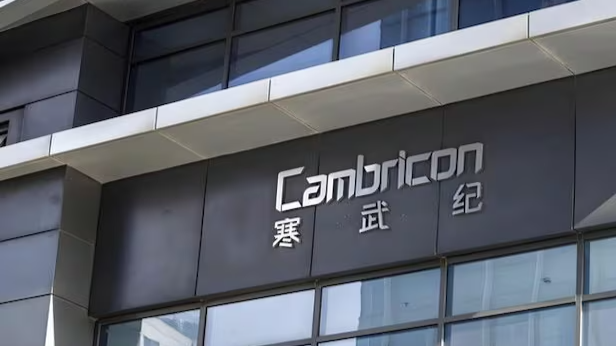
Cambricon Technologies specializes in high-performance AI accelerators and has earned the label "Nvidia of China" in industry coverage. The comparison reflects both the company's ambition and the vacuum created by U.S. export controls that restrict Chinese access to advanced Nvidia chips.
A report ranking the top 50 Chinese AI companies found that AI chip specialists took seven of the top ten spots in 2025, a striking shift that underscores how central domestic silicon has become to China's AI strategy. Chinese manufacturers including Huawei's Ascend line and Alibaba's T-Head division are struggling to produce enough chips to meet surging demand from domestic labs. Cambricon's position in that supply chain makes it strategically important in ways that pure software companies are not.
The composition of this ranking reveals three distinct competitive tiers. Consumer-facing platforms like ByteDance, Alibaba, and Baidu have scale and revenue. Well-funded startups including Zhipu, Moonshot, MiniMax, and StepFun are racing toward public markets and capability parity. And infrastructure players like Cambricon are becoming more important as export controls reshape the compute supply chain.
One pattern cuts across nearly every entry: Chinese AI companies are integrating advances from multiple external sources while building proprietary capabilities on top. The CISA advisories naming DeepSeek and MiniMax for distillation campaigns, and StepFun's documented use of nine external models, make that strategy explicit. Whether it produces durable competitive advantage or leaves these companies perpetually one step behind the frontier remains the central question for the sector heading into 2027.
Related Posts

3 Comments
Join the discussion and share your thoughts