Rezonant Review in 2026: Login, App, Free AI, Download & FAQs


Table of Contents
Every other week, a new AI tool drops into our inbox at Nubia Magazine with promises of changing how teams build software. Most of them fade after a few weeks of hype. A few stick around long enough to be worth a real look. Rezonant is one of the names that has been popping up consistently in 2026, especially among product managers, founders, and small engineering teams who say they are tired of writing long specs that nobody reads.
So we took our time with this one. We signed up, played around with the free plan, tested the login flow, poked at the Chrome extension, and read through real user feedback before forming an opinion. This Rezonant review in 2026 is our honest take on what the tool does well, where it stumbles, and whether the free version is actually worth the time it asks of you.
Spoiler for those skimming: it is interesting, it is genuinely useful in places, but it is not without friction. That is why we landed on a 2.9 out of 5. Read on to see exactly why.
Rezonant Brand Profile
Before we get into the experience, here is a quick snapshot of the brand for readers who like the facts first.
Field | Details |
|---|---|
Brand Name | Rezonant |
Founder / CEO | Emma Burrows |
Founding Team | Sam Walker (Founding Designer), Sam Stephens (Founding Engineer), Brad Mallow (Founding Engineer), Vincenzo Bianco (Chief of Staff) |
Headquarters | United Kingdom (operates globally online) |
Industry | AI / SaaS / Product Management Tooling |
Product Category | AI workspace for product teams; turns product ideas into engineering tickets and shipped code |
Official Website | rezonant.app |
Login Portal | rezonant.app/login |
Signup Page | rezonant.app/signup |
Free Plan | Yes, 1,000 credits per workspace per month, up to 3 users, no credit card needed |
Paid Plans | Business at $25 per user / month (monthly) or $20 (annual). Enterprise is custom |
Browser Extension | Rezonant Alter, available on the Chrome Web Store |
Integrations | GitHub, Jira, Linear, PostHog, plus other product stack tools |
Mobile App | No dedicated iOS or Android app at the time of this review |
Investors | General Catalyst, Firstminute Capital |
Support Channels | Community (Free), priority email (Business), dedicated account manager (Enterprise) |
Contact Email | |
Socials | LinkedIn, X (Twitter), YouTube |
Nubia Magazine Rating | 2.9 / 5 |
What Is Rezonant?
Rezonant is an AI-powered product workspace built for teams that want to move from a rough idea to working code without spending days writing documents in between. The team behind it describes their tool as the layer that sits between what you want to build and what eventually gets deployed. In simple terms, you tell Rezonant what you want, and it shapes that into structured tickets that engineers or coding agents can actually ship.
Founded by Emma Burrows and a small team based in the UK, Rezonant is backed by serious money from General Catalyst and Firstminute Capital. The brand sits in a crowded space alongside tools like Linear, Jira, and the new wave of AI agents, but it tries to carve out its own lane by focusing on product intent rather than just task management.
Customers listed on their homepage include Skyscanner, Microsoft, and The Telegraph, which gives the platform some weight in terms of credibility. Whether that translates into a smooth experience for the average solo founder or small team is what we wanted to find out.

Rezonant Login Experience
Getting into Rezonant is straightforward, at least on paper. You go to rezonant.app, click Sign in, and you are taken to the login portal at rezonant.app/login. You can sign in with Google or use an email and password combination. There is no two-factor prompt on the free tier, which is fine for casual use but something larger teams may want to check on before committing.
We tested the login on both Chrome and Safari and it worked without drama on both. The page loads quickly and the design is clean, with that minimal black and white aesthetic that startups in this space tend to favour. One small thing worth noting is that if you sign up with Google, the system pulls your profile data immediately and drops you into a workspace setup wizard. That part is smooth.
Our gripe with the login flow is small but real. If you sign out and come back later, the platform sometimes asks you to reconnect your GitHub or Jira integration even when nothing has changed. It is not broken, just slightly annoying. For a tool that markets itself on saving you time, asking you to reauthorise the same account twice in a week feels off.
Rezonant App: What You Actually Get
Rezonant does not have a dedicated mobile app on iOS or Android at the time of this review. It is a web-based platform, accessed through your browser, which is fine for the kind of work it is built for but worth flagging if you were hoping for something you could tap on your phone during a commute.
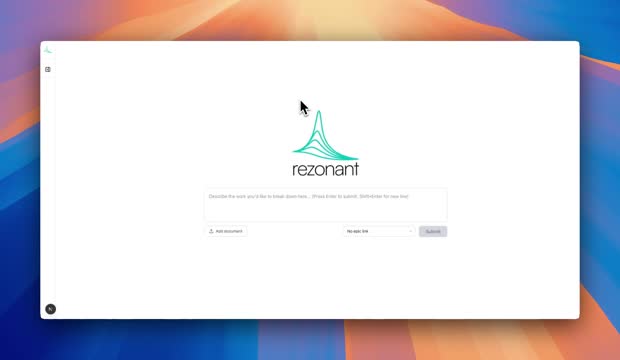
Inside the main web app, you get a workspace where you can create what Rezonant calls Refinements. A Refinement is essentially a chat-style canvas where you describe a product change, a feature idea, or a problem you are trying to solve. The AI then asks you questions, pulls context from your connected codebase and Jira or Linear, and produces a set of tickets that are ready to be sent to your engineering tool of choice.
The interface is genuinely well designed. Buttons are where you expect them, the AI responses are clear, and the workflow from idea to ticket actually makes sense. The thinking partner feature, which lets you push back on your own assumptions before turning them into work, is the standout in our view. It feels less like a glorified chatbot and more like a junior product manager who has read your whole codebase.
That said, the app has a learning curve. The credit system, integrations, and templates can feel like a lot if you are coming in cold. We needed a couple of sessions to really feel comfortable with what each part of the workspace does.
Rezonant Free AI Plan
This is the section most of you are here for. Yes, Rezonant has a free plan, and yes, it works without a credit card. You get 1,000 credits per workspace per month, up to 3 users, and the ability to connect 1 code repository. You also get access to the standard template library and community support.
In real terms, 1,000 credits is enough to play with the tool, run a handful of Refinements, and generate maybe a dozen or so tickets depending on how complex they are. It is not a plan you can run a real team on. It is closer to a generous trial than a permanent free tier.
That is not necessarily a bad thing. The Rezonant team is transparent about the fact that coding agents burn real compute, and they would rather show you the cost upfront than hide it inside a flat subscription. We respect that. But if you are expecting unlimited AI usage on the free plan, adjust those expectations. The free AI tier is best treated as a way to test whether Rezonant fits your workflow, not as a long-term solution.
There is also a Chrome extension called Rezonant Alter that you can install for free from the Chrome Web Store. It lets you point at any UI element on your live web app, describe a change in plain English, and have Rezonant turn it into a ticket. We found this surprisingly fun to play with, though we noticed it works best when your GitHub repo is already connected and your codebase is well organised.
How to Download Rezonant
There is no traditional download for the main Rezonant platform because it lives entirely in your browser. You sign up at rezonant.app/signup, log in, and you are in. No installer, no setup file.
The only thing you actually download is the Rezonant Alter Chrome extension if you want it. You can find it in the Chrome Web Store by searching for Rezonant Alter. Installation is the same as any other Chrome extension. Click Add to Chrome, confirm the permissions, and the icon appears in your browser bar. It took us under thirty seconds from search to installed.
For anyone hoping for a desktop app or a mobile equivalent, you will need to wait. The team has not announced any plans for native apps as of this review.
Rezonant User Experience
This is where we have to be honest, even if it costs Rezonant a few points. The user experience has bright spots and frustrating spots in roughly equal measure.
What works well
The design is genuinely lovely. It is one of those tools that feels expensive to use, in the best way. Animations are subtle, typography is sharp, and the way information is grouped on screen rarely overwhelms you. The AI itself is fast and the suggestions are usually relevant, especially once it has had time to learn your codebase.
Integration with GitHub, Jira, and Linear is well executed. When it works, you can go from a vague product idea to a set of properly scoped tickets sitting in your project tracker in about ten minutes. For small teams that hate writing PRDs, that is a real win.
What needs work
Onboarding is the weakest part of the experience. We watched a few first-time users get lost between the Refinement, project, and ticket concepts because the labels are not always intuitive. The product needs a better in-app walkthrough or interactive demo, and the existing documentation does not always fill the gap.
The credit system, while honest, adds mental load. You find yourself watching your remaining balance instead of focusing on the work. Some users we spoke to said they hit credit limits faster than they expected on the free plan and felt nudged into upgrading earlier than they were ready for.
And then there is the issue of trust with sensitive code. Rezonant connects to your GitHub repository, which some engineering leads we spoke to are still uncomfortable with, even though the company says it does not use your data to train models. The opt-out is on by default, which is the right call, but the conversation about AI and codebase privacy is far from settled in 2026.
Add up the wins and the losses, and the user experience lands at a solid but uneven place. Hence our 2.9 rating. It is not bad, but it is not yet the polished experience the marketing implies.
Rezonant Pricing in 2026
The pricing structure is simple, which we appreciate. The Free plan is $0 forever with the limits already mentioned. The Business plan costs $25 per user per month when billed monthly, or $20 per user when billed annually, which is a 20 percent discount. You get 3,000 credits plus an additional 1,000 per seat each month, unlimited users and teams, unlimited connected repos, and priority email support.
Enterprise is custom and aimed at larger organisations. It adds SSO, SCIM provisioning, advanced roles, a negotiated credit pool, a named account manager, and procurement and security review processes. If you have a security team that demands a Data Processing Agreement, Enterprise is the route.
Compared to flat-rate competitors, Rezonant can end up cheaper or more expensive depending on how heavily you use the AI agent. Light users will probably feel good about the cost. Teams that hammer the agent all day may need to plan their budget more carefully.
Nubia Magazine Verdict
Rezonant is one of the more thoughtful AI product tools we have reviewed this year. It clearly comes from a team that has felt the pain of broken handovers between product and engineering, and the solution they have built is genuinely creative. The thinking partner, the Refinement flow, and the Chrome extension all show real care.
But it is not without rough edges. Onboarding could be smoother, the credit anxiety is real on the free plan, and the lack of a mobile app limits where and how you can use it. For solo founders and small product teams who already live in Jira or Linear and want a smarter front end, Rezonant is worth trying. For larger teams or anyone who needs strict data residency guarantees, the Enterprise conversation will need to happen before any rollout.
We rate Rezonant 2.9 out of 5. It earns the high parts of that score with strong design and a genuinely useful AI workflow. It loses ground on its learning curve, credit pressure, and the fact that it is still maturing as a product.
Frequently Asked Questions About Rezonant in 2026
1. Is Rezonant free to use?
Yes. Rezonant offers a forever free plan that gives you 1,000 credits per workspace each month, up to 3 users, and one connected code repository. No credit card is required to sign up. It is a good way to test the tool, though heavy users will likely run out of credits and need to upgrade to the Business plan.
2. How do I log in to Rezonant?
Go to rezonant.app and click Sign in, or visit rezonant.app/login directly. You can log in with Google or with an email and password. If you signed up with Google originally, you must continue using that method to access the same account.
3. Does Rezonant have a mobile app?
No. As of 2026, Rezonant is a web-based platform and does not have a dedicated iOS or Android app. You can still open the site in a mobile browser, but the experience is built for desktop use. The team has not publicly announced any plans for native mobile apps.
4. What is Rezonant Alter and how do I download it?
Rezonant Alter is a free Chrome extension that lets you point at any element on your live web app, describe a change in plain English, and have Rezonant turn it into a ticket. You can download it from the Chrome Web Store by searching for Rezonant Alter. Installation takes less than a minute.
5. Is Rezonant safe to connect to my GitHub repository?
Rezonant uses OAuth to connect to GitHub and only accesses the data needed to generate accurate change proposals and tickets. The company states clearly that it does not use your code or content to train models, and AI training opt-out is on by default across all plans. As with any third party tool, larger teams should still run their own security review before connecting production repositories.
6. How much does Rezonant cost on the paid plan?
The Business plan is $25 per user per month when billed monthly, or $20 per user per month when billed annually, which works out to $240 per user per year. It includes 3,000 base credits plus 1,000 credits per seat each month, unlimited users, unlimited connected repositories, custom templates, team management, and priority email support. Enterprise pricing is custom and requires contact with their sales team.
7. What happens when I run out of Rezonant credits?
On the Free plan, you have to wait until the next billing cycle or upgrade to Business. On the Business plan, your credits scale with seats, so adding teammates also adds to your monthly pool. Unused credits roll over once on paid plans before expiring. If you need more credits mid-cycle, you can contact Rezonant to top up.
8. Who owns Rezonant and is the company legit?
Rezonant was founded by Emma Burrows and a UK-based team that includes Sam Walker, Sam Stephens, Brad Mallow, and Vincenzo Bianco. The company is backed by General Catalyst and Firstminute Capital, both well known venture firms. Customers featured on the homepage include Skyscanner, Microsoft, and The Telegraph, which gives the brand real credibility. It is a legitimate company with serious investors, though like any early stage startup, longevity is something to keep in mind when committing to long-term workflows.
9. Can I cancel my Rezonant subscription anytime?
Yes. Business plan users can upgrade, downgrade, or cancel at any time through their account settings. Any unused rollover credits stay with you until they would normally expire. Enterprise contracts are annual and have their own terms negotiated at signing.
10. Does Rezonant work with Jira and Linear?
Yes. Rezonant integrates with both Jira and Linear, and you can push generated tickets directly into either tool. It also connects to GitHub and pulls in documentation from your existing product stack to give context to its AI suggestions. These integrations are one of the strongest parts of the product.
If you are reading this and trying to decide whether to give Rezonant a try, our honest advice is this. Sign up for the free plan, connect one repository, and run two or three Refinements over a week. You will know quickly whether the workflow clicks with how your team thinks. For some people it is a revelation. For others it is overhead. Either way, the free tier gives you enough room to make that call without spending a cent.
Nubia Magazine will keep an eye on Rezonant through the rest of 2026. If the team can smooth out onboarding and ease the credit pressure on lighter users, that 2.9 has plenty of room to climb. For now, it is a tool worth knowing about but not yet a tool we can recommend without caveats.
Related Posts



0 Comments
Join the discussion and share your thoughts
No Comments Yet
Be the first to share your thoughts on this article!