Context.dev Review 2026: Tools, Download, Generator, AI, Pricing & FAQs

Table of Contents
Product Name
Context.dev
Previously Known As
Brand.dev
Category
Web Context API / AI Developer Tools
Website
context.dev
Founded
2024 (rebranded to Context.dev in 2026)
Pricing Model
Freemium (Free, Developer, Pro, Scale, Enterprise)
Starting Price
Free | Paid from $25/month
Trusted By
5,000+ companies including Mintlify, Daily.dev, SiteGPT
SDK Support
TypeScript, Python, Ruby + REST API
Integration Time
Under 10 minutes
Overall Rating
4.0 / 5.0 (Nubia Magazine)
Product Name | Context.dev |
Previously Known As | Brand.dev |
Category | Web Context API / AI Developer Tools |
Website | context.dev |
Founded | 2024 (rebranded to Context.dev in 2026) |
Pricing Model | Freemium (Free, Developer, Pro, Scale, Enterprise) |
Starting Price | Free | Paid from $25/month |
Trusted By | 5,000+ companies including Mintlify, Daily.dev, SiteGPT |
SDK Support | TypeScript, Python, Ruby + REST API |
Integration Time | Under 10 minutes |
Overall Rating | 4.0 / 5.0 (Nubia Magazine) |
Introduction
Not too many developer tools show up and make you rethink what building with the web could feel like. Context.dev is one of those rare exceptions. Originally launched under the name Brand.dev, it started as a brand data extraction tool, focused on pulling logos, colors, and company metadata from any domain. By 2026, the product had evolved into something much bigger: a single unified API that lets developers and AI agents scrape the web, extract structured data, pull brand assets, crawl sitemaps, identify transactions, and build LLM-ready pipelines, all through one integration.
The Nubia Magazine team spent time digging into Context.dev, from its free tier to its production-level capabilities, to give you an honest look at what it does well, where it falls short, and whether it is actually worth your time in 2026.
Our Ratings Breakdown
Category | Score | Note |
Tools & Features | 4.2 / 5 | Comprehensive API suite; covers scraping, brand data, AI extraction |
Ease of Use | 4.0 / 5 | Clean docs, quick setup; non-developers still need a coder |
AI Capabilities | 4.1 / 5 | Strong LLM-ready output; AI query endpoints genuinely useful |
Pricing & Value | 3.8 / 5 | Free tier is generous; volume costs can climb fast |
User Experience | 4.0 / 5 | Smooth dashboard; transparent credit system |
Support & Documentation | 4.2 / 5 | Responsive team, fast turnaround on requests |
OVERALL | 4.0 / 5 | A strong, well-built tool for any developer working with AI agents |
What is Context.dev?
Context.dev is a web context API built for developers and the AI applications they are building. The simplest way to explain it: instead of piecing together a web scraper, a logo fetching service, a sitemap crawler, and a markdown converter as separate projects, Context.dev gives you all of that through a single API endpoint.
The platform sits at the intersection of AI development and web data infrastructure. If you are building a RAG pipeline that needs real-time web content, an AI agent that has to reason about what a company looks like, a SaaS product that pulls client brand assets during onboarding, or a CRM that needs automatic company enrichment, Context.dev has an answer for each of those use cases without requiring you to build and maintain separate tools for each one.
It was previously called Brand.dev when its scope was narrower. The rebrand to Context.dev reflects how the product has expanded: it is no longer just about brand data. It now handles web scraping, sitemap crawling, structured AI extraction, screenshots, visual styleguide generation, and transaction enrichment too.
Context.dev Tools: What You Actually Get
1. The Web Scraping API
This is the part of Context.dev that most people reach for first. You point it at any URL and it returns clean, structured markdown rather than raw HTML. The output is ready for LLMs to read without additional cleanup. For developers building RAG systems or AI agents that need to reason about web content, this single feature eliminates the Puppeteer plus Readability plus html-to-markdown stack that so many teams have been maintaining at their own expense.
What stands out is the crawl endpoint. Instead of scraping pages one at a time, you pass in a domain and it follows the sitemap to index an entire website in a single API call. SiteGPT, an AI chatbot platform for customer support, switched from Firecrawl to Context.dev specifically for this feature, completing the migration in under a day.
JS rendering, anti-bot bypass, and premium proxies are all included at the standard rate of one credit per page. There are no hidden surcharges for stealth requests, which is a genuinely useful thing compared to some competitors where you find out about extra costs after you have already integrated.
2. The Brand API
The Brand API is what made Context.dev a known name in the first place. You pass in a domain, an email address, a company name, or a stock ticker, and it returns the company's logo, primary colors, fonts, social media profiles, and firmographic data. The response is normalized and structured, not a raw dump of whatever was on the page.
This is used heavily by CRM teams who want to auto-fill company profiles with the right visual assets, and by SaaS platforms that customize their interface with each client's branding. Logo Link, a separate lightweight endpoint within the Brand API, has no rate limits and has its own credit bucket, meaning you can embed logos by domain into your product without eating into your main API credit balance.
3. Styleguide & AI Extraction
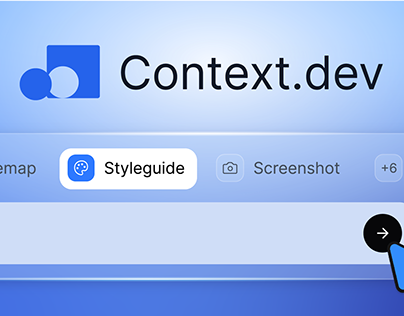
Context.dev also offers a styleguide generation feature that goes a step beyond logos and colors. It returns a complete visual identity snapshot for any brand, including typography settings and spacing patterns. This is useful for teams building white-label products or competitive analysis tools.
The AI extraction endpoint allows you to define your own schema and have Context.dev pull structured data from any website into the shape you specify. Product listings, pricing tables, news articles, whichever structured content you need from a site, you describe the output shape and the API does the extraction. This is one of the more flexible capabilities and one that has a lot of potential for teams building data enrichment pipelines.
4. Screenshots and Transaction Enrichment
Two smaller but useful features round out the toolkit. The screenshot API captures a visual render of any URL, useful for monitoring tools, content archiving, or visual audits. The transaction enrichment feature is aimed at fintech teams: it takes a raw transaction descriptor from a bank statement and returns the matched brand, logo, and industry classification. This is a pretty niche use case but genuinely valuable for the expense management and personal finance tools that need it.
Download and Getting Started
Context.dev is not a downloadable app in the traditional sense. You access it through their web platform at context.dev and integrate the API into your own codebase. There is no desktop application to install. The product is built for developers who want to call an API from their backend.
Getting started takes less than ten minutes if you follow the documentation. You sign up, grab your API key from the dashboard, and start making requests. Official SDKs are available for TypeScript, Python, and Ruby, which means most teams can drop into an existing project without writing wrapper code from scratch. If you work in another language, the REST API is clean enough that you can integrate it with a standard HTTP client.
The free plan is available without a credit card. You get 500 API credits when you sign up with a work email address, or 250 credits with a personal email like Gmail or Yahoo. You also get 10,000 Logo Link requests on the free tier regardless of email type. That is enough to meaningfully test the API and see if it fits before spending anything.
Context.dev as an AI Tool
This is where Context.dev has positioned itself most aggressively in 2026. The whole product philosophy is built around giving AI agents and LLM-powered applications reliable, structured access to the web. Most AI applications that need to reason about web content hit the same wall: the web is messy, dynamic, and anti-bot protected. Raw HTML is noisy. Puppeteer setups break. Maintaining scrapers against site changes is engineering time you could spend on the actual product.
Context.dev solves this by sitting between your AI agent and the web. Your agent asks for a URL, Context.dev returns clean markdown. Your agent needs to know what a company looks like before sending an outreach email, Context.dev returns the logo, colors, and firmographics in one call. Your AI product wants to give users a branded experience based on their company domain, Context.dev has the styleguide endpoint for that.
The maxAgeMs parameter is worth mentioning here because it matters a lot in AI pipelines. You can control caching at the millisecond level, telling Context.dev exactly how fresh you want the content to be before it goes back and refetches. This gives AI agents the ability to decide when to reuse stored context and when to fetch again, which is an important efficiency consideration in agents that run repeatedly.
Mintlify, a documentation platform, used Context.dev to build a tool that converts any GitHub repository URL into a complete branded documentation site. The integration took under ten minutes. That kind of time-to-ship story is what Context.dev is really selling: not just the features, but how quickly the features pay off.
Pricing: What Does Context.dev Actually Cost?
Context.dev uses a credit-based pricing model. Credits are the currency across all API calls, though different features cost different amounts of credits per call. Scraping a page costs one credit. More compute-intensive calls like brand retrieval, styleguide generation, structured AI extraction, or industry identification cost ten credits each.
Logo Link requests are counted separately and do not touch your API credit balance. This is a nice design choice because it means high-volume logo delivery does not eat into the credits you need for heavier API calls.
Plan Overview
Plan | Monthly Price | Rate Limit | Best For |
Free | $0 | 10-30 req/min | Testing and evaluation |
Developer | $25/month | 60 req/min | First real workflow or app |
Pro | $149/month | 300 req/min | Production app with steady traffic |
Scale | $499/month | 700 req/min | High-volume production use |
Enterprise | Custom | Custom | Teams exceeding 2M credits/month |
One important note on pricing: you are only billed for successful responses. Failed requests and blocked pages do not consume credits. Paid plans also come with metered overage billing, so your production traffic keeps running even if you go over your monthly allowance, and you can disable overage from your dashboard if you prefer hard limits.
There is also a startup discount of up to 30% off for one year for pre-Series A companies. That alone can make the Pro or Scale plan significantly more accessible for early-stage teams. Annual billing on any plan saves the equivalent of two months compared to paying monthly.
User Experience: What It Is Actually Like to Use
The dashboard is clean and does not overwhelm you. When you log in, you see your credit balance, your usage history, and access to your API keys. There is no bloat. The credit system is transparent: you can see exactly how much each type of request costs before you make it, and the documentation makes it easy to calculate what a given workflow will cost per month before you commit.
The documentation itself is one of Context.dev's stronger points. It is written for developers, which sounds obvious but is not always the case. The examples are practical, the edge cases are addressed, and the endpoint references are organized in a way that lets you find what you need quickly.
Where the experience gets harder is for non-technical users. Context.dev is an API platform. If you do not have a developer on your team or the ability to write code, you cannot do much with it. There is no no-code interface, no Zapier-style visual builder, no drag-and-drop workflow tool. You will need someone who can write TypeScript, Python, Ruby, or at minimum REST API calls to actually use it. This is a design choice, not a flaw, but it does limit the audience.
Support quality has come up consistently in user feedback. The team is responsive, and one user noted that feature requests tend to get addressed within one to two days. That kind of support pace is unusual for a developer tool at this price point and is genuinely worth mentioning.
Pros and Cons
What Works Well
One API covers scraping, brand data, sitemaps, AI extraction, screenshots, and transaction enrichment. You get clean LLM-ready markdown output without needing to build post-processing logic. There are no hidden charges for JS rendering, anti-bot bypass, or premium proxies. The free tier is generous enough to actually test the product before paying. SDKs for TypeScript, Python, and Ruby make integration fast. Support is genuinely responsive. The pricing-on-success-only model protects you from paying for failed scrapes.
What Could Be Better
Brand color extraction still has some rough edges when it comes to detecting primary versus accent colors accurately. The credit-based pricing can get expensive quickly at high volume if you rely heavily on the ten-credit-per-call features. Non-technical users have no path to using the platform without a developer. Pricing details for the higher tiers are not fully transparent on the website without reaching out directly. Logo Link is excellent, but overall brand data freshness may vary depending on how recently a given company's site was last crawled.
Who Should Use Context.dev in 2026?
The product pitch makes most sense if you are working with at least two of its three main pillars: web scraping, brand data, and AI extraction. If you only need one narrow capability, a single-purpose tool might be cheaper and simpler. But if you need two or three of those pillars, the bundled approach genuinely saves you engineering time and maintenance overhead.
It fits best for developers building AI agents that need real-time web access. It also works well for startups enriching customer or prospect data automatically, for CRM and sales teams who want company profiles populated without manual research, and for fintech products that need transaction identification handled as a managed service. Generative AI applications that want to match their output to a specific company's visual identity also have a clear use case here.
It is less obviously the right choice if you are already deeply integrated with a competing scraping tool that covers your use case at a lower price, or if your team has no technical capacity to work with an API directly.
Frequently Asked Questions About Context.dev
What is Context.dev and what does it do?
Context.dev is a unified web context API that gives developers and AI applications structured access to web data through a single integration. It combines URL scraping into clean markdown, brand data extraction (logos, colors, fonts, company information), sitemap crawling, AI-powered structured extraction, screenshot capture, and transaction enrichment into one platform. It was previously known as Brand.dev before expanding its capabilities and rebranding in 2026.
Is Context.dev free to use?
Yes, Context.dev has a free tier that requires no credit card. If you sign up with a work email address, you get 500 API credits and 10,000 Logo Link requests. Signing up with a personal email like Gmail gives you 250 API credits instead. The free plan is genuinely useful for testing and evaluating the API before committing to a paid plan.
How does Context.dev pricing work?
Context.dev uses a credit-based system. Simple page scraping costs one credit per call. More advanced operations like brand data retrieval, styleguide generation, structured AI extraction, or industry identification cost ten credits each. Logo Link requests are counted separately and do not consume your API credit balance. Paid plans start at $25 per month (Developer), $149 per month (Pro), and $499 per month (Scale), with Enterprise plans available for very high volumes. You are only charged for successful API responses, not failed ones.
How does Context.dev compare to Firecrawl?
Both tools offer web scraping with clean markdown output, but Context.dev differentiates itself through its broader feature set, particularly the Brand API and AI extraction capabilities. A practical difference noted by users is that Context.dev does not enforce concurrent browser limits, which matters for AI applications with high concurrency. SiteGPT publicly migrated from Firecrawl to Context.dev and completed the switch in under a day. The right choice depends on whether you need just scraping or also the brand data and AI extraction layers.
What programming languages does Context.dev support?
Context.dev provides official SDKs for TypeScript, Python, and Ruby. For all other languages, you can use the platform through standard REST API calls with an HTTP client. The REST API is clean and well-documented, so integrating from languages outside the three SDKs is straightforward.
Does Context.dev handle JavaScript-heavy sites and anti-bot protections?
Yes. JavaScript rendering, anti-bot bypass, and premium proxy routing are all included in the standard pricing at one credit per page. There are no additional surcharges for stealth requests. The platform handles these at the infrastructure level so developers do not have to manage Puppeteer setups or proxy rotation themselves.
Can Context.dev be used to power AI agents and RAG pipelines?
This is one of its main use cases. Context.dev returns web content as clean, structured markdown that LLMs can process without additional cleanup. The crawl endpoint allows an agent to index an entire website in a single call rather than scraping page by page. The maxAgeMs parameter lets AI pipelines control cache freshness at the millisecond level, which helps agents decide when to reuse stored context versus fetching fresh data.
Is there a discount available for startups?
Yes. Context.dev offers a startup discount of up to 30% off for one year for early-stage companies that are still pre-Series A. You can apply through their website at context.dev/startup-discount. Annual billing on any paid plan also saves the equivalent of two months compared to paying month to month.
Nubia Magazine Verdict
Context.dev has done something that most developer tool companies struggle with: it built a genuinely useful bundle instead of just marketing one. The combination of web scraping, brand intelligence, and AI extraction through a single API, with SDKs ready to drop into any project and a free tier that lets you validate the fit before spending, makes it one of the more practical tools available for anyone building AI-powered applications in 2026.
It is not without rough edges. Brand color accuracy is still improving, pricing can scale up quickly at high volumes, and non-technical users have no on-ramp. But for developers building agents, CRM tools, SaaS platforms, or data enrichment pipelines, the case for using Context.dev over assembling your own scraping and enrichment infrastructure is genuinely strong.
Nubia Magazine rates Context.dev 4.0 out of 5.0 for 2026. Recommended for developer teams building AI-native applications that need reliable, structured web data without the infrastructure headache.
Related Posts




0 Comments
Join the discussion and share your thoughts
No Comments Yet
Be the first to share your thoughts on this article!