Tough Tongue AI Review 2026: Funding, AI, Pricing, App, Founding & FAQs


Table of Contents
There is a very specific kind of regret that most professionals know well. You walk out of a job interview, a salary negotiation, or a difficult conversation with a manager and spend the next few hours running through everything you should have said. The moment is gone, and all that is left is the mental replay.
Tough Tongue AI was built to eliminate that feeling. Founded in 2024 by Ajitesh Abhishek, a former Google Product Manager, the platform gives individuals and teams a place to practice the conversations that actually matter, through hyper-realistic AI roleplay that feels nothing like clicking through a training module.
In the time since its launch, Tough Tongue AI has gone through three major versions, raised seed funding, attracted users from large enterprises to university admissions offices, and built a reputation on Product Hunt and beyond as one of the more genuinely useful AI tools in the professional development space. We at Nubia Magazine looked carefully at the product, the team, the pricing, and the real-world user feedback to give you an honest picture of where it stands in 2026.
Tough Tongue AI Company Profile
TOUGH TONGUE AI — COMPANY PROFILE | |
Company Name | Tough Tongue AI |
Founded | 2024 |
Founder & CEO | Ajitesh Abhishek (Ex-Google PM, IIT Delhi, Kellogg MBA) |
Co-founder & CTO | Mayank Raj |
VP, GTM & Growth | Pratik Gupta |
Headquarters | Mountain View, California, USA |
Industry | AI, Conversational Coaching, SaaS, Voice AI |
Product Type | AI-powered roleplay, voice agents, conversation coaching |
Total Funding | $1M Seed Round |
Backers | Foundation Capital (non-equity assistance noted) |
Team Size | ~11 employees (as of mid-2026) |
Free Tier | Yes, 25 minutes free practice, no credit card required |
Paid Plans | Starter from $10/month; Enterprise custom pricing |
Student Discount | 50% off Starter plan with valid .edu email |
Key Use Cases | Interview prep, sales coaching, leadership training, hiring, AI calling agents |
Notable Clients | Sharda University, Idyll, pharma teams, hiring professionals globally |
Integrations | Google Slides, Zoom, Google Meet, CRM platforms, LMS/HR workflows |
Website | toughtongueai.com |
Nubia Magazine Rating | 4.5 out of 5 |
Nubia Magazine Rating Breakdown
Category | Rating |
AI Realism & Voice Quality | 4.7 / 5 |
Scenario Range & Depth | 4.5 / 5 |
Ease of Use | 4.6 / 5 |
Feedback Quality | 4.4 / 5 |
Pricing & Accessibility | 4.5 / 5 |
Enterprise & Team Features | 4.2 / 5 |
Overall Score | 4.5 / 5 |
The Founding Story
Ajitesh Abhishek did not set out to build a conversation coaching platform. He left Google after years working as a Product Manager on Gemini within Google Cloud, and spent some time trying to build a different startup entirely. That venture did not work out. And the conversation he had to have with himself and his co-founder about shutting it down? He practiced it using an early prototype of what would eventually become Tough Tongue AI.
That origin story says a lot about the product. It was not conceived in a boardroom or a venture fund pitch meeting. It came from a real moment of needing to say something hard and not feeling ready to say it.
Abhishek had noticed this gap at multiple points in his career. During MBA admissions, PM interviews at top companies, promotion discussions at Google, he found that knowledge was rarely the problem. The problem was the actual experience of doing it under pressure. Professional coaching existed, but it was expensive and rarely available at 10 PM the night before the big meeting. Friends and family could listen but could not provide calibrated feedback or realistic pushback.
He built what he wished had existed. Together with co-founder and CTO Mayank Raj, also an experienced engineer, the team put together an initial version in December 2024. They launched, got users, listened to feedback, and iterated. By early 2026, they were on version 3.0, with Pratik Gupta heading up go-to-market and growth, and a team of around 11 people operating out of Mountain View, California.
The name caused some friction early on. Abhishek has been open about the fact that early users and advisors pushed back on it, saying it was odd. But he kept it, and the reasoning makes sense once you hear it: the name captures the product's purpose better than anything generic. Tough Tongue means the difficult things you need to say, and the tongue you need to develop to say them well. Users who actually used the product understood it immediately.
Tough Tongue AI Funding
Tough Tongue AI raised a $1 million seed round to scale its voice-AI coaching platform. According to Dealroom, the funding was directed toward improving product and model capabilities, expanding enterprise and education pilots, and growing the scenario library for role-specific training.
The company has also been noted in connection with Foundation Capital through a non-equity assistance arrangement, which points to backing from serious investors even if the formal equity round is still at the seed stage. For a team of 11 building in a competitive AI market, that is a lean but smart way to operate. The founders have spoken publicly about being deliberate with fundraising timing, prioritising product and traction over premature capital raises.
The $1 million seed is modest compared to some competitors in the AI coaching space, but Tough Tongue AI has clearly been building efficiently. The product has gone through three major versions, expanded into enterprise solutions, and accumulated a growing user base without burning through capital on premature hiring or marketing. That kind of capital discipline at the early stage is something serious investors pay attention to.
Given the pace of iteration and the traction the team has shown across hiring, education, and enterprise use cases, a larger round is likely on the horizon as the platform continues to scale.
The AI Technology Behind Tough Tongue AI
Tough Tongue AI is not a chatbot with a voice layer bolted on. The core of the product is a genuine multimodal AI engine that was rebuilt from scratch between versions 2.0 and 3.0 to become what the founders describe as the first truly agentic roleplay engine.
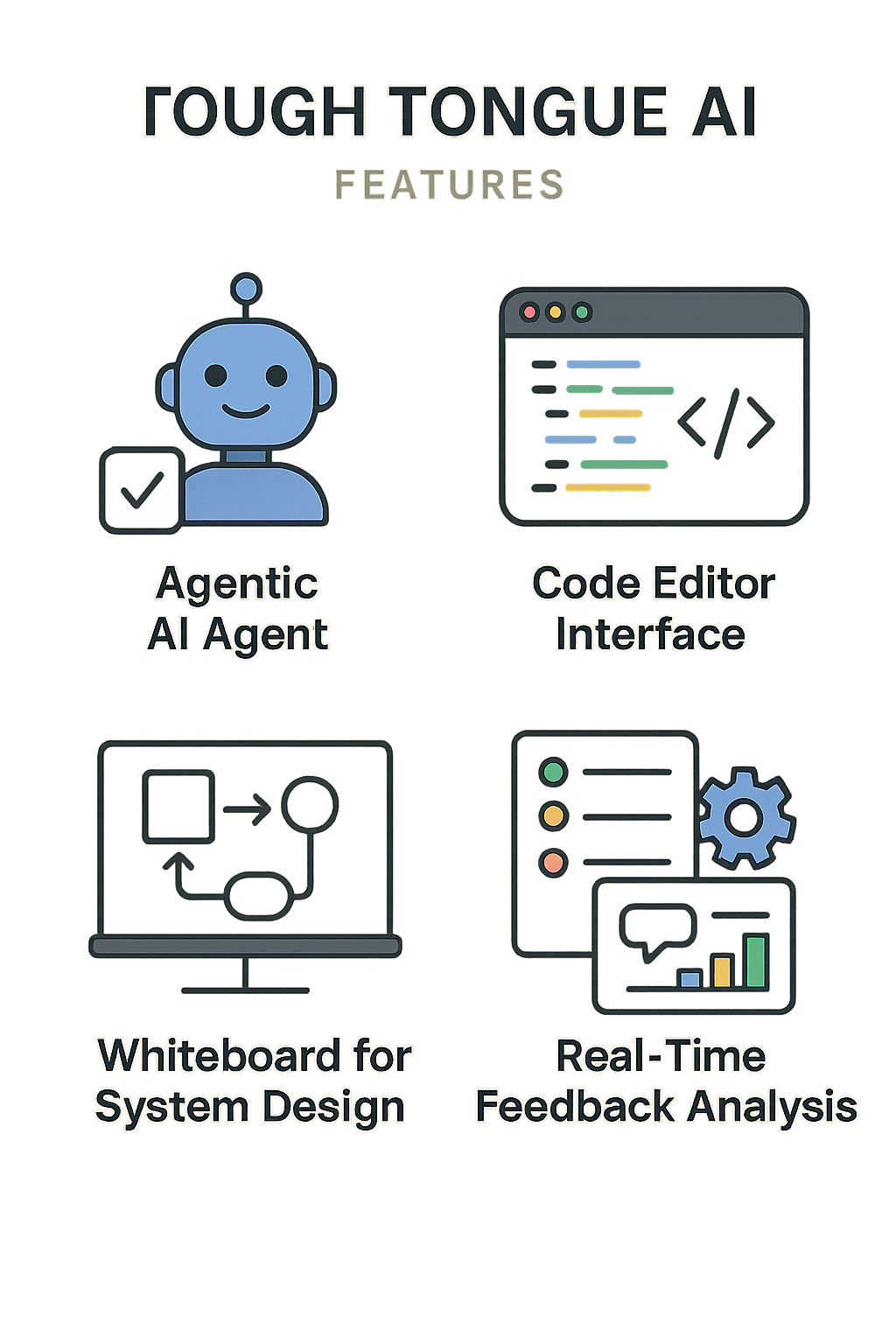
What that means in practice: the AI does not just respond to what you say. It uses tools during the conversation. It can generate cards and diagrams, open a code editor, read from a whiteboard, pull up slides, and use Mermaid diagrams to visualize concepts in real time. When you are practicing a system design interview, the AI can sketch out the architecture you are describing. When you are in a sales roleplay, it can display product slides while pushing back on your pitch.
The latency has been a consistent point of praise from users. The platform aims for near real-time response, and reviewers across Product Hunt and other platforms have called it out specifically. In the world of voice AI, where even a half-second delay breaks the conversational feel, low latency matters enormously. Tough Tongue AI has clearly treated it as a first-class engineering priority.
The AI also has memory. When you want it to, the platform remembers previous sessions and what you have worked on before, allowing it to track your improvement over time and calibrate difficulty accordingly. Users can control what the AI retains, which is an important detail for privacy.
On the enterprise and developer side, Tough Tongue AI operates as a full voice agent platform with sub-500ms latency, handling speech recognition, language model orchestration, voice synthesis, and telephony in a single integrated stack. The Scenario Studio, a no-code visual builder, lets non-technical teams build and deploy AI calling agents without touching code. For developers who want to go deeper, the API allows custom integrations with fewer than 50 lines of code.
The platform also introduced an AI clone feature in early 2026. Users can create a version of themselves that speaks in their voice and joins meetings on their behalf. It takes about 10 minutes to set up. The use cases range from sales teams cloning their best performer to individual professionals who want an AI counterpart for preliminary calls. It is the kind of feature that sounds futuristic until you realise the underlying technology has been available for a while and someone finally wrapped it in a product that normal people can actually use.
The Tough Tongue AI App
The platform lives in the browser at toughtongueai.com. There is no separate desktop application required, and the experience is built to work across devices, though the most immersive sessions naturally happen on a laptop or desktop where your camera and microphone can be properly used.
When you first land on the homepage, you can try a scenario without signing up at all. The Google PM interview agent is accessible directly from the landing page, which is a smart product decision. It lowers the barrier to experiencing what the product actually does before any commitment or account creation.
Once inside, users are greeted with a clean scenario library. The pre-built scenarios span a wide range: product management interviews, sales calls, performance review discussions, system design sessions, negotiation practice, feedback conversations, and more. The library has grown considerably with each version, and users regularly request new scenarios in the community, which the team appears to act on.
Custom scenario creation is available for teams and enterprise users. You define the goal of the conversation, the persona the AI should play, the difficulty level, and the specific pressure points you want to rehearse. The Scenario Studio for enterprise is the same visual no-code builder used for the AI calling agent product, which means the same configuration skill transfers across both use cases.
Post-session feedback is one of the places where the product earns its reputation. After a practice conversation, you get a breakdown of your performance: communication style, emotional intelligence markers, how you handled specific moments, what you should try differently. The analysis goes beyond grammar or filler word counts into the actual substance of how you responded under pressure.
Video feedback on body language and facial expressions has been called out by multiple users as a standout feature. Knowing that you looked down at a critical moment, or that your tone shifted when challenged, is the kind of insight that is hard to get without a human coach watching closely. The AI captures it automatically.
Version 3.0 introduced coding interview support with a live code editor integrated into the voice conversation. Users can work through algorithm problems verbally while writing code, with the AI functioning as an interviewer who pushes back on both the logic and the approach. Reviewers have noted this feature is still maturing, with occasional bugs and some missing automated feedback triggers, but the concept is sound and the direction is clear.
Tough Tongue AI Pricing in 2026
Tough Tongue AI has one of the more approachable pricing structures in the AI coaching category. The free tier gives you 25 minutes of practice with no credit card required and access to the full scenario library, transcription, and analysis features. That is enough to form a real opinion of whether the product works for you.
Paid plans start at $10 per month for the Starter tier. This puts Tough Tongue AI within reach of individual professionals, job seekers, and students in a way that many enterprise AI tools simply are not. The Starter plan covers regular individual use with expanded practice time and features.
Students with a valid .edu email address get 50% off the Starter plan, bringing it to $5 per month. Professional coaches who use the platform with clients can access bulk pricing and custom scenario creation tools. Developers building on top of the platform can access API pricing with generous rate limits for testing.
Enterprise pricing is custom and handled through a sales conversation. Enterprise plans include advanced data security, compliance features, air gap deployment support for organisations with strict data requirements, dedicated account management, priority support, and custom scenario libraries built for the organisation's specific workflows.
Google employees can have their Tough Tongue AI subscription reimbursed through job-related and personal learning benefits, and the company is actively expanding the corporate reimbursement program to other employers. If your company has a learning and development budget, there is a downloadable reimbursement letter on the platform's Resources page that makes the process straightforward.
For the value delivered, the pricing holds up well. At $10 a month, a professional practicing twice a week is getting something closer to what a session with a human coach might cost per hour, but available every day, at any hour, with consistent calibrated feedback every time.
User Experience
The word that comes up most consistently in Tough Tongue AI user reviews is realistic. Not impressive for AI. Not surprisingly good. Just realistic, which is the closest comparison users have to the standard they actually want to meet.
The voice interaction is fluid. The latency, as mentioned, is close to real time. The AI does not just accept your answers: it pushes back, asks follow-up questions, escalates the difficulty when you handle easy parts too comfortably, and introduces the kind of curveballs that real interviewers and clients actually throw. Users describe the experience of finishing a Tough Tongue session and feeling like they have genuinely exercised something.
The scenario breadth is another area of consistent praise. From pharma reps practicing product pitches to MBA admissions officers automating first-round interviews to tech leads rehearsing performance conversations with team members, the range of contexts the platform handles is genuinely wide. One university admissions office reported replacing faculty interview scheduling entirely with Tough Tongue AI for first-round applicant screening, with unbiased analysis and structured rubrics applied consistently across every candidate.
The free flow mode, which lets users practice without a defined script or structured objective, has been particularly praised by managers and senior professionals who need to rehearse the texture of a difficult conversation more than a specific sequence of answers. It mirrors the reality that most high-stakes conversations do not follow a neat script.
There are some areas where the product is still catching up. The coding interview module, introduced in version 3.0, has received feedback about occasional crashes and delayed transcripts. The feature is clearly in active development, and the roadmap suggests it will mature, but teams planning to use it heavily for engineering interview prep should be aware it is not yet at the same polish level as the other modules.
Some users have also mentioned wanting additional practice time credits on the free tier, particularly job seekers who are using the platform intensively before upcoming interviews. The free tier is genuinely useful, but 25 minutes goes quickly when a single practice session can run 15 to 20 minutes for a complex scenario.
On the team and enterprise side, the hiring use case has been a quiet success story for the platform. Organisations using Tough Tongue AI to screen candidates before human interviews report cleaner, more consistent assessments and meaningful time savings for hiring managers. The ability to create a custom scenario built around a specific role's real demands is a level of specificity that generic interview tools do not offer.
Frequently Asked Questions About Tough Tongue AI (2026)
1. What is Tough Tongue AI and what is it used for?
Tough Tongue AI is an AI-powered roleplay and coaching platform built for high-stakes professional conversations. It gives individuals and teams a realistic environment to practice job interviews, sales calls, salary negotiations, performance discussions, leadership conversations, and more. The platform uses voice AI, video analysis, and multimodal tools like live whiteboards and code editors to create practice sessions that feel like the real thing. It is used by job seekers, sales teams, managers, hiring professionals, universities, and enterprise organisations.
2. Who founded Tough Tongue AI?
Tough Tongue AI was founded in 2024 by Ajitesh Abhishek and Mayank Raj. Abhishek, the CEO, previously worked as a Product Manager at Google Cloud on Gemini. He studied at IIT Delhi and holds an MBA from the Kellogg School of Management at Northwestern University. Mayank Raj is the CTO and handles the engineering side of the platform. Pratik Gupta leads go-to-market and growth. The team is headquartered in Mountain View, California.
3. How much does Tough Tongue AI cost?
Tough Tongue AI starts with a free tier that gives you 25 minutes of practice with no credit card needed. Paid plans begin at $10 per month for individual users. Students with a valid .edu email address receive 50% off the Starter plan. Enterprise pricing is custom and available through a sales conversation. Google employees can have their subscription reimbursed through learning and development benefits, and the company is expanding the reimbursement program to other employers.
4. Is there a free trial or free version?
Yes. Tough Tongue AI offers 25 minutes of free practice with no commitment and no credit card required. The free tier gives access to the full scenario library, transcription, and analysis features. You can also try one of the scenarios, such as the Google PM interview, directly from the homepage without even creating an account. It is one of the more generous free tiers in the AI coaching category.
5. How much funding has Tough Tongue AI raised?
Tough Tongue AI raised $1 million in a seed round, directed toward product and model improvements, enterprise and education pilots, and expanding the scenario library. The company has also been associated with non-equity assistance from Foundation Capital. The founders have been deliberate about fundraising timing, prioritising traction over premature capital raises. Given the growth trajectory, a larger institutional round is widely expected as the platform scales further.
6. How realistic are the AI simulations?
This is consistently the most praised aspect of the product in user reviews. The AI does not passively accept your answers. It pushes back, asks follow-up questions, adjusts difficulty mid-conversation, and introduces pressure in the way a real interviewer or client would. The near real-time latency means the conversation flows naturally without the slight pause that usually betrays AI-generated responses. The platform also analyses body language and facial expressions through video, and post-session feedback covers both what you said and how you said it.
7. What kinds of scenarios does Tough Tongue AI support?
The scenario library includes interview preparation across roles (product management, engineering, sales, MBA admissions, and more), sales and negotiation practice, leadership and management conversations, performance reviews, feedback discussions, customer escalations, and system design sessions. Version 3.0 added coding interview support with a live integrated code editor. Enterprise and team users can build fully custom scenarios tailored to their specific roles, industries, and conversation challenges. The library continues to grow based on user requests.
8. Can companies use Tough Tongue AI for hiring?
Yes, and this is one of the strongest enterprise use cases the platform supports. Organisations can build custom scenarios designed around a specific role and use Tough Tongue AI to conduct AI-powered first-round interviews with applicants. The platform applies consistent rubrics and provides structured analysis of each candidate, giving hiring teams clean, unbiased assessments before human involvement. Sharda University has used it to automate first-round MBA admissions interviews, replacing the need to schedule slots with faculty while maintaining assessment quality.
9. Is Tough Tongue AI suitable for enterprise use?
Yes. The platform has a dedicated enterprise tier with advanced data security, compliance features, and support for air gap deployments for organisations with strict data handling requirements. Enterprise plans include custom scenario libraries, dedicated account management, priority support, and flexible user management. For teams needing to embed the AI conversation experience within their own applications, developer API access with custom integration support is also available.
10. What makes Tough Tongue AI different from other interview prep tools?
Most interview prep tools give you a list of common questions and model answers. Tough Tongue AI gives you the experience of actually being in the conversation. The AI plays the other person, with a defined persona and genuine pushback, and you have to respond in real time under pressure. The multimodal tools, including live whiteboards, code editors, and slide generation, mean the platform can simulate contexts that other tools cannot come close to. And the AI clone feature, which lets you create a voice-and-face version of yourself that joins meetings autonomously, is a capability that goes well beyond interview prep into real-world professional workflows.
Nubia Magazine Verdict
Tough Tongue AI is doing something that very few tools in this space have managed to do: it actually makes you better at the conversations you need to have. Not theoretically better. Not more informed about best practices. Actually better, in the way that practice makes you better, because the platform gives you practice that is genuinely challenging.
The founding team has built the product with unusual focus for a startup at this stage. The AI realism is the best we have encountered in the roleplay category. The scenario range is broad enough to be useful across roles and industries. The pricing is accessible in a way that means individuals do not need a corporate budget to benefit from it. And the enterprise capabilities, from custom scenario building to AI calling agents to the hiring module, are mature enough for serious organisational use.
The areas that still need work are real but not disqualifying. The coding interview module is catching up to the polish of the rest of the product. The free tier's 25 minutes goes fast for intensive users. And as the team grows, maintaining the product's current quality and responsiveness to user feedback will require careful prioritisation.
On the basis of what Tough Tongue AI is right now, and the trajectory it has shown across three versions in under two years, we rate it 4.5 out of 5. If you are preparing for something important, there is no better place to practice.
Related Posts


0 Comments
Join the discussion and share your thoughts
No Comments Yet
Be the first to share your thoughts on this article!