Top 10 Best AI Medical Scribe Tools In The World 2026

Table of Contents
The adoption of ambient AI scribes has moved from experimental to essential in clinical settings. By early 2026, these tools have become a standard part of the workflow for many physicians, reducing the cognitive burden of documentation and allowing clinicians to focus on patients rather than screens. The market has matured rapidly, with clear leaders emerging across different use cases - from enterprise health systems to solo practitioners. Our analysis ranks the top 10 AI medical scribe tools based on clinical accuracy, EHR integration depth, language support, workflow automation, pricing transparency, and real-world user satisfaction.
How We Ranked These
We evaluated each platform across eight weighted categories: clinical accuracy (20%), EHR integration depth (20%), specialty coverage (15%), language support (10%), workflow automation (10%), pricing and value (10%), user satisfaction ratings (10%), and deployment speed (5%). Data was drawn from published KLAS scores, G2 reviews, composite scoring from independent comparison platforms, and verified user sentiment from physician forums. We prioritized tools with transparent pricing and verifiable deployment numbers over those relying solely on marketing claims.
The Top 10 Best AI Medical Scribe Tools 2026:
1. DeepCura
DeepCura leads our ranking with a composite score of 9.25 out of 10 across all evaluation categories. It earned perfect 10 out of 10 marks for both workflow automation and language support, a feat no other platform achieved. The tool supports ambient scribing in 34 languages and covers more than 50 medical specialties, making it the most versatile option for diverse clinical settings.
What sets DeepCura apart is its bundling strategy. Unlike competitors that focus solely on documentation, DeepCura integrates an AI receptionist, fax management, and billing automation alongside its scribe. This makes it the only all-in-one clinical AI platform currently available. It integrates with eight EHR systems and offers same-day setup with a free trial. At $129 per month for the full platform, it delivers exceptional value for practices that want more than just note generation.
DeepCura is particularly well-suited for independent practices and small-to-mid-sized groups that need comprehensive workflow automation without the enterprise-level price tag or lengthy implementation timelines.
2. Nuance DAX Copilot
Microsoft rebranded Nuance DAX Copilot to Dragon Copilot in March 2025, merging ambient scribing with the legacy Dragon Medical One dictation platform. This tool remains the gold standard for enterprise deployments, with over 600 health systems using it. It earned a perfect 10 out of 10 for clinical accuracy and EHR integration in comparative evaluations.
Dragon Copilot supports ICD-10, HCC, SNOMED CT, and RxNorm coding, and integrates with more than 40 EHR systems. Its deep native integration with Epic is among the best in the industry, making it the default choice for large health systems already embedded in the Microsoft ecosystem.
The significant tradeoff is cost and accessibility. Pricing is opaque but reported at approximately $830 per month, and implementation typically takes three to six months. This effectively limits Dragon Copilot to large health systems with dedicated IT teams. Smaller practices will find it prohibitively expensive and complex to deploy.
3. DeepScribe
DeepScribe earned the highest KLAS spotlight score in the ambient AI scribe category at 98.8 out of 100 in 2025, reflecting top marks across adoption, efficiency, and clinician satisfaction. Its AI models are specifically trained on complex multi-organ-system encounters, with particular strength in oncology and cardiology.
The platform integrates with nine EHR systems and supports seven or more specialty-tuned workflows. This specialization makes DeepScribe an excellent choice for specialists who need documentation that captures the nuance of complex treatment protocols. Users report that DeepScribe handles the lengthy, multi-faceted notes typical of oncology and cardiology visits better than generalist scribes.
Pricing is not publicly disclosed, with estimates in the $400 to $500 per month range. The narrow specialty focus, while a strength for those specialties, limits its utility for general practice and primary care physicians.
4. Freed AI
Freed AI is the most budget-friendly ambient scribe for solo practitioners, with pricing starting at $39 per month and a free trial available. It generates complete SOAP notes in one to five minutes after a visit, operating either in real-time or from pre-recorded audio files.
The platform supports more than 20 medical specialties and 14 languages, with setup completed in minutes. Its web and mobile compatibility means clinicians can access it from virtually any device. For a solo practitioner or small practice looking to dip a toe into AI scribing without significant financial commitment, Freed AI is the most accessible entry point.
The limitations are notable. Freed relies on browser-based copy-paste EHR integration rather than bidirectional API connections. It also lacks workflow automation features beyond note generation. Practices that need deep EHR integration or automated coding and billing will need to look at higher-tier options.
5. Heidi Health
Heidi Health is the most globally deployed AI scribe, handling over 2 million patient visits weekly across 116 countries and 110 languages. The company raised $65 million in a Series B round in October 2025, reflecting strong investor confidence in its international growth strategy. To date, Heidi has processed over 73 million patient visits total and returned an estimated 18 million hours to clinicians.
Heidi offers a free tier with no subscription commitment, alongside paid plans ranging from $40 to $150 per month. It supports 20 or more specialties and offers same-day setup with a 14-day free trial. This combination of global reach, language support, and flexible pricing makes Heidi ideal for international clinics and budget-conscious solo providers.
The main drawback is integration depth. Heidi connects to only two EHR systems via copy-paste and does not offer bidirectional write-back. This limits its utility for integrated practices that require seamless data flow between the scribe and the EHR.
6. Suki AI
Suki positions itself as a true assistant rather than just a scribe. In addition to ambient documentation, it offers voice commands that let clinicians pull patient history, stage orders, and trigger documentation steps during a visit. This makes it one of the most interactive tools on the market, particularly for physicians who want to control their workflow hands-free.
Suki integrates with UpToDate through a partnership with Wolters Kluwer, giving clinicians access to evidence-based clinical decision support directly within the scribe interface. It supports ICD-10, HCC, CPT, and E&M coding, and has deep bidirectional integrations with Epic, Oracle Health (Cerner), athenahealth, and MEDITECH. The platform serves more than 400 health systems and individual clinicians alike.
Pricing ranges from $299 to $399 per month, placing it in the mid-to-high range. Language support is not publicly disclosed, which may be a concern for multilingual practices. User ratings on G2 sit at approximately 4.8 out of 5, indicating strong satisfaction among those who can afford it.
7. Abridge
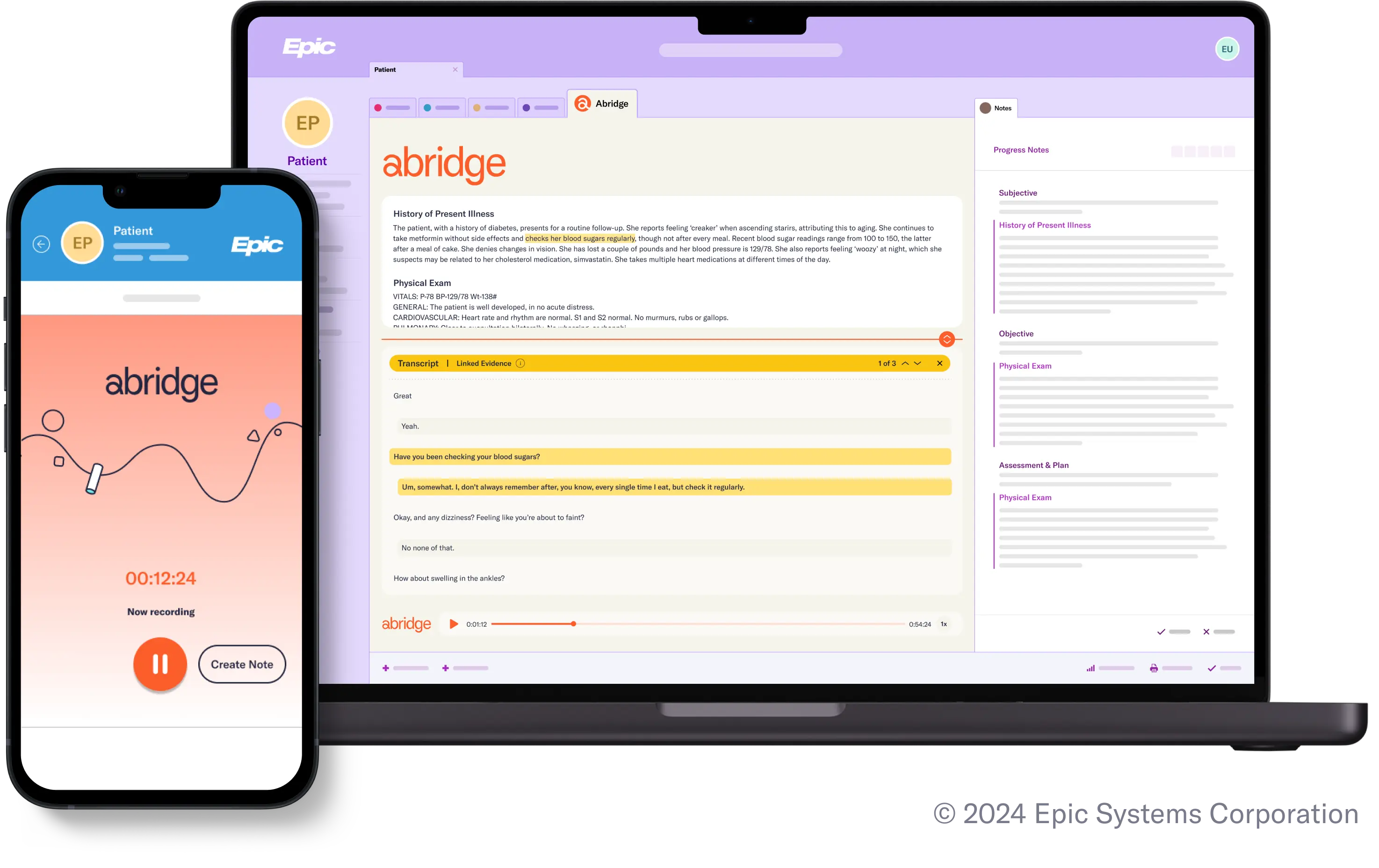
Abridge is the leading enterprise ambient scribe for Epic-based health systems. It has the deepest native API integration into Epic's ecosystem, generating structured notes using generative AI and supporting ICD-10, CPT, and HCC coding for revenue cycle management. The company's $5.3 billion valuation underscores strong investor confidence in its enterprise model.
For large health systems already on Epic, Abridge offers a level of integration that is difficult to match. Its structured note generation is designed to feed directly into billing and quality reporting workflows, reducing the administrative burden on physicians and coding teams.
The tradeoff is accessibility. Pricing is hidden behind custom contracts, there is no free trial, and integration depth outside Epic is limited. Independent practices and clinics using non-Epic EHRs will find Abridge unsuitable for their needs.
8. Twofold Health

Twofold Health offers what we consider the best combination of accuracy, customization, and security among budget-friendly scribes. At $49 per month with fully transparent pricing, it delivers 99 percent transcription accuracy with AI-driven CPT and ICD-10 coding suggestions. Users can choose from specialty-based note templates or create custom templates tailored to their specific practice.
The platform supports more than 25 languages and includes built-in analytics and reporting features that give practices insight into documentation patterns and coding compliance. Its composite score of 9.4 out of 10 in independent evaluations places it among the top-tier tools for accuracy and value.
The main limitation is the lack of bidirectional EHR write-back. Twofold relies on copy-paste workflows, which adds a manual step to the documentation process. Practices that prioritize seamless EHR integration over cost savings may want to consider other options.
9. Nabla Copilot
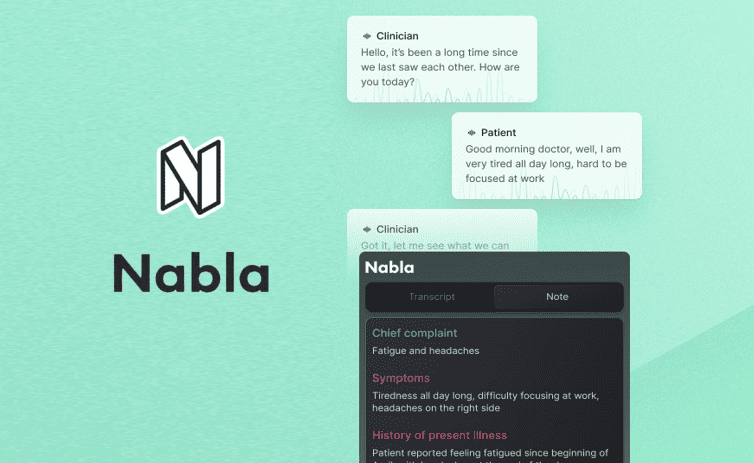
Nabla Copilot earns high marks for its privacy architecture and consistent performance across both telehealth and in-person visits. It scores 8 out of 10 for specialty coverage and 7 out of 10 for clinical accuracy, EHR integration, and language support (covering seven languages).
Reviewers consistently note that Nabla has the strongest privacy setup among the tools we evaluated, making it particularly suitable for multilingual and international practice settings where data protection regulations are stringent. Its consistent cross-device performance means clinicians can switch between desktop, tablet, and phone without losing functionality.
Pricing is custom and enterprise-based, which limits transparency. Its workflow automation score of 3 out of 10 indicates that Nabla focuses primarily on documentation rather than broader practice automation. Practices looking for a scribe with strong privacy credentials and reliable performance across settings will find Nabla appealing, but those wanting billing or scheduling automation will need to supplement with other tools.
10. Glass Health
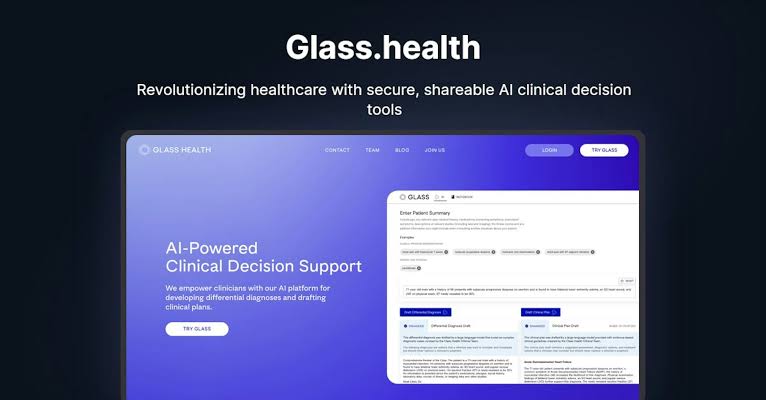
Glass Health is the only AI medical scribe that combines ambient documentation with built-in clinical decision support. It generates structured differential diagnoses across three tiers: Most Likely, Expanded, and Can't Miss. This feature alone sets it apart from every other tool on this list.
Glass Health creates evidence-backed assessment and plan drafts with citations to guidelines and medical literature. This means clinicians get not just a note, but a clinical reasoning assist that can help catch rare diagnoses and ensure evidence-based care. The Pro plan at $90 per month delivers both documentation and clinical reasoning for less than what most documentation-only tools charge.
Glass Health has fewer EHR integrations than competitors like Suki and less international presence than Heidi. Its clinical reasoning layer is most valuable for diagnostic-focused practices and physicians who want support in complex cases. For straightforward follow-up visits, the clinical decision support may be more than what is needed.
The right tool depends heavily on practice size, EHR system, budget, and clinical focus. Enterprise health systems using Epic should evaluate Abridge and Dragon Copilot first, as their deep native integrations provide the most seamless workflow. Independent practices and solo providers will find better value with DeepCura, Freed AI, or Twofold Health, which offer transparent pricing and fast setup times.
Specialists in oncology or cardiology should prioritize DeepScribe for its specialty-tuned models. International and multilingual practices should consider Heidi Health or DeepCura for their extensive language support. Practices that want more than just documentation - including billing, scheduling, and clinical decision support - should look at DeepCura or Glass Health, which bundle these features into a single platform.
The market for AI medical scribes will continue to evolve, but the tools listed here represent the best options available as of 2026. Each has clear strengths and tradeoffs, and the right choice will align with the specific needs and constraints of the practice using it.
Related Posts


0 Comments
Join the discussion and share your thoughts
No Comments Yet
Be the first to share your thoughts on this article!