Perpetual Futures in 2026: How Traders Use Leverage Without Losing Control

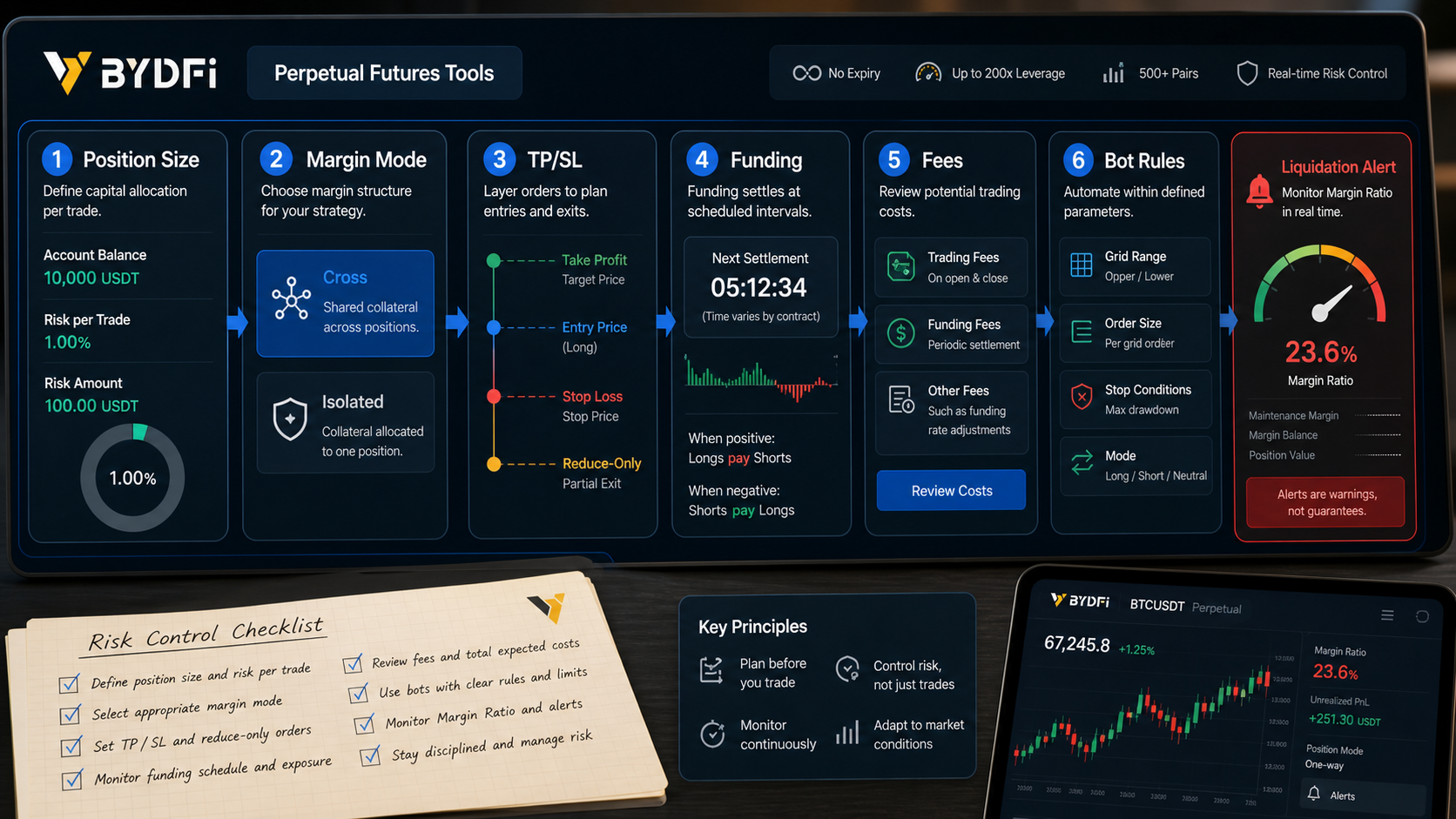
Perpetual futures and leveraged trading carry a high risk of loss. Readers should conduct their own research and consult a qualified financial advisor before trading.
Liquidation events keep happening, a recurring pattern highlighting something important: leverage increases both potential gains and potential losses. The challenge is whether traders have clear structural controls around position size, margin, and exits. In 2026, perpetual futures leverage control is increasingly about the systems surrounding a position rather than simply choosing a leverage multiplier.
Several exchanges now offer frameworks designed to answer that. BYDFi's perpetual futures offering includes no-expiry contracts, up to 200x leverage, and access to 500+ trading pairs.
What follows is a breakdown of the specific mechanisms - margin modes, hedging structures, order architecture, and automated trading tools - traders are using in 2026 to manage leveraged perpetual futures positions. These mechanisms form part of a broader leverage risk control framework.
Margin Modes and Position Sizing: The First Layer of Risk Control
Leverage management starts with two decisions before a trade is placed: which margin mode to use and how much leverage to apply. Across the perpetual futures market, settlement models can include USDT-M, USDC-M, and COIN-M, with each model determining the asset used as collateral.
A more consequential structural choice is Cross versus Isolated margin.
Parameter | Cross Margin | Isolated Margin |
|---|---|---|
Margin allocation | Shared across eligible positions | Assigned to one position |
Risk scope | Losses may affect shared margin collateral | Risk is limited to allocated position margin |
Typical use case | Multi-position management | Position-specific risk management |
BYDFi's perpetual futures framework combines shared collateral in cross-margin mode with bi-directional position management and other tools designed to help traders manage exposure across positions. Because shared-margin structures connect eligible positions to a common collateral pool, traders should still set position limits and monitor account-level margin carefully.
BYDFi offers adjustable leverage of up to 200x on eligible perpetual contracts, while available limits can vary by contract. Some start with lower multiples paired with Take Profit/Stop Loss orders, though individual strategies vary and none of this constitutes financial advice.
Bi-Directional Hedging and Short-Side Strategies
Holding both a Long and Short on the same pair can support hedging structures that reduce net directional exposure, depending on position size, funding costs, and execution conditions.
A trader holding a spot asset might open a Short perpetual position to partially offset downside exposure. It is not a free hedge: funding costs, margin requirements, and potential liquidation of the short all factor in. Traders expecting a price drop can also go Short on perpetual futures to profit from the decline without owning the underlying asset.
Funding payments can create periodic costs or income for positions that remain open at scheduled settlement times. The timing varies by contract and platform. When positive, Longs pay Shorts; when negative, the flow reverses. For hedgers running both sides, net funding exposure becomes a calculable line item rather than an unknown drag.
Order Architecture and Real-Time Monitoring
Advanced platforms typically offer Limit, Market, Stop Limit, Stop Market, Take Profit/Stop Loss, and Reduce-Only orders, along with GTC time-in-force settings. Layering them is where the structure becomes practical. A trader running a leveraged Long position can set a Stop Market at a defined loss threshold, a Take Profit at target, and a Reduce-Only order to partially de-leverage at an intermediate zone, all simultaneously. A structured crypto futures strategy starts with position sizing, margin selection, and predefined exits.
The full workflow: deposit collateral, choose Cross or Isolated margin, select a trading pair and leverage, place a Long or Short order, set TP/SL thresholds, and monitor funding at scheduled intervals. Real-time Margin Ratio monitoring and liquidation alerts provide structural scaffolding for ongoing position management. Margin Ratio should be monitored continuously during volatile sessions, because alerts are warning tools rather than guarantees that a trader can exit before liquidation. Position limits and predefined exits still need to be set before market conditions move against the trade.
Copy Trading and Trading Bots
BYDFi's copy trading system allows users to follow selected lead traders and configure their own copy settings, including how much capital is allocated to copied trades.
BYDFi's trading bots add an automation layer to rule-based futures strategies. For example, a Futures Grid approach can place orders within a predefined price range, allowing traders to follow a structured strategy without manually placing every order. Automation can help apply predefined rules consistently, but traders still need to define ranges, exposure limits, and exit conditions carefully.
Fee Structure Considerations
Fee impact becomes more noticeable when traders use larger notional position sizes or trade frequently. Leverage does not change the fee rate itself, but traders who use it to take larger notional positions may incur higher absolute trading costs. Opening and closing positions can both create transaction costs, while funding payments follow a separate schedule and may vary over time. For active strategies that scale in, scale out, or rebalance frequently, cumulative costs can become an important part of performance review. Cost planning should therefore sit alongside entry price, liquidation threshold, and exit logic when traders evaluate a leveraged setup across changing market conditions, during both planning and review. Traders should review the current fee schedule before opening leveraged positions.
Balancing the Trade-Offs
Perpetual futures leverage control in 2026 depends less on choosing the highest available multiplier and more on the structure surrounding each position. Margin modes, bi-directional position management, layered orders, trading bots, and real-time monitoring can all help traders define exposure more systematically.
BYDFi brings these mechanisms together through its perpetual futures environment, while its partnership with Newcastle United adds a broader dimension to the brand's international presence. Through the BYDFi perpetual futures tools, traders can access market information and the tools needed to structure their approach in one environment.
These features can support more disciplined risk management, but they do not eliminate funding costs, market volatility, or liquidation risk. The practical goal is not to remove risk entirely, but to define exposure and manage it more deliberately.
Related Posts

Top 10 Best Crypto Trading Platforms In Africa 2026

Understand how betting apps such as Bizbet protect user data
Advanced encryption protocols, user identification, and secure payments systems: see in detail how reliable bookmakers such as Bizbet ensure customer protection

Top 10 Best AI Tools for Zoho Desk in 2026

Top 10 Best Insurance Companies In Kenya 2026
1 Comment
Join the discussion and share your thoughts