Diigo Review 2026: App, Extension, Login, Signup, Alternatives & FAQs

Table of Contents
Diigo keeps turning up on “best bookmarking tools” lists year after year, yet a lot of people who search for it in 2026 are not entirely sure what it still does, how much it costs now, or whether it is worth creating an account for. We went through the app, the browser extension, the signup and login flow, and what current users on Capterra, G2 and the App Store have said about Diigo recently, so you do not have to dig through all of it yourself. Here is our full review, including the rating we settled on after testing and research.

Diigo Company Profile
Full name | Diigo (short for Digest of Internet Information, Groups and Other stuff) |
Founded | 2005 |
Founders | Wade Ren, Maggie Meichi Tsai and Joel Liu |
Headquarters | Reno, Nevada, United States |
CEO | Wade Ren |
Category | Social bookmarking, web annotation and research management |
Platforms | Web app, Chrome, Firefox, Edge and Safari extensions, iOS and Android apps |
Free plan | Yes, with limited highlights, bookmarks and ads |
Paid plans | Basic from about $7/year, Standard around $40/year, Professional around $59/year, Business around $10 per user/month |
Company size | Roughly 10 to 50 employees |
Website | diigo.com |
Nubia Magazine rating | 2.8 out of 5 |
What Is Diigo?
Diigo is one of the older names in social bookmarking, launched in 2005 by Wade Ren, Maggie Meichi Tsai and Joel Liu. It started as a way to save and tag links, but it grew into something closer to a research tool. You can highlight text on any web page or PDF the same way you would mark up a printed page, drop sticky notes on specific sections, save a cached copy of a page in case it disappears, and organize everything with tags or an outliner. It also lets you share collections with groups, which is part of why schools and research teams adopted it early on.
Diigo App Review in 2026
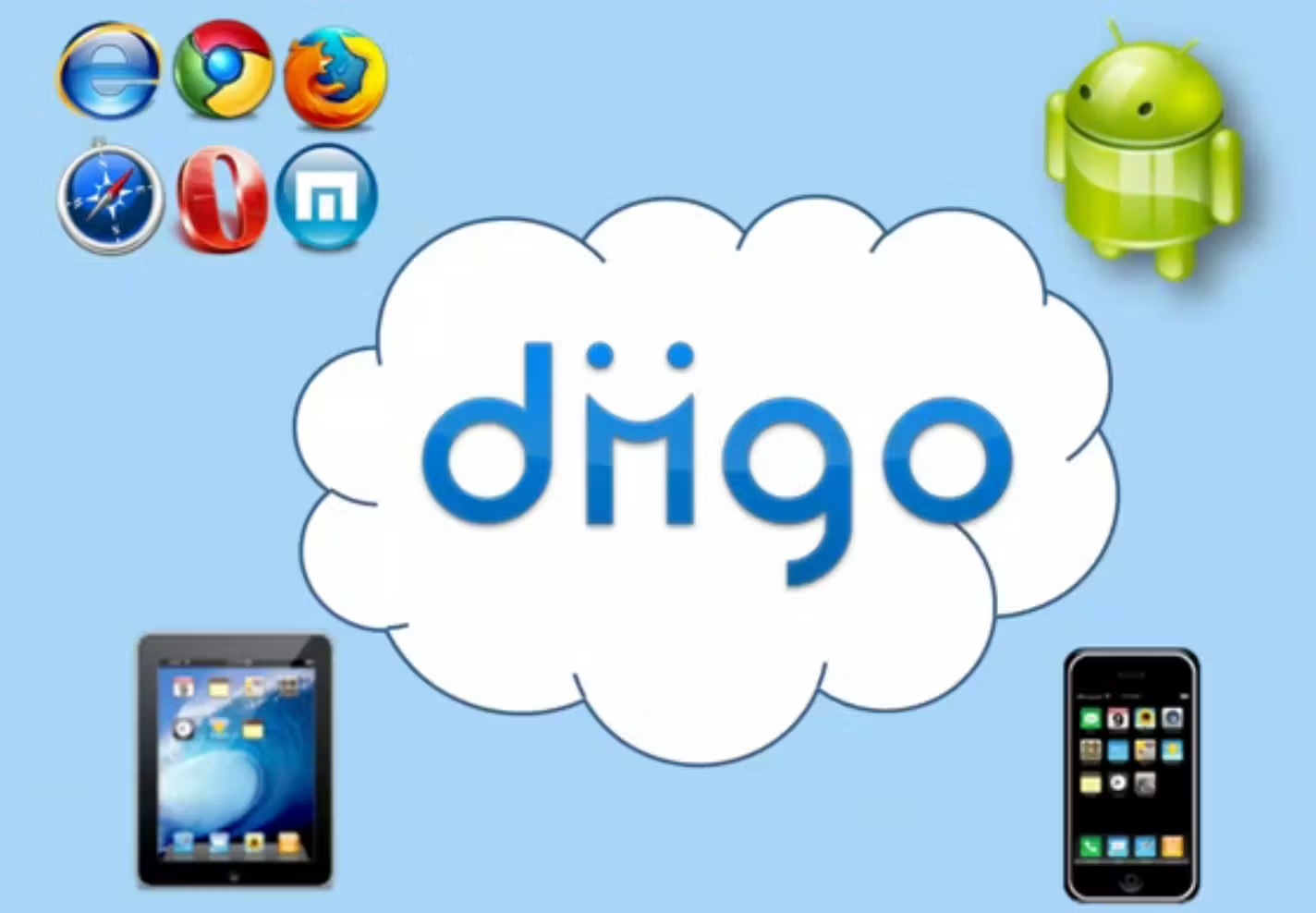
The mobile side of Diigo is handled by an app called Diigo Browser, available on iOS and Android. On the App Store it holds a 4.5 out of 5 rating, though the review count is modest for a product this old, which tells its own story about how active the user base still is.
What people like about the app:
- Bookmarks and highlights sync to the web library within seconds
- Jumping between the app and the browser extension feels fairly seamless
- Good for reading saved articles offline on a phone or tablet
What people complain about:
- The app does not support multiple accounts, which is awkward if you separate work and personal reading
- Some users report the app crashing a few minutes into a session
- Jumping straight from the iOS share sheet to an annotated page does not always work, so you end up opening the app manually
- The design has not changed much in years and feels dated next to newer read-it-later apps
Our take is that the app does its core job of saving and syncing bookmarks, but it feels like a tool that has been maintained rather than actively improved.
Diigo Extension Review in 2026
The browser extension, officially called Diigo Web Collector, is really the heart of the product. It is available for Chrome, Firefox, Edge and Safari, and on the Chrome Web Store it currently sits at around 4.6 out of 5 from roughly 2,300 ratings. With it you can bookmark a page, highlight and annotate text directly on the live page, attach sticky notes, take a screen capture, and save a page for later reading.
Independent extension testing from mid-2026 gave Diigo Web Collector a score of 7.6 out of 10, which is a solid but not outstanding result. The same test noted that the install base has roughly halved since its previous check, and pointed to slower, always-on syncing compared to newer offline-first highlighters, plus occasional problems with the link creation feature.
In day-to-day use, the highlighting and annotation features are genuinely still some of the best in this category. Where it falls short is speed and polish. Pages can take a moment to load when sync is running, and the overall interface looks like it belongs to an earlier era of the web.
How to Log Into Diigo
Logging into Diigo is straightforward if you already have an account:
- Go to diigo.com and click Sign In at the top of the page
- Enter the email address or username you registered with, along with your password
- If you originally signed up using Google, Facebook or Twitter, use the matching button instead of typing a password
- If you forget your password, use the Forgot Password link to get a reset email
- Once logged in on the website, the browser extension and mobile app will use the same credentials to sync your library
How to Sign Up for Diigo
Creating a new Diigo account takes only a couple of minutes:
- Visit diigo.com and click Sign Up or Join Diigo
- Choose a username, enter your email address, and set a password, or use the Continue with Google option for a faster setup
- Confirm your email address through the verification link Diigo sends you
- Install the browser extension so you can start saving and highlighting pages right away
- You will land on the free plan by default, with the option to upgrade to Basic, Standard, Professional or Business later from your account settings
Diigo Alternatives in 2026
Diigo is cheap compared to most of its competitors, but several newer tools offer a cleaner interface if annotation is not your main priority. Here are the ones worth considering:
- Raindrop.io: a modern, visually driven bookmark manager with a Pro tier around $3 a month. Better design, lighter on annotation features.
- Pocket: built for simple read-it-later saving rather than annotation, with Premium priced close to $5 a month. Note that Pocket itself is winding down as a standalone product, so check its current status before switching.
- Evernote: a broader note-taking tool with web clipping built in, starting around $8 a month, aimed at people who want notes and bookmarks in one place.
- Notion: flexible workspace software with a web clipper, starting near $10 a month, better suited to people already living inside Notion for other work.
- Hypothesis: a free, education-focused annotation tool that some former Diigo users switch to specifically for social annotation on course readings.
- Pinboard: a minimalist, no-frills bookmarking service favored by people who want tagging and search without any extra features.
If highlighting, sticky notes, cached pages and an outliner in one subscription matter to you, Diigo is still hard to beat on price. If you mainly want a clean place to dump links, the newer tools above will likely feel more modern.
User Experience: What People Are Actually Saying
Across Capterra, G2 and Software Advice, Diigo's aggregate ratings sit around 4.0 to 4.2 out of 5 from a relatively small pool of reviewers, which is worth keeping in mind. The praise and the criticism are both fairly consistent across platforms.
What users consistently like:
- Highlighting and annotating web pages the way you would mark up paper
- Tagging and organizing large numbers of links without losing track of them
- Customer support that several reviewers describe as responsive for a product this size
- A genuinely useful free tier for casual users
What users consistently dislike:
- An interface that feels clunky and mouse-dependent, with little support for keyboard navigation
- The free plan only allows searching by tag, not by keyword, which frustrates people with large libraries
- No spreadsheet or database-style view for managing bookmarks in bulk
- Pricing that some long-time users feel has crept up over the years for features that used to be included
- A design that has not kept pace with newer competitors
Nubia Magazine's Verdict
Diigo earns real credit for its annotation tools and its price, and the highlighting feature alone is enough reason for some researchers and students to stick with it. But the parts of the experience that touch everyday use, the interface, the speed of sync, and the lack of recent visible updates, pull the overall score down. We rate Diigo 2.8 out of 5. It is a capable, affordable tool for a specific kind of heavy reader and researcher, but it is not the tool we would recommend to someone who just wants a quick, modern place to save links in 2026.
Frequently Asked Questions About Diigo in 2026
1. What is Diigo used for?
Diigo is used for saving, tagging and organizing links, highlighting and annotating text on web pages and PDFs, taking screen captures, and sharing research with groups or colleagues.
2. Is Diigo free to use?
Yes. Diigo has a free plan that includes a capped number of bookmarks and highlights along with ads. Paid plans remove the ads and raise or remove those limits, starting at around $7 a year for the Basic tier.
3. Is Diigo still active in 2026?
Yes, Diigo is still operating, still updating its browser extensions, and still accepting new signups. That said, independent testing this year has noted a shrinking install base and a slower pace of visible improvement compared to its earlier years.
4. How do I install the Diigo extension on Chrome?
Go to the Chrome Web Store, search for Diigo Web Collector, and click Add to Chrome. After installation, sign in with your Diigo account so your bookmarks and highlights sync with the web library.
5. Can I use Diigo without creating an account?
No. You need a free or paid Diigo account to save bookmarks, highlights or notes, since everything is tied to your library and synced across devices.
6. Is Diigo safe to use?
Diigo has been around since 2005 without major public security incidents, and independent reviewers have rated its security practices reasonably well. As with any cloud service, avoid saving sensitive personal data in shared or public collections.
7. What is the difference between Diigo's paid plans?
Basic removes ads and raises free-tier limits. Standard adds unlimited cloud bookmarks, highlights, image storage and cached pages, plus Kindle highlight import. Professional adds unlimited PDF storage and outliners. Business adds team libraries, collaborative annotation and an admin dashboard for multiple users.
8. What are the best alternatives to Diigo?
Raindrop.io, Pocket, Evernote, Notion, Hypothesis and Pinboard are the alternatives people compare most often with Diigo, depending on whether they want better design, simpler saving, or more annotation features.
9. Does Diigo work on mobile devices?
Yes, through the Diigo Browser app on iOS and Android, which syncs with your web account and browser extension so bookmarks and highlights stay up to date across devices.
10. Can I cancel a Diigo subscription at any time?
Yes, paid plans can be cancelled from your account settings, after which your account reverts to the free plan and its usage limits at the end of the billing period.
Related Posts
1 Comment
Join the discussion and share your thoughts