Top 10 Best WhatsApp Clone Apps In 2026


Table of Contents
The market for WhatsApp clone apps has split into two distinct tracks by 2026. On one side are white-label messenger scripts and SDKs that let developers and entrepreneurs launch their own WhatsApp-style chat product under their own brand. On the other are consumer messaging apps that replicate WhatsApp's feature set for everyday users. This guide covers the top 10 best WhatsApp clone apps across both categories, ranked by feature completeness, codebase maturity, integration depth, and market presence.
To build this ranking, we weighed several factors. Feature coverage mattered most: how closely each product matches WhatsApp's core toolkit of messaging, calling, status updates, and encryption. We also assessed the maturity of the underlying codebase, whether source code is delivered outright or licensed, and how each option handles deployment, whether self-hosted, cloud, or turnkey. Integration ecosystems, documented delivery timelines, and real market adoption rounded out the criteria. Consumer alternatives earned their places by scale, security reputation, or serving as the benchmark that clone developers imitate. The result is a list that serves both audiences: builders shopping for a launch-ready platform and users hunting for a credible WhatsApp replacement
The Top 10 Best WhatsApp Clone Apps In 2026
1. WhatsApp Clone Script (AppDupe White-Label Suite)
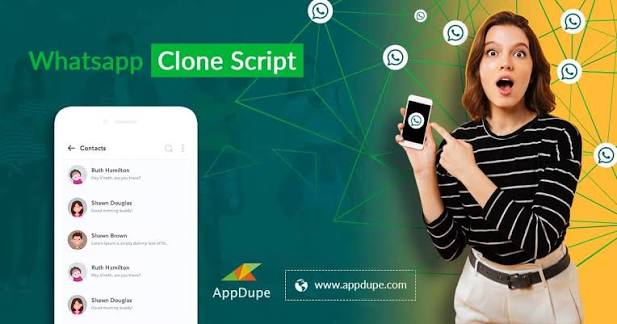
AppDupe's WhatsApp clone script is the most established turnkey package on the market, and it earns the top spot on breadth alone. The suite ships with more than 50 pre-built features covering text messaging, voice and video calls over WebRTC, group chat, status updates, contact sync, and end-to-end encryption. Buyers receive native Android and iOS apps plus a web admin panel, all delivered with source code and full rebranding rights under a single license.
What separates AppDupe from cheaper scripts is its documented track record. Deployment typically runs two to four weeks, and the vendor maintains a large public portfolio of launched messengers, which gives buyers something concrete to evaluate before committing. The admin dashboard handles user management, analytics, and content moderation out of the box.
For entrepreneurs who want a WhatsApp-style product live quickly without assembling a development team, this remains the safest starting point. The trade-off is that a turnkey package limits deep architectural customization unless you have in-house engineers to modify the delivered source.
2. MirrorFly WhatsApp Clone (Self-Hosted Chat SDK)

MirrorFly, built by Contus, takes a different approach. Rather than a pure script, it offers a WhatsApp-style chat SDK and ready-made clone app aimed at enterprises that need complete data ownership. The platform advertises more than 1,000 chat, voice, and video features, 150+ REST APIs, and support for 1,000+ concurrent users per server, with deployment either self-hosted or in the cloud.
The feature set covers HD voice and video calls, group conferencing, file sharing, message reactions, and end-to-end encryption. Its compliance posture stands out: MirrorFly supports HIPAA and GDPR-ready deployments, which matters for healthcare, finance, and any organization handling regulated data. That combination of API depth and self-hosting is why it ranks second despite requiring more technical integration than a plug-and-play script.
Companies comparing MirrorFly against lighter options should note the trade-off clearly. You get enterprise-grade infrastructure and control, but you also need developers who can wire the SDK into your existing stack.
3. Appkiz WhatsApp Clone App
Appkiz targets startups launching niche messaging products, and its pitch is straightforward: full source code delivery at a price point that undercuts the enterprise vendors. The package handles real-time messaging, media sharing, group chats, online and offline presence, and block and report features, plus a web-based admin dashboard for user management and analytics.
On the technical side, Appkiz documents socket-based architecture that supports up to 5,000+ concurrent connections per node, with scaling documentation included. Push notifications and multi-language support come standard. For a founder building a community app, a regional messenger, or a vertical-specific chat tool, that combination of code transparency and affordability is hard to beat.
It sits third rather than higher because its integration ecosystem and public portfolio are thinner than AppDupe's or MirrorFly's. Buyers get solid bones and full ownership, but they should expect to do more of their own engineering.
4. Signal
Among consumer alternatives, Signal carries the strongest security reputation in the industry. The nonprofit-run app counts roughly 70 million+ monthly active users as of 2025 estimates, and its code is fully open-source under GPLv3. More significantly, the Signal Protocol it developed is the encryption standard WhatsApp itself licenses, which makes Signal the original that competitors build on.
The feature set covers messaging, group chats, voice and video calls, disappearing messages, and usernames that let people connect without sharing a phone number. There is no advertising and no data monetization, a structural difference from Meta-owned WhatsApp and its roughly 2.9 billion users.
Signal ranks fourth because its user base remains far smaller than WhatsApp's, and network effects matter in messaging. But for anyone whose priority is privacy, it is the most credible replacement available, and its protocol underpins much of the clone ecosystem covered in this list.
5. Telegram
Telegram is the largest WhatsApp alternative by scale, with more than 1 billion monthly active users as of 2025. Its cloud-based architecture supports unlimited media storage, multi-device sync, groups of up to 200,000 members, channels, and an open bot API that has spawned an enormous developer ecosystem.
Feature velocity is Telegram's calling card. Stories, premium subscription tiers, and business accounts have rolled out at a pace that consistently outpaces WhatsApp. For clone developers, the platform matters for a second reason: its MTProto-based architecture is widely referenced in clone development, and its feature set is the benchmark most white-label vendors copy.
Strictly speaking, Telegram is a competitor rather than a clone script, which is why it lands at five instead of higher on a list weighted toward build-your-own platforms. As a consumer product, though, it is the most complete WhatsApp alternative in existence.
6. Troop Messenger (Team-Chat WhatsApp Clone)
Troop Messenger occupies the business-messaging lane, offering a WhatsApp-style platform with a clone-friendly architecture and enterprise controls layered on top. It packs 30+ features, including group calls for up to 100 participants, file sharing up to 500 MB, screen sharing, and video conferencing, with both on-premise and cloud deployment options.
The platform is used by more than 4,000 organizations, and its UI closely mirrors WhatsApp while adding an admin console and user provisioning for IT departments. That combination makes it a frequent entry in WhatsApp clone roundups: it is a deployable product rather than a raw script, so businesses can adopt it without a development project.
For teams that want WhatsApp's feel with corporate administration built in, Troop Messenger is the most production-ready option in this tier.
7. Wire
Wire is a secure collaboration platform whose open-source clients, available on GitHub, are frequently forked as the foundation for custom WhatsApp-style messengers. Every conversation is end-to-end encrypted, and the platform carries a strong European compliance story with GDPR alignment and government and enterprise clients on its roster.
The feature set includes messaging, group calls, file sharing, and ephemeral messages. What makes Wire valuable to developers is the licensing: its open-source codebase gives technical teams a compliant, encrypted starting point without building cryptography from scratch.
It ranks seventh because it is less turnkey than the dedicated script vendors. You are not buying a launch-ready product so much as a proven, auditable foundation that your engineers extend into a clone.
8. Viber

Viber, owned by Rakuten, demonstrates the clone-plus-business-API model that many white-label vendors now emulate. The messenger reports 1 billion+ registered users and 900+ million unique IDs, with particular strength in Eastern Europe, the Middle East, and Southeast Asia. It offers calls, group chats, communities, and a mature business messaging API backed by a 99.9% uptime SLA.
That API is the reason Viber appears on a list about clones. Its documentation is a common reference point for developers adding monetization and business messaging to their own WhatsApp-style products, and its regional scale proves the model works commercially.
As a consumer app, Viber is a capable WhatsApp alternative. As a case study for clone developers, it is arguably the clearest blueprint on this list.
9. Apphitect WhatsApp Clone Script

Apphitect sells speed. Its WhatsApp clone script delivers in roughly 15 business days, the fastest documented timeline among turnkey vendors, and bundles Android and iOS apps, an admin panel, and Socket.io-based real-time messaging under a one-time license fee.
The package covers 40+ features, including voice and video calls, live location, and broadcast lists, along with monetization hooks for ads and subscription flags. Apphitect also includes documentation for App Store and Play Store submission, which removes a common friction point for first-time founders.
Feature depth trails the top three vendors, and buyers should plan for that. But for entrepreneurs who need a branded messenger live within weeks and priced transparently, Apphitect is the fastest route from purchase to launch.
10. Element

Element is an open-source messenger built on the Matrix protocol, licensed under Apache 2.0 and used by more than 1,000 organizations. Its defining feature for this list is bridging: Element can connect WhatsApp conversations into a self-hosted client, making it effectively a WhatsApp-compatible clone for privacy-focused deployments.
The platform offers end-to-end encryption, group calls, and federation across servers, so organizations can run their own infrastructure while interoperating with the wider Matrix network. No other option here combines open protocols with real WhatsApp bridging.
Complexity is the catch. Element demands technical teams capable of running federated infrastructure, which limits it to organizations with engineering resources. For those teams, though, it is the only federated, open-protocol path to a WhatsApp-style messenger in 2026.
Related Posts


0 Comments
Join the discussion and share your thoughts
No Comments Yet
Be the first to share your thoughts on this article!