Top 10 Best Self-Hosted Apps In The World 2026


Table of Contents
Self-hosting has moved from a niche hobby to a mainstream strategy for anyone who values privacy, data ownership, and long-term cost control. In 2026, the ecosystem of self-hosted software is more mature than ever, with applications that directly rival the biggest names in Big Tech. Whether you are running a home lab on a Raspberry Pi or managing a small business server, the right self-hosted app can replace a monthly subscription with a one-time setup. Our team has analyzed the current landscape based on GitHub activity, community support, feature completeness, and real-world usability to bring you the definitive list of the top self-hosted apps this year.
How We Made Our Picks
We evaluated each application on five core criteria: GitHub star count as a proxy for community trust and development activity, the quality of the user experience compared to commercial alternatives, resource efficiency (RAM and CPU usage), the frequency and reliability of updates, and the breadth of features offered. We prioritized apps that directly replace a major paid or privacy-invasive service, ensuring that every entry on this list solves a real, everyday problem. The rankings reflect a balance between raw popularity and practical utility for both beginners and advanced users.
The 10 Best Self-Hosted Apps In 2026:
1. Immich

Immich has become the undisputed champion of self-hosted photo management, amassing over 40,000 GitHub stars and a development pace that rivals commercial software. It directly replaces Google Photos, offering AI-powered face recognition, object detection, and automatic mobile backup. The application requires at least 4GB of RAM, with more memory needed if you enable its machine learning features for tagging and search. In 2026, families and photographers alike choose Immich for its shared albums, timeline views, and on-device processing that keeps every photo private. The active development community releases updates frequently, fixing bugs and adding features at a speed that puts some paid products to shame.
2. Vaultwarden
Vaultwarden remains the gold standard for self-hosted password management, and for good reason. It is a lightweight, Bitwarden-compatible server that idles at under 10MB of RAM, making it deployable on the cheapest VPS or even a Raspberry Pi Zero. With over 30,000 GitHub stars, it supports all official Bitwarden clients, including mobile apps, browser extensions, and desktop applications. Users get self-registration, organizational vaults, and secure sharing without the overhead of the official Bitwarden server. The friction is near zero: if you have used Bitwarden before, Vaultwarden feels identical on the client side, but you control the server.
3. AppFlowy

AppFlowy is the leading open-source alternative to Notion, and it delivers a self-hosted workspace that includes documents, databases, kanban boards, and calendars. Licensed under AGPL 3.0 and built with Elixir, it has attracted over 22,000 GitHub stars. The financial argument is compelling: a 10-person team self-hosting AppFlowy on a $12-per-month VPS spends $144 per year, compared to $1,920 per year for Notion Teams. That is a savings of $1,776 annually. The app supports offline mode, rich markdown editing, and a plugin system, making it a powerful productivity hub for teams that want data ownership without sacrificing collaboration features.
4. Plausible Analytics

Plausible Analytics has become the go-to self-hosted web analytics tool for website owners who want to respect visitor privacy. It requires no cookies, making it automatically compliant with GDPR, ePrivacy, and CCPA regulations. The dashboard is clean and fast, displaying pageviews, referrers, top pages, device data, and geographic breakdowns without the bloat of Google Analytics. With over 20,000 GitHub stars, Plausible solves a specific headache: it gives you actionable traffic data without the legal risk of tracking users. In 2026, it is the standard choice for bloggers, small businesses, and anyone running a site that values privacy by default.
5. n8n

n8n is the leading self-hosted workflow automation tool, and it has the GitHub stars to prove it, with over 50,000. It replaces Zapier and Make, offering 200+ integrations through a visual node-based editor. Users can build complex automations with conditional logic, error handling, and branching, all without writing code. The fair-code license means the core is open source, and when self-hosted, there are no per-execution pricing limits. For businesses running hundreds of workflows, n8n eliminates the monthly costs that scale with usage. The community has built nodes for everything from Slack to custom APIs, making it the most flexible automation engine available.
6. Paperless-ngx
Paperless-ngx is the definitive self-hosted document management system, and it solves a universal pain point: paper clutter. It automatically ingests PDFs, images, and emails, running OCR on every document and using machine learning to classify them by correspondent, document type, and tags. The system consumes roughly 1GB of RAM and has over 20,000 GitHub stars. Searching through thousands of documents takes seconds, and the AI classification improves over time as you correct its suggestions. For anyone committed to going paperless, Paperless-ngx provides full local control and eliminates the need for third-party document scanning services.
7. Nextcloud
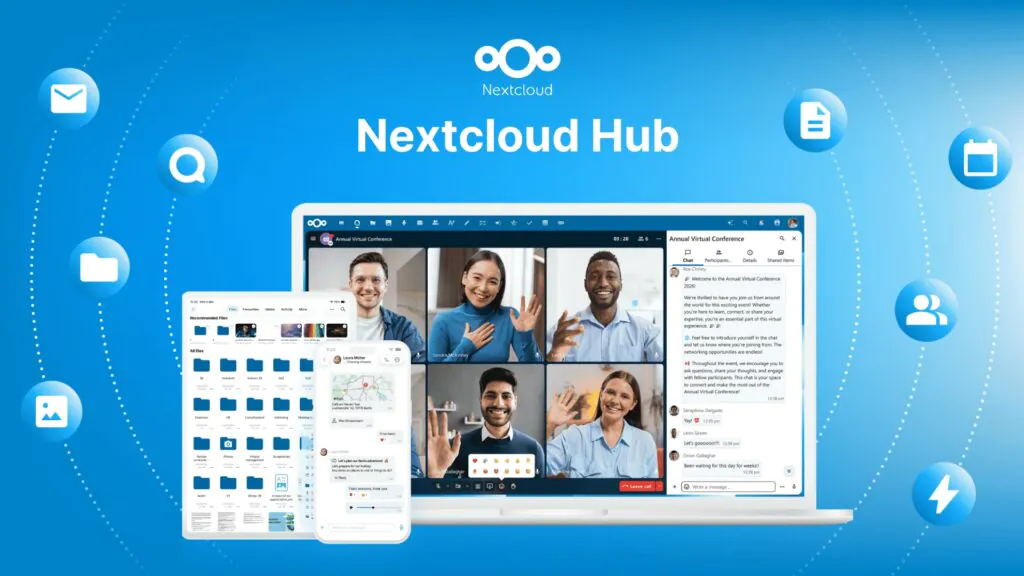
Nextcloud is the Swiss Army knife of self-hosted productivity, offering file sync, calendar, contacts, video calls, and office document editing in a single platform. With over 25,000 GitHub stars and a marketplace of 500+ apps, it replaces Google Drive, Dropbox, and even Slack for some teams. It supports end-to-end encryption, external storage mounts, and collaborative editing. However, its resource requirements are higher than simpler alternatives, needing at least 2GB of RAM for a smooth experience. In 2026, Nextcloud remains the most comprehensive option, but its complexity means it ranks lower for users who only need a single function like file sync or calendar hosting.
8. Uptime Kuma
Uptime Kuma is the simplest way to monitor your self-hosted services, and it has exploded in popularity with over 50,000 GitHub stars. It checks the status of websites, APIs, and services via HTTP, TCP, Ping, and DNS, displaying results on a beautiful, responsive dashboard. The killer feature is its notification system: it supports over 90 channels, including email, Telegram, Slack, and Discord. Deployment is a single Docker container, and the interface is intuitive enough for beginners. In 2026, no self-hosted setup is complete without Uptime Kuma watching over it.
9. Stirling PDF
Stirling PDF is a self-hosted web-based PDF manipulation tool that handles over 50 operations, including merging, splitting, compressing, converting, OCR, and signing. It runs on less than 512MB of RAM and imposes no file size limits, unlike many online PDF services. With 35,000 GitHub stars, it replaces dozens of paid tools with a single, free container. All processing happens in-browser, requiring no internet connection and keeping sensitive documents private. For office use or personal document management, Stirling PDF is the ultimate privacy-respecting utility.
10. GoDoxy

GoDoxy rounds out our list as a lightweight reverse proxy that automatically discovers Docker containers and configures routes from container labels and exposed ports. Written in Go, it is a simpler alternative to Traefik or Nginx Proxy Manager, requiring no manual configuration for most services. The web UI makes it easy to manage SSL certificates and routing rules. In 2026, GoDoxy is the ideal entry-level reverse proxy for home lab users who want automatic HTTPS without the learning curve of more complex tools. It fills a critical infrastructure role, making every other self-hosted app accessible via domain names with secure connections.
The self-hosted ecosystem in 2026 is defined by maturity and ease of use. These ten applications represent the best of what is available, each solving a specific problem with a level of polish that rivals commercial software. Whether you are protecting your photos with Immich, automating workflows with n8n, or managing documents with Paperless-ngx, the tools are ready. The only question left is what you will build.
Related Posts




0 Comments
Join the discussion and share your thoughts
No Comments Yet
Be the first to share your thoughts on this article!