Top 10 Best AI Customer Service Platforms In 2026

Table of Contents
Customer service has become the first place many companies deploy autonomous AI, and the market has responded with a crowded field of platforms that promise to resolve tickets without a human ever touching them. Our ranking of the top 10 best AI customer service platforms in 2026 weighs resolution rates, pricing models, deployment speed, and fit across company sizes. The leaders this year fall into three rough camps: all-in-one suites that bundle ticketing with AI agents, ecommerce specialists built around order and returns automation, and enterprise workflow engines that treat service as one more process to orchestrate.
What separates the top performers from the pack is no longer whether they can answer a question. It is whether they can resolve it, hand off cleanly when they cannot, and prove the savings in a dashboard a finance team will believe. According to our analysis of 2026 comparison roundups and vendor disclosures, the platforms below consistently appear at the top of independent evaluations.
How We Ranked These
We weighed four factors: demonstrated automation performance (published resolution and deflection rates), deployment effort and time to value, pricing transparency, and depth of native integrations with the systems support teams already run. We favored platforms with verifiable customer counts and third-party review data over marketing claims, and we gave weight to how well each tool handles the handoff to human agents. Enterprise scale, SMB affordability, and vertical specialization were all treated as legitimate strengths rather than penalized as narrowness.
These Are The Top 10 Best AI Customer Service Platforms In 2026:
1. Intercom (Fin AI Agent)
Intercom takes the top spot because it solves the hardest problem in AI support: making automation and human escalation feel like one system. The Fin AI Agent resolves roughly 65% of inbound conversations on average, according to the company's published figures, and it runs on top of a mature ticketing and inbox infrastructure. That matters more than it sounds. Many AI agents can close a conversation, but few can hand a messy one to a human with full context intact.
The pricing model has become its own selling point. Intercom charges $0.99 per resolved conversation for Fin, which shifts the cost structure from seats to outcomes. For a support organization handling tens of thousands of tickets a month, that math is easy to defend to a CFO. The platform serves more than 25,000 businesses, and in 2026 comparisons it is repeatedly cited as the top overall pick for balancing automation performance, omnichannel coverage, and ease of deployment.
The trade-off is that Intercom's per-resolution pricing can climb quickly at high volumes, and teams that already run Zendesk or Salesforce will face a migration decision rather than a simple add-on. For companies starting fresh or willing to consolidate, it remains the most complete package on the market.
2. Zendesk (AI Agents + Agent Copilot)

Zendesk is the system of record for customer service ticketing, full stop. More than 100,000 customers worldwide run their support operations on it, and in 2026 the company has layered AI agents, an agent-assist copilot, and intelligent triage on top of that foundation. The result is a platform that feels less like a chatbot bolted onto a help desk and more like the help desk itself getting smarter.
Its strength is depth of integrations and configurability at enterprise scale. Large support organizations with complex routing rules, multiple brands, and strict compliance requirements tend to default to Zendesk because it is reliable rather than novel. The G2 rating sits around 4.3 out of 5 across more than 2,000 reviews, which reflects both genuine satisfaction and the frustration that comes with any platform this configurable.
The catch is cost and effort. Advanced AI features start around $50 per agent per month as an add-on, and getting the most out of them requires real configuration work. Compared with Intercom's turnkey approach, Zendesk asks more of the buyer. For enterprises that already have the team to do that work, the payoff is a support stack that will not need replacing.
3. Salesforce Agentforce (Service Cloud)
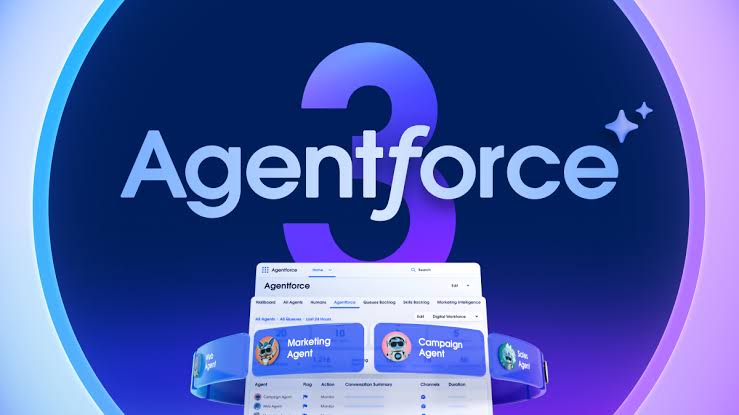
Agentforce is the most consequential bet in the category. Salesforce built autonomous AI agents natively into Service Cloud, which means the agents can act on case history, order data, and account records already sitting in the CRM without heavy integration work. For the 150,000-plus organizations standardized on Salesforce, that contextual advantage is difficult to replicate with a third-party tool.
Pricing runs around $2 per conversation under Salesforce's Flex Credits model, and Einstein and Agentforce capabilities are included in higher Service Cloud tiers. The model rewards companies that already pay for Salesforce and penalizes those who would need to adopt the CRM just to get the AI. That is the central tension of Agentforce: it is extraordinarily powerful inside its own walls and awkward outside them.
For smaller teams, complexity and cost remain real barriers. Implementation typically requires a Salesforce partner, and the licensing structure takes time to model. Enterprise buyers with existing Salesforce investment, however, get a level of context that standalone AI support tools simply cannot match.
4. Zowie
Zowie is the specialist that has earned its place near the top. The platform is purpose-built for ecommerce, automating conversations across chat, email, social, and messaging channels with integrations tuned to the questions online retailers actually get: where is my order, how do I return this, when will it ship. Typical resolution rates for routine ecommerce inquiries land between 50% and 70%, and multiple 2026 reviews named it the best overall omnichannel AI platform.
What makes Zowie interesting is deployment speed. Direct-to-consumer brands rarely have the engineering resources that enterprise support organizations do, and Zowie is designed to go live in days rather than quarters. Its WISMO (where is my order) automation alone can eliminate a large share of a retail support queue.
The limitation is scope. Zowie is not a full help desk, and companies with complex B2B service operations will outgrow it. For direct-to-consumer brands, though, it is arguably best-in-class, and its rise in 2026 rankings reflects that focus rather than despite it.
5. ServiceNow (AI Agents for CSM)
ServiceNow extends its workflow automation leadership into customer service management with AI agents, AI Search, and Now Assist generating answers from knowledge bases and case history. Roughly 8,000 enterprise customers run on the Now Platform, and the Gartner Peer Insights rating sits around 4.4 out of 5.
Where ServiceNow shines is complexity. In B2B, telecom, and regulated environments, a single customer issue can span billing, field service, and engineering. ServiceNow treats service as one more workflow to orchestrate, which is exactly what those organizations need. AI Search and Now Assist are included in CSM Pro Plus tiers, so the AI capabilities arrive without a separate negotiation.
The cost is implementation overhead. ServiceNow deployments are projects, not sign-ups, and the learning curve is steeper than dedicated support tools. Companies that already run ServiceNow for IT service management get disproportionate value; those buying it cold should budget accordingly.
6. Ada
Ada takes a different approach: build a branded AI agent without code, deploy it across voice and chat, and measure everything against automation rate. Customers commonly report automated resolution rates above 50%, and the platform serves more than 300 enterprise brands. The no-code builder means support leaders, not engineers, can own the agent's behavior.
Its analytics are the quiet differentiator. Ada ties AI performance to business outcomes rather than just conversation counts, which is the metric that actually survives a budget review. Pay-per-resolution options are available, giving buyers a way to align cost with results.
Ada is more of a specialist layer than a full help desk, so it typically sits alongside an existing ticketing system rather than replacing one. For enterprises that want a strong automation engine without ripping out their current stack, that positioning is a feature.
7. Forethought (Solve + Triage)
Forethought attacks the part of the support queue most vendors ignore: intake. Its Triage product uses generative AI to categorize, prioritize, and route tickets before they reach a human, improving SLA performance on the front end. The Solve AI agent then handles automated resolution for the tickets it can close. Brands including Grammarly and Carta use the combination.
Average ticket deflection across deployments runs above 60%, according to the company. Because Forethought plugs into existing help desks like Zendesk and Salesforce, it functions as a high-ROI add-on rather than a platform migration. That makes it one of the easier business cases to approve in a tight budget year.
The trade-off is that Forethought is not a standalone platform. Companies wanting a single vendor for ticketing and AI will look elsewhere. Companies wanting to squeeze more out of the help desk they already own should put it on the shortlist.
8. Freshworks (Freshdesk Freddy AI)
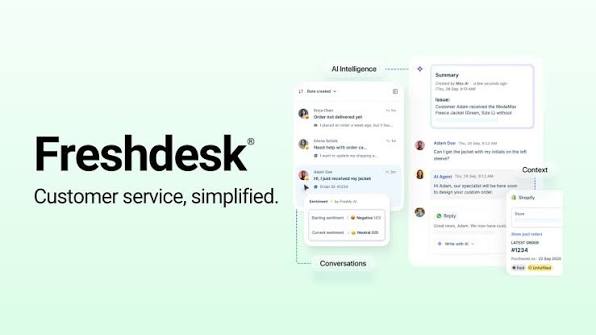
Freshworks has built one of the better value propositions in the category. Freddy AI brings chatbots, agent assistance, and auto-summarization into Freshdesk, and the company serves more than 70,000 customers globally. AI features are increasingly bundled into standard plans rather than sold as expensive add-ons, which is a meaningful shift for mid-market buyers.
Pricing starts around $15 to $79 per agent per month depending on tier, with Freddy AI available across Growth and Pro plans. Setup is quick, and the price-to-capability ratio is among the strongest in 2026. For SMBs and mid-market teams that need solid automation without enterprise procurement cycles, Freshdesk is a sensible default.
AI depth trails the enterprise leaders. Companies with very high ticket volumes or complex routing needs will find the ceiling sooner than they would with Zendesk or Intercom. For everyone else, the savings are real.
9. Zoho Desk (Zia AI)

Zoho Desk wins on cost, and it is not particularly close. Zia AI provides sentiment analysis, answer suggestions, anomaly detection, and workflow automation, and it is included in higher Desk tiers with entry pricing around $7 to $14 per agent per month. The platform is part of the Zoho suite, which serves more than 100 million users across 150-plus countries.
The integration story is the real argument. Companies already running Zoho CRM and other Zoho business apps get a support desk that shares data with sales and finance without middleware. For budget-conscious SMBs, that combination is hard to beat.
Autonomous resolution capabilities are less advanced than the top-tier specialists, so Zoho Desk is better at assisting human agents than replacing them. Buyers expecting fully autonomous agents should look higher on this list.
10. Cognigy (now part of NiCE)
Cognigy rounds out the list as the voice specialist. The company builds conversational AI for voice and chat at contact-center scale, with an AI Agent platform designed for telephony-grade voice bots in multiple languages. Its deployments handle millions of calls monthly, and NiCE acquired the company in 2025 to anchor its enterprise CCaaS voice automation strategy.
That acquisition matters for buyers. Cognigy now sits inside a larger contact-center platform, competing directly with voice AI offerings from Amazon, Google, and Microsoft. Enterprises evaluating large-scale voice automation get a vendor with both deep conversational AI and an established contact-center footprint.
Cognigy is an enterprise and contact-center specialist rather than a broad SMB platform. Smaller companies will find it overbuilt and overpriced. For organizations replacing IVR systems with conversational voice agents at scale, it is a leading 2026 option.
Related Posts



0 Comments
Join the discussion and share your thoughts
No Comments Yet
Be the first to share your thoughts on this article!