Top 10 Best Electronics Brands In Japan 2026

Table of Contents
Japan's electronics industry built its reputation on precision engineering, and in 2026 that reputation still holds. The top 10 best electronics brands in Japan generated a combined revenue exceeding ¥37 trillion in their most recent fiscal years, spanning image sensors, cameras, home appliances, automotive batteries, and audio equipment. Our ranking draws on company financial disclosures, global market share data from industry trackers, and product reputation among professional and consumer users.
What separates these ten companies from hundreds of smaller Japanese electronics firms is scale matched with staying power. Sony Group Corporation alone posted ¥13.0 trillion (roughly $87 billion) in revenue for FY2024, while Zojirushi, the smallest entrant on this list, commands a level of customer loyalty in rice cookers that no competitor has managed to crack in over a century.
How We Ranked These
We weighed four factors: annual revenue from the most recent fiscal year filings, global market share in each company's core product category, brand recognition outside Japan, and long-term viability given current strategy. Financial data came from corporate earnings reports and exchange filings. Market share figures came from industry associations and analyst estimates for 2024 and 2025. Companies that have pivoted successfully into new sectors scored higher than those relying purely on legacy products. No weighting formula was used. Each brand was judged on whether it still leads in something that matters.
Here Are The Top 10 Best Electronics Brands In Japan 2026:
1. Sony Group Corporation
Sony is the largest Japanese electronics company by global brand value, and the gap between it and the rest isn't close. Founded in Tokyo in 1946, the company reported ¥13.0 trillion (approximately $87 billion) in revenue for FY2024. Its semiconductor division controls roughly 50% of the global image sensor market, meaning most smartphones sold worldwide, including Apple's iPhone, carry a Sony sensor inside them.
The PlayStation console line remains the anchor of its gaming division, with the PlayStation 5 continuing to sell steadily into 2026. Sony's Alpha mirrorless cameras have overtaken Nikon in the full-frame professional segment, and the Bravia TV line still holds premium shelf space in Japanese electronics stores from Yodobashi Camera to Bic Camera.
What makes Sony difficult to compete with is the entertainment-tech synergy. It owns music labels, a film studio, and a gaming platform, all of which feed content into hardware it manufactures. No other Japanese electronics firm has assembled that kind of vertical integration. The Walkman brand, now in its digital audio player iterations, still sells to audiophiles who pay premium prices for hardware most consumers have replaced with phones.
2. Panasonic Holdings Corporation
Panasonic, founded in 1918 and headquartered in Kadoma, Osaka, is the oldest company on this list and still one of the most diversified. Revenue for FY2024 reached ¥8.5 trillion (about $57 billion). At its peak, the company employed over 500,000 people worldwide.
The Panasonic most consumers know sells Viera TVs, washing machines, and kitchen appliances. The Panasonic that matters most to global supply chains makes automotive batteries. The company is a key Tesla supplier, and its energy division has become central to its long-term strategy as EV production scales worldwide.
Panasonic holds more patents than any other Japanese electronics firm. That patent portfolio spans battery chemistry, industrial automation, and aviation entertainment systems. The company's shift toward B2B operations in energy and mobility reflects a broader trend among Japanese electronics giants: consumer hardware margins are thin, but industrial and energy contracts are lucrative.
Domestically, Panasonic remains a household name. Its home appliance division still commands strong shelf presence across Japan, and its air conditioning and ventilation systems are standard in Japanese commercial buildings.
3. Canon Inc.
Canon reported ¥4.5 trillion (roughly $30 billion) in revenue for FY2024 and holds approximately 46% of the global interchangeable-lens digital camera market. Founded in Tokyo in 1937, the company built its reputation on optical precision and has maintained it for nearly nine decades.
The EOS R series mirrorless cameras and RF lens ecosystem are the current benchmark for Canon's imaging business. Professional photographers working in sports, wildlife, and journalism still favor Canon bodies for autofocus reliability, and the company's lens catalog is the deepest in the industry.
Cameras are only part of the picture. Canon produces medical imaging equipment, semiconductor lithography machines, and office printers. The medical and industrial imaging divisions are where Canon is investing most aggressively, recognizing that consumer camera sales have plateaued globally. The company's lithography equipment competes with Nikon and ASML in the semiconductor manufacturing supply chain, a market with far higher barriers to entry than consumer electronics.
4. Fujifilm Holdings Corporation
Fujifilm's story is one of the most successful corporate transformations in Japanese business history. Founded in 1934 as a photographic film company, it faced near-certain obsolescence when digital photography wiped out film demand in the 2000s. Instead of collapsing, Fujifilm redirected its chemical expertise into healthcare, pharmaceuticals, and semiconductor materials.
Revenue for FY2024 reached ¥3.2 trillion (about $21 billion). The company holds roughly 10% of the global mirrorless camera market, and its X-series and GFX medium-format cameras have developed a devoted following among photographers who prioritize color science and tactile controls over spec sheets.
The GFX system, in particular, brought medium-format image quality to a price point that was previously inaccessible. Portrait and landscape photographers who once needed Hasselblad or Phase One equipment now shoot Fujifilm.
Healthcare is now Fujifilm's largest revenue segment. The company manufactures medical imaging systems, endoscopes, and pharmaceutical ingredients. Its semiconductor materials division supplies photoresists and chemical mechanical polishing slurries used in chip fabrication. The film business that nearly killed the company now accounts for a negligible fraction of revenue, but the chemical engineering knowledge it built transferred directly into the businesses keeping Fujifilm profitable today.
5. Nikon Corporation
Nikon, founded in 1917, is the oldest optics company on this list. Revenue for FY2024 was ¥720 billion (approximately $4.8 billion), and the company holds about 12% of the global interchangeable-lens camera market. That's a significant decline from its peak years, when Nikon and Canon split the professional photography market between them.
The Z-mount mirrorless system is Nikon's current flagship camera platform. Among professional photographers, the brand retains prestige, particularly for its optical quality and ergonomics. The F-mount system, which served professionals for over six decades, still has a massive installed base of lenses that adapt to Z-mount bodies.
Where Nikon has quietly built a strong business is semiconductor lithography. The company supplies lithography equipment used in chip manufacturing, competing with Canon and ASML. It also produces precision optical instruments for industrial and healthcare applications. These B2B operations now generate a substantial share of revenue and insulate Nikon from the volatility of consumer camera sales.
Nikon's challenge going forward is balancing its heritage brand status in photography with the reality that the camera market is shrinking. Its pivot toward semiconductor and healthcare equipment is the right strategic move, but it puts Nikon in direct competition with larger, better-capitalized rivals.
6. Toshiba Corporation
Toshiba, founded in 1875, is one of Japan's oldest industrial conglomerates. The company reported ¥3.4 trillion (about $23 billion) in revenue for FY2023 before being taken private by Japan Industrial Partners (JIP) in a ¥2 trillion ($14 billion) deal completed in 2023. That transaction ended decades of public listing and marked the close of a turbulent chapter that included an accounting scandal, nuclear division bankruptcy, and repeated restructuring attempts.
Under private ownership, Toshiba has narrowed its focus to energy, infrastructure, semiconductors, and quantum technology. The company's power systems division builds turbines, generators, and grid equipment. Toshiba Electronic Devices & Storage produces hard drives and discrete semiconductors.
Quantum technology is the wildcard. Toshiba has invested in quantum key distribution systems for secure communications, a field where Japan sees strategic advantage. Whether that investment pays off commercially remains uncertain, but it signals that Toshiba's new owners intend to compete in high-value technology sectors rather than chase consumer electronics volume.
7. Sharp Corporation
Sharp's place in electronics history is secure. Founded in 1912, the company invented the world's first LCD calculator in 1964 and mass-produced the first LCD televisions. Revenue for FY2024 was ¥2.3 trillion (approximately $15 billion).
Foxconn (Hon Hai Precision Industry) owns roughly 90% of Sharp, having acquired a controlling stake in 2016. That ownership has reshaped Sharp's strategy toward display panels, sensors, and smart home appliances. The company remains a major supplier of LCD panels for televisions and automotive displays, though the display industry's margins have compressed severely as Chinese manufacturers scaled up production.
In Japan, Sharp's home appliance brand still carries weight. Its air purifiers, microwave ovens, and refrigerators sell well domestically. The company's Plasmacluster ion technology, used in air treatment products, has been a reliable differentiator in the Japanese market for over two decades.
8. Casio Computer Co., Ltd.
Casio generated ¥270 billion (about $1.8 billion) in revenue for FY2024, making it one of the smaller companies on this list by financial scale. But revenue doesn't capture cultural impact, and Casio's G-Shock line has sold over 1.4 billion watches since its introduction in 1983.
The G-Shock became a global icon by doing one thing exceptionally well: surviving abuse that destroys normal watches. The original DW-5000, designed by Kikuo Ibe, was built to withstand a 10-meter drop, 10-bar water pressure, and 10-year battery life. That "triple ten" design philosophy still guides the line.
Casio's calculator division remains profitable and dominant in Japan's education market. Its electronic musical instruments, particularly the Privia and Celviano digital pianos, have found a following among budget-conscious musicians. The company also produces projectors and label printers, maintaining a portfolio of compact electronics that prioritize durability over trend-chasing.
What keeps Casio relevant is that it hasn't tried to become something it isn't. It makes reliable, functional products at accessible prices. In an industry where companies routinely overextend into markets they don't understand, that discipline has kept Casio profitable for decades.
9. Pioneer Corporation
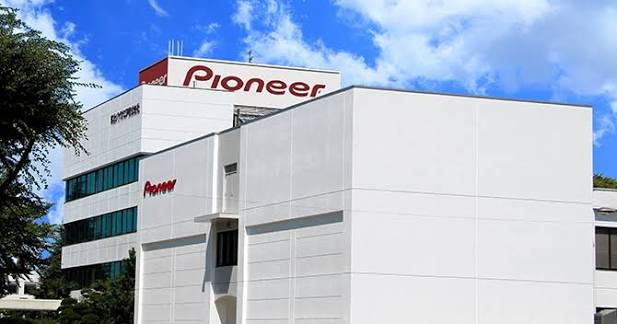
Pioneer, founded in 1938, reported ¥360 billion (roughly $2.4 billion) in revenue for FY2024. The company spent over 80 years building a reputation in audio, and its name still carries weight among car audio enthusiasts and DJs.
Pioneer pioneered the car stereo market and the in-dash navigation system. Its aftermarket automotive electronics division remains a leading brand, particularly in Japan and North America. The company's DJ equipment line, including the CDJ series, became the industry standard for club and festival performances worldwide.
Automotive telematics and OLED display technology for vehicles are Pioneer's growth areas. The company has shifted much of its focus toward B2B automotive partnerships, supplying infotainment systems and display components to vehicle manufacturers. The consumer-facing car audio business continues, but the real revenue growth is in OEM contracts.
Pioneer's enthusiast following is genuine. Walk into any car audio competition in Japan or the United States, and you'll find Pioneer head units in a significant share of the vehicles. That loyalty was earned over decades of consistent product quality, and it persists even as the company's overall market presence has narrowed.
10. Zojirushi Corporation
The company's "fuzzy logic" and IH (induction heating) rice cookers are considered the gold standard in Japan. Japanese consumers take rice seriously, and Zojirushi's ability to consistently produce perfectly cooked rice across different varieties and water hardness levels has made it the default choice in Japanese kitchens. The company's pressure IH models, which adjust cooking pressure to optimize texture, sell for prices that would seem absurd for a rice cooker anywhere else in the world.
Zojirushi's stainless steel vacuum mugs have developed a global following for heat retention that outperforms most competitors. The company's thermal carafes and lunch jars are staples in Japanese offices and schools. Its bread machines have a cult following among home bakers in the United States and Europe.
What Zojirushi demonstrates is that dominance doesn't require massive scale. It requires being genuinely better at something specific. The company's domestic loyalty is extraordinary, and its international growth has come organically through word of mouth rather than aggressive marketing.
Related Posts




1 Comment
Join the discussion and share your thoughts