Top 10 Best AI Security Platforms In The World 2026

Table of Contents
As organizations race to adopt generative AI and large language models, a new class of threats has emerged. Attackers are using AI to craft more convincing phishing campaigns, automate vulnerability discovery, and evade traditional signature-based defenses. The response from the security industry has been equally swift. The top AI security platforms in the world for 2026 are no longer simple detection tools. They are autonomous, agentic systems that can investigate incidents, roll back changes, and hunt for threats without waiting for a human to type a command.
We evaluated dozens of platforms to find the ten that stand out in this new landscape. Our list prioritizes platforms with proven enterprise adoption, strong third-party validation from analysts like Gartner and Forrester, and clear evidence that their AI capabilities translate into real-world protection. Here are the platforms that defined the category in 2026.
How We Made Our Picks
Our selection process weighed several factors. Annual revenue and customer count provided a baseline for market adoption. Ratings on Gartner Peer Insights and placement in analyst Magic Quadrants and Critical Capabilities reports gave us independent validation. We also looked for platforms that demonstrated genuine AI-native architecture rather than bolting on machine learning as an afterthought. Each platform had to show measurable outcomes: reduced mean time to detect, improved alert triage rates, or autonomous remediation capabilities. Finally, we considered breadth of coverage, favoring platforms that protect endpoints, cloud workloads, identities, and supply chains within a unified system.
The List Of The Top 10 Best AI Security Platforms In 2026:
1. CrowdStrike Falcon Platform
CrowdStrike Falcon remains the market leader in AI security by a wide margin. The platform generated over $3.4 billion in annual revenue and protects more than 29,000 organizations globally. Its 4.8 out of 5 rating on Gartner Peer Insights reflects strong customer satisfaction across industries ranging from finance to healthcare to government.
What sets Falcon apart is its cloud-native architecture. The platform processes over 7 trillion events per week, feeding a telemetry graph that enables behavioral detection at an enormous scale. CrowdStrike's machine learning models identify and block sophisticated attacks including ransomware, zero-day exploits, and fileless malware without relying on signatures. The platform's AI-assisted investigation workflows allow security teams to trace the full attack chain from initial compromise to lateral movement to data exfiltration. For organizations that need endpoint detection and response at enterprise scale, CrowdStrike Falcon sets the standard.
2. SentinelOne Singularity Complete

SentinelOne Singularity Complete has carved out a strong position as the most autonomous platform on the market. It holds a 4.7 out of 5 Gartner Peer Insights rating and serves over 11,000 enterprise customers. The platform processes more than 100 million events daily per customer, giving it the data density needed for accurate behavioral AI detection.
The standout feature is one-click remediation. When Singularity detects malicious activity, it can autonomously roll back changes to the operating system, registry, and files without human intervention. This capability dramatically reduces response times. The platform's Purple AI technology lets analysts query security data using natural language. Instead of writing complex SQL or KQL queries, a security analyst can type "show me all processes that connected to known bad IPs in the last hour" and get results instantly. For teams struggling with alert fatigue, SentinelOne's automation is a genuine force multiplier.
3. Palo Alto Networks AI Security Platform
Palo Alto Networks brings its dominant position in network security into the AI era. The company reported $6.9 billion in annual revenue and serves over 85,000 customers worldwide. It has ranked number one in the Gartner Magic Quadrant for Network Firewalls for 12 consecutive years, a streak that gives it enormous credibility in enterprise security buying decisions.
The Palo Alto AI Security Platform integrates capabilities across network, cloud, and endpoint through its Security Operating Platform. The Cortex XSIAM platform ingests and normalizes security data from hundreds of sources, applying machine learning to detect anomalies and automate incident response workflows. Its AI-driven root cause analysis uses behavioral analytics and path visualization to trace complex threats across hybrid environments. For organizations already invested in Palo Alto firewalls, the AI platform extends their existing security investment with advanced detection and response capabilities.
4. Microsoft Security Copilot + Sentinel Enterprise
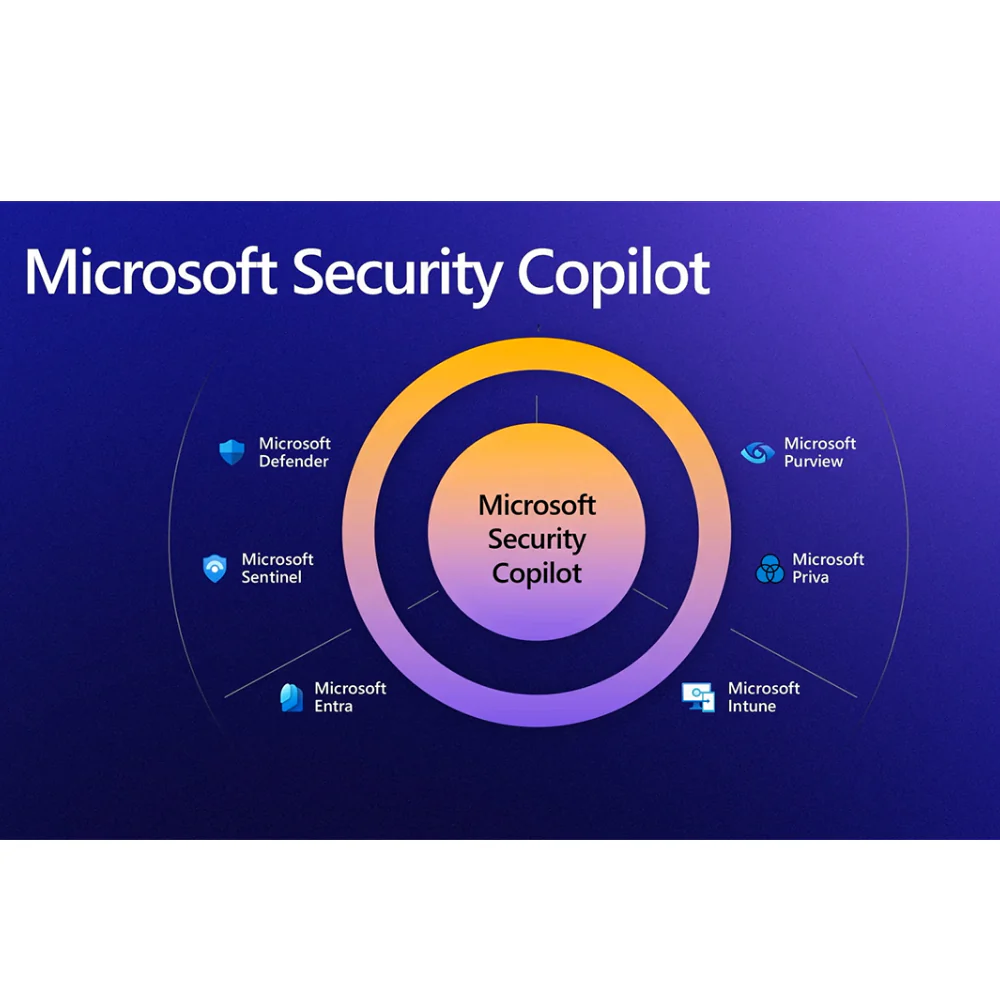
Microsoft Security Copilot is bundled with Azure Sentinel SIEM and is available at no additional cost to more than 10 million Microsoft 365 E5 subscribers. This pricing strategy alone makes it one of the most widely accessible AI security platforms in the world. The platform supports over 300 connectors through Sentinel and offers 12 specialized AI agents for different investigation types.
Security Copilot uses graph-based reasoning over security data to generate narratives and recommendations. When an incident is detected, the AI constructs a timeline of events, identifies the affected assets, and suggests containment steps. The platform supports multilingual queries and global-scale deployments, making it practical for multinational enterprises. Its alignment with Microsoft's compliance frameworks for GDPR, HIPAA, and FedRAMP is a significant advantage for organizations in regulated industries. For companies already deep in the Microsoft ecosystem, Security Copilot is the natural choice.
5. D3 Morpheus
D3 Morpheus has built a reputation as the platform that delivers on the promise of autonomous security operations. It offers more than 800 native connectors and can achieve autonomous L2 depth on up to 95 percent of alerts. This means the platform can investigate and triage the vast majority of security events without human involvement.
The platform's Attack Path Discovery feature traces threats horizontally across integrated tools and vertically through time, giving analysts a complete picture of an incident. D3 Morpheus also features self-healing integrations that automatically detect API drift and regenerate code, eliminating the maintenance burden that plagues many SOAR platforms. Its built-in SOAR execution engine removes the need for a separate orchestration platform, while native multi-tenancy with hard isolation supports MSSP deployments with white-label UI capabilities. For organizations that want to reduce their mean time to respond, D3 Morpheus delivers measurable results.
6. Cycode Platform
Cycode has established itself as the leading platform for application security posture management. It ranked number one for Software Supply Chain Security in the Gartner Critical Capabilities for Application Security Testing and raised $80 million from Insight Partners and YL Ventures. The platform was recognized as a Leader in the IDC MarketScape for Application Security Posture Management and entered the 2025 Gartner Magic Quadrant for Application Security Testing.
Cycode's AIBOM feature, short for AI Bill of Materials, provides complete visibility into AI components used across an organization. This enables security teams to identify vulnerabilities in AI models and their dependencies, a capability that is becoming essential as enterprises deploy more AI-powered applications. The platform secures the entire software development lifecycle, from code to deployment, making it particularly valuable for organizations that need to balance innovation velocity with security rigor.
7. Checkmarx One + Checkmarx SAST
Checkmarx One is the unified, cloud-native application security platform for enterprises that need to secure code, applications, and AI-driven development at scale. The platform was named a Leader in the Forrester SAST Wave for 2025 and brings together SAST, SCA, IaC, API, DAST, container, and supply chain security testing capabilities within a single system.
The Checkmarx SAST engine combines high-precision analysis with broad language coverage and a new speed-optimized engine that provides AI-driven guidance to developers. The platform integrates deeply into IDEs, CI/CD pipelines, and ASPM workflows, supporting inner, middle, and outer loop agentic AI use cases. This allows enterprises to scale secure coding without sacrificing velocity. For development teams that want to shift security left without slowing down, Checkmarx One provides the tools and automation needed to make that transition work.
8. AccuKnox AI Security Platform
AccuKnox takes a different approach by focusing on runtime enforcement in production environments. The platform provides runtime controls that prevent vulnerabilities from being exploited while maintaining complete audit visibility. It pairs observability with enforcement, automatically applying network rules, restricting access, and generating audit records when anomalies are detected.
The platform's infrastructure-native approach secures models, infrastructure, data, and workflows within a unified architecture. This eliminates the gaps that often exist when organizations use separate point solutions for different parts of their AI security posture. AccuKnox also delivers the audit evidence required for regulatory compliance, making it a strong option for organizations in regulated industries that need to demonstrate control over their AI deployments.
9. HackerOne Platform
HackerOne has evolved from a bug bounty platform into a comprehensive threat exposure management solution. The company has raised over $160 million in total funding and introduced two major AI-powered offerings in 2026. h1 Validation, launched in April 2026, helps enterprises manage the surge in AI-discovered vulnerabilities by providing expert verification of findings from AI security scanners.
The Agentic PTaaS offering, launched in January 2026, delivers continuous, expert-verified penetration testing at enterprise scale. It combines autonomous AI agents with human security researchers for comprehensive coverage. This hybrid approach addresses a key challenge in AI security: AI scanners can find a high volume of potential vulnerabilities, but many are false positives. HackerOne's human verification step ensures that security teams focus their remediation efforts on genuine risks.
10. Lasso Security Platform
Lasso Security rounds out our list with a focused approach to protecting generative AI deployments. The platform is available on AWS and Azure and comprises four main solutions for applications, employees, developers, and red teaming. Its MCP secure gateway provides protection for AI agents, enabling non-experts to define security policies and protect their LLM use from a single, unified security interface.
While Lasso's scope is limited to protecting interactions involving generative AI, it provides specialized protection for organizations deploying large language models and generative AI applications. The red teaming tool identifies vulnerabilities by simulating real-world attacks against AI systems, including prompt injection, data extraction, and model manipulation. For organizations that are deploying generative AI at scale and need dedicated protection for those systems, Lasso Security fills a specific and important niche.
The platforms on this list represent the state of the art in AI security for 2026. What unites them is a shift from passive detection to active, autonomous protection. The best AI security platforms no longer wait for a human to investigate an alert. They investigate, triage, and in many cases remediate threats automatically. This shift is essential because the volume and sophistication of AI-powered attacks continue to grow. Organizations that adopt these platforms gain a significant advantage in defending their systems, data, and AI models against the next generation of threats.
Related Posts



1 Comment
Join the discussion and share your thoughts