Anrok Review 2026: Login, Pricing, Funding, Revenue & FAQs

Table of Contents
Our verdict, in short: Anrok is a genuinely strong sales tax tool if you run a SaaS or subscription business and most of your revenue comes from software. It struggles a bit more once you step outside that lane, and the pricing model still confuses a lot of finance teams we talked to. That mixed picture is why we're landing at 3 out of 5 rather than higher.
Company Profile at a Glance
Company name | Anrok, Inc. |
Founded | 2020 |
Headquarters | San Francisco, California |
Founders | Michelle Valentine and David Poirier |
Category | Sales tax and VAT compliance software |
Best suited for | SaaS, software, AI and other digital-first companies |
Total funding raised | Over $109 million across 5 rounds |
Latest funding round | Series C, $55 million, closed October 21, 2025 |
Lead investor (Series C) | Spark Capital, with Sapphire Ventures, Sequoia Capital, Index Ventures and Khosla Ventures |
Reported valuation | Around $525 million as of October 2025 |
Customer base | 3,000+ companies in 100+ countries, including Anthropic, Cursor, Notion and Mistral |
Starting price | From about $100 per market per month on the Starter plan |
Free trial | Not publicly offered; demo required |
Login portal | app.anrok.com/sign-in |
Nubia Magazine rating | 3.0 out of 5 |
What Is Anrok, Exactly?
Anrok is a sales tax and VAT compliance platform built mainly for companies that sell software or digital products. It was started in 2020 by Michelle Valentine and David Poirier, two former Stripe and Vanta employees who saw how badly general purpose tax tools handled subscription billing, proration, and usage based pricing.
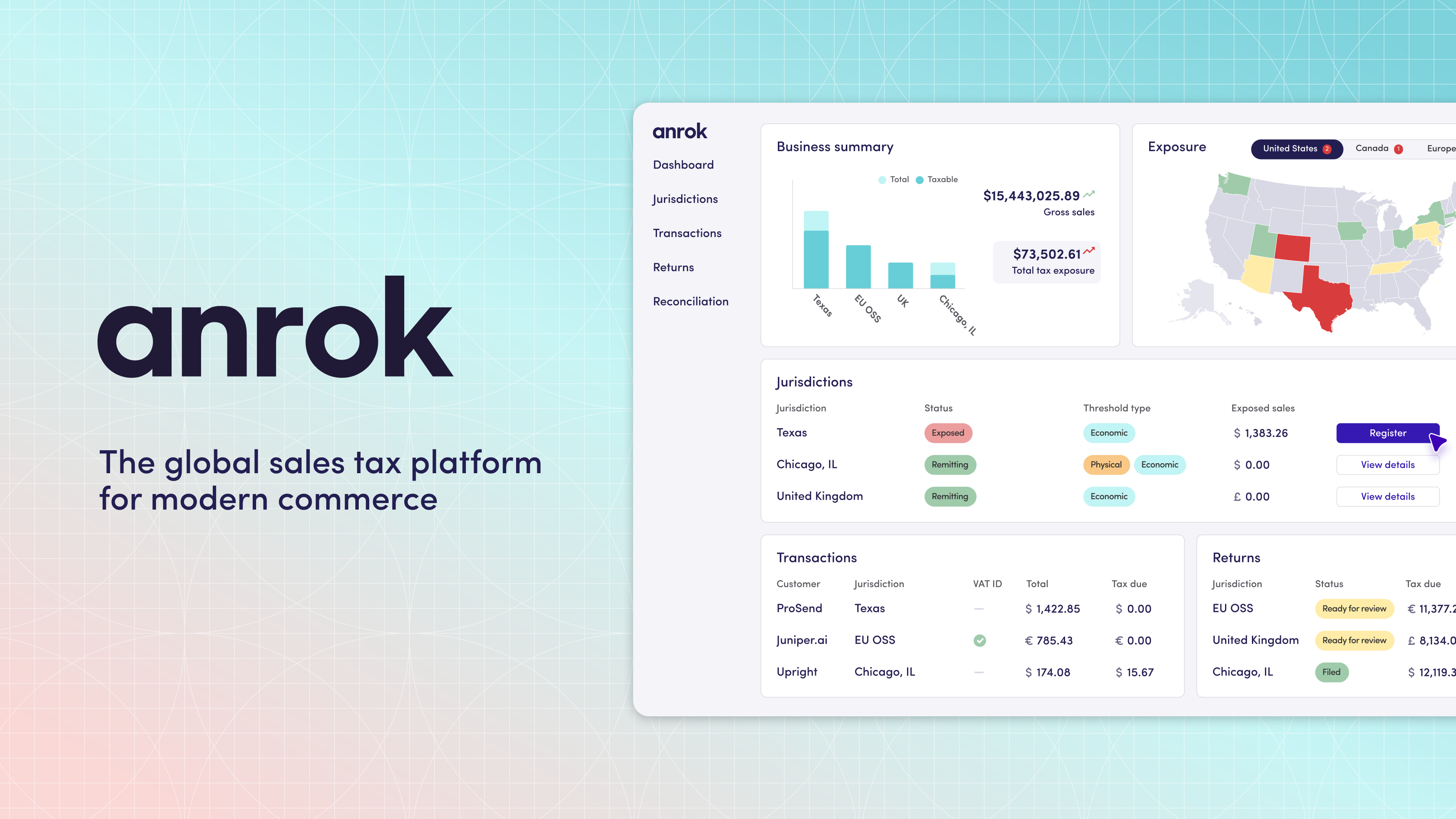
The platform connects to your billing and payment tools, such as Stripe, Chargebee, or NetSuite, and keeps track of where you owe sales tax or VAT as your revenue grows in new states and countries. It also watches for what's called physical nexus, meaning tax obligations that get triggered simply by hiring a remote employee in a new state. Once it flags an issue, Anrok can help you register in that jurisdiction and, in many cases, file and remit the tax on your behalf.
Companies like Anthropic, Cursor, Notion, Clay, and Vanta are named as customers on Anrok's own site, which gives you a sense of who this tool is really built for: fast growing, venture backed software companies rather than traditional retailers.
Is There an Anrok App for Windows?
This is one of the more common questions we saw people typing into search bars, so let's clear it up. Anrok does not have a downloadable Windows or Mac desktop application. It is entirely browser based. You sign in through app.anrok.com from Chrome, Edge, Safari, or any modern browser, on Windows, macOS, or Linux, and everything runs in the cloud.
If you were expecting a program you install and open like a typical desktop accounting tool, that is not how Anrok works. This is generally a good thing for a finance tool since it means updates roll out automatically and your team doesn't need to manage installs across different machines, but it is worth knowing going in.
How to Log In to Anrok
Logging in is straightforward once your account is set up:
- Go to app.anrok.com/sign-in in your browser.
- Enter the email address your finance or operations team used to create the workspace.
- Sign in with your password, or use single sign-on if your company has that configured.
- If you've forgotten your password, there's a reset flow at app.anrok.com/password-reset/start that emails you a reset link.
- Once inside, you land on the main dashboard showing exposure alerts, upcoming filing deadlines, and connected integrations.
A couple of readers asked us about API keys too. If your team needs to pull data programmatically, that's managed from inside the dashboard under Settings, then Manage API keys, where you can generate and revoke keys as needed.
Anrok's Funding History
Anrok has raised a total of roughly $109 million since it launched in 2021, spread across five funding rounds. Its investor list reads like a who's who of enterprise SaaS backers: Sequoia Capital, Index Ventures, Khosla Ventures, Sapphire Ventures, and Spark Capital have all written checks.
The most recent and by far the largest round was a $55 million Series C, announced on October 21, 2025 and led by Spark Capital. Bloomberg reported at the time that the round more than doubled Anrok's valuation to around $525 million. Sapphire Ventures joined as a new investor alongside the existing backers.
According to Anrok's own announcement, the company was serving more than 3,000 finance teams across over 100 countries by the time this round closed, and it plans to use the money to expand its product partnerships and push further into AI powered compliance tooling. It's a strong signal of investor confidence, though it's also worth remembering that a large valuation doesn't automatically translate into a product that fits every business, which is something we get into further down.
How Much Revenue Does Anrok Make?
Anrok is privately held, so it doesn't publish official revenue numbers, and we want to be upfront that we couldn't verify a reliable, current figure from a primary source. Some data aggregators list revenue estimates that don't line up with each other, which is common for private startups where numbers get inferred from headcount, funding, and web traffic rather than actual filings.
What we can say with more confidence is that Anrok's growth story is told through its customer count rather than disclosed revenue: it went from a smaller customer base to more than 3,000 companies in a few years, and its Series C valuation of roughly $525 million suggests investors are betting on continued strong growth. If you need Anrok's actual revenue for a business decision, we'd recommend asking their sales team directly rather than relying on third party estimates.
Anrok Pricing in 2026
Anrok's pricing has shifted a bit over the past year, and it's honestly one of the more confusing parts of evaluating this tool. Here's what we found on their official pricing page and cross checked against buyer research firm Vendr.
Starter plan
Priced at $100 per market per month. A 'market' generally means a US state or a country where you have tax obligations. This plan covers global exposure monitoring, real time tax calculation, filing and remittance, exemption certificate management, and physical nexus tracking. Anrok also introduced a separate startup offer around $500 per month with unlimited US regions for the first year, though the fine print is that standard volume based fees kick back in during year two.
Custom plan
For larger companies, pricing scales with total transaction volume and is quoted individually by an account representative. Vendr's buyer data suggests platform fees commonly fall between $1,500 and $2,500 a month for early stage companies, and between $3,000 and $7,000 a month for mid market companies with multiple jurisdictions and higher filing frequency.
There's no free trial. You'll need to book a demo before you can see a real quote, and several reviewers online have noted that the combination of platform fees plus transaction volume fees can add up faster than expected once a company starts expanding into new states or countries. Anrok has reportedly started offering flat annual pricing to bigger accounts who push back on the fee structure, but that option isn't advertised publicly and seems to depend on negotiation.
User Experience: What Reviewers Are Actually Saying
We read through a stack of reviews on G2 and Gartner Peer Insights to get a feel for what day to day use is actually like, beyond the marketing copy.
What people like
- Setup is genuinely fast. Several reviewers described connecting Stripe or Chargebee and getting useful nexus data within an hour, with no code required.
- The dashboard is clean and easy to read, even for non tax specialists on a finance team.
- Handling of proration, mid cycle upgrades, and usage based billing is noticeably better than general purpose tax tools, which makes sense given that's exactly what Anrok was built around.
- Customer support gets consistent praise, with reviewers pointing to responsive account teams and genuine tax expertise rather than just a support ticket queue.
What people don't like
- The pricing structure is a recurring complaint. Multiple reviewers said the combination of per market fees and usage based charges made costs hard to predict as they scaled.
- Coverage outside SaaS is thinner. Anrok only added support for physical goods in 2025, so companies selling a mix of hardware and software, or running an ecommerce storefront, report a less mature experience than pure SaaS customers.
- International filing coverage, while solid for the EU, UK, and Canada, is narrower than category leader Avalara, which supports over 190 countries compared to Anrok's roughly 100.
Taken together, the experience seems to genuinely delight the customers it was built for, which is venture backed, subscription first software companies, while leaving a more mixed impression among businesses with more complex or hybrid revenue models.
Anrok Pros and Cons
Pros
- Purpose built for SaaS billing complexity like proration and usage based charges
- Fast, no code setup with popular billing and payment tools
- Automatically tracks nexus triggered by remote hires, not just sales
- Free US registration handling on most plans
- Strong, well funded company backed by top tier investors
Cons
- Pricing can be difficult to predict as you add markets and transaction volume grows
- No public free trial or self serve signup
- Physical goods and ecommerce support is newer and less battle tested than the SaaS side
- International filing footprint is narrower than some competitors
Nubia Magazine Verdict
★★★☆☆ 3.0 / 5
We landed on 3 out of 5 for a specific reason. Anrok is clearly excellent at the one thing it was originally built to do: handle sales tax for subscription software companies with complicated billing. If that's your business, it likely deserves a higher score from you personally. But as a general purpose recommendation for anyone searching 'sales tax software 2026,' the unpredictable pricing, the lack of a trial, and the narrower fit for ecommerce and hardware sellers keep us from rating it higher across the board.
If you're a SaaS company with subscription or usage based billing and you're outgrowing spreadsheets or a general accounting tool's built in tax feature, Anrok is worth a serious look. If you sell physical goods primarily, or you need the widest possible international filing coverage, it's worth comparing against Avalara or TaxJar before you commit.
Frequently Asked Questions
1. Is Anrok legit?
Yes. Anrok is a real, venture backed company founded in 2020 and headquartered in San Francisco. It has raised over $109 million from well known investors including Sequoia Capital and Spark Capital, and its customer list includes recognizable names like Anthropic, Notion, and Cursor.
2. Does Anrok have a Windows app?
No. Anrok is a cloud based, browser only platform. There is nothing to download or install on Windows or Mac. You access it entirely through a web browser at app.anrok.com.
3. How do I reset my Anrok password?
Go to app.anrok.com/password-reset/start, enter the email tied to your account, and follow the reset link sent to your inbox.
4. How much funding has Anrok raised?
Anrok has raised roughly $109 million across five rounds since 2021. Its most recent round was a $55 million Series C in October 2025, led by Spark Capital, which reportedly valued the company at around $525 million.
5. Does Anrok offer a free trial?
Not publicly. Anrok requires prospective customers to book a demo with its sales team, and pricing is only shared after that conversation, or listed at a starting rate on its pricing page.
6. What does Anrok cost per month?
The Starter plan is $100 per market per month. Larger companies are quoted custom pricing based on transaction volume, and third party buyer data suggests typical platform costs range from about $1,500 to $7,000 a month depending on company size and jurisdiction count.
7. Is Anrok good for ecommerce businesses, not just SaaS?
It can work, since Anrok added physical goods support in 2025 and offers a native Shopify app. That said, most of its reviews and product depth still come from SaaS customers, so ecommerce sellers may want to compare it against ecommerce first tools like TaxJar or Zamp before deciding.
8. Who are Anrok's biggest competitors?
Avalara and Vertex are the most established names in the broader sales tax category. Within the SaaS specific niche, Anrok is often compared against Zamp, Sphere, and Stripe Tax.
9. Who founded Anrok and who runs it today?
Anrok was founded in 2020 by Michelle Valentine and David Poirier. Michelle Valentine continues to serve as CEO as of 2026.
10. Does Anrok handle tax filing, or just calculation?
Both. Beyond calculating sales tax and VAT in real time, Anrok also handles registration, automated filing, and remittance, and offers free US registration handling on its plans.
Anrok has built something genuinely useful for a specific type of company, and the funding and customer growth back that up. But a 2026 buyer should go in clear eyed: this is a premium tool with a pricing model that rewards companies who understand exactly what they're signing up for, and it's still sharpest for SaaS businesses rather than everyone selling something online. That combination of real strength and real friction is exactly why we're scoring it a solid, middle of the pack 3.0 out of 5, useful, well regarded by the right customers, but not yet a universal recommendation.
0 Comments
Join the discussion and share your thoughts
No Comments Yet
Be the first to share your thoughts on this article!