Top 10 Biggest Cybersecurity Companies In Europe 2026

Table of Contents
Europe's cybersecurity market hit USD 76.21 billion in 2025, and Market Data Forecast projects it will climb to USD 85.68 billion in 2026 on its way to USD 218.58 billion by 2034, a compound annual growth rate of 12.42 percent. That growth has a clear driver: the NIS2 Directive took effect in October 2024, pulling thousands of additional entities across the EU into regulated territory and turning vendor selection into a compliance decision rather than a simple procurement one. Buyers are rewarding providers that can prove European data sovereignty, local regulatory fluency, and, in many cases, the security clearances needed for defense and government work.
To build this ranking of the top 10 biggest cybersecurity companies in Europe in 2026, we weighed a combination of factors: market capitalization where publicly reported, headcount and security operations center footprint, breadth of platform, verified user sentiment from Gartner Peer Insights and G2, and depth of fit with European frameworks such as GDPR, NIS2, DORA, and France's SecNumCloud qualification. Government and defense relationships carried weight, as did hardware-level sovereignty credentials like certified key management and encryption products built inside the EU. No single metric decided the order. A company with a smaller revenue base but unmatched clearance levels or cryptographic infrastructure could outrank a larger vendor with a broader consumer footprint. Where sources conflicted, we deferred to the most recent 2026 data available.
Here Are The Top 10 Biggest Cybersecurity Companies In Europe 2026:
1. Eviden (Atos Group)
Eviden sits at the top of this list because no other European security provider combines its scale with its clearance depth. The Atos Group business unit employs more than 6,000 security professionals and runs 16 security operations centers worldwide, with the highest security clearances held across multiple European countries. For defense ministries, intelligence agencies, and critical infrastructure operators, that combination is difficult to replicate.
The company's sovereign cloud offerings and European-manufactured encryption hardware, including the Trustway HSM, give it a distinct position in the sovereignty conversation. Eviden holds France's SecNumCloud qualification and builds its services around NIS2, DORA, and GDPR requirements from the outset. For organizations where compliance failure carries existential risk, that portfolio is the core selling point.
2. Airbus CyberSecurity
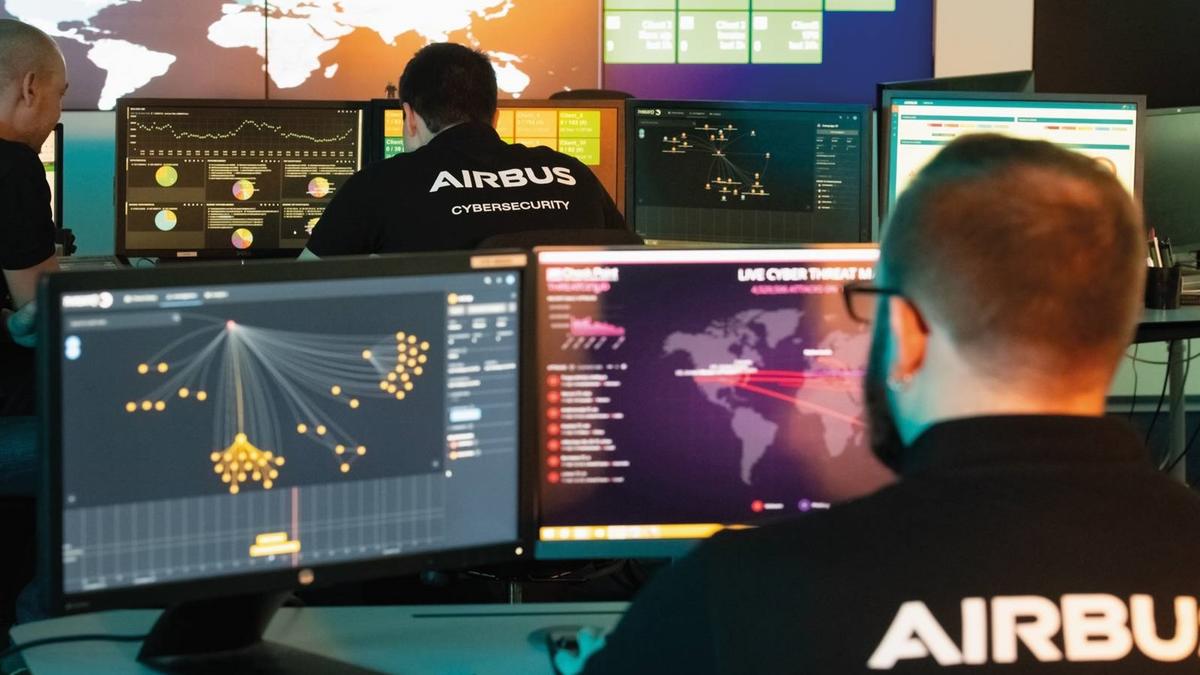
A score of 8.2 out of 10 in 2026 European rankings reflects what Airbus CyberSecurity has built on the back of its parent group's defense and aerospace footprint. Headquartered in Munich, Germany and Elancourt, France, the subsidiary serves defense, aerospace, and critical infrastructure clients with sovereign security requirements that most commercial vendors cannot meet.
Its integration into the wider Airbus ecosystem is the differentiator. Government and military relationships across Europe, built over decades of aircraft and defense contracting, translate directly into high-security government work. Few cybersecurity firms arrive at a procurement conversation with that kind of institutional trust already established.
3. Thales
Thales operates at the cryptographic foundation layer of European security. Its hardware security modules and key-management platforms are used by governments, banks, and critical infrastructure operators across the continent, and the company ranks among the top three European IT security firms by market cap, which stood at approximately USD 50 billion as of September 2026.
What makes Thales strategically important is where its products sit in the stack. Key material and cryptographic functions managed by a European vendor stay within European jurisdictions, a point that matters increasingly as post-quantum cryptography readiness moves from research topic to procurement requirement. Organizations planning security infrastructure on a ten-year horizon are factoring Thales into those decisions now.
4. Sophos
Verified customer feedback puts Sophos in rare territory. The UK-headquartered vendor holds 4.8 stars on Gartner Peer Insights for Endpoint Protection Platforms and 4.6 stars on G2 across more than 2,300 verified reviews. Those numbers are unusually consistent for a company selling across firewall, managed detection and response, and endpoint detection and response categories.
Reviewers repeatedly point to ease of use, enterprise readiness, and support quality. That combination has made Sophos a default choice for mid-market organizations that want integrated security operations without assembling a stack from multiple vendors. The company's British base also gives it a straightforward answer to data residency questions from European buyers.
5. Bitdefender
Founded in Romania in 2001, Bitdefender has spent more than two decades building one of the most recognized security brands in Europe. Its malware detection engine earns consistent praise in independent testing, and the company serves everyone from individual consumers to small businesses to large enterprises.
The privacy-first approach baked into its products aligns naturally with GDPR and NIS2 obligations. For European buyers weighing a US-centric vendor against a regional alternative, Bitdefender's roots and data handling practices often settle the question before price even enters the conversation.
6. Heimdal
Copenhagen-based Heimdal was nominated for Best Cloud Security Company at the Expert Insights Cybersecurity Community Awards 2026, and the nomination reflects a deliberate design philosophy. The company built its unified XDR-centric platform for Europe's regulatory environment specifically, with compliance treated as an architectural starting point rather than an add-on.
A single license covers prevention, detection, vulnerability management, privileged access, DNS security, and more. The platform supports GDPR, NIS2, and Cyber Essentials frameworks with auditability and accountability built into the tooling itself. For compliance officers who need to demonstrate controls rather than just deploy them, that design choice matters.
7. ESET
ESET's history stretches back further than its official founding date. The Slovakia-based company was established in 1992, but its roots trace to the NOD antivirus product released in the late 1980s, making it one of the longest-running security operations in Europe.
Core operations, including executive management and product development, run across multiple EU countries. That structure gives ESET a credible European data sovereignty story to pair with its long-standing reputation for reliable malware detection. Government agencies and enterprises that prioritize jurisdictional control over marketing claims have kept ESET on shortlists for years.
8. Darktrace
Founded in 2013 and headquartered in Cambridge, United Kingdom, Darktrace approaches security from a different angle than most of this list. Its ActiveAI Security Platform uses self-learning artificial intelligence to map an organization's unique digital baseline, then flags anomalous behavior instead of matching known attack signatures.
That approach lets the system autonomously isolate and neutralize threats like ransomware and phishing before lateral movement begins. The company listed more than 75 open positions as of 2026, a signal that it continues to invest through a period when many security vendors have slowed hiring. For organizations facing novel attack techniques that signature-based tools miss, Darktrace's behavioral model addresses a real gap.
9. F-Secure
Finland's F-Secure appears among the key market players in 2026 European cybersecurity market analysis, and its position rests on a mix of innovation and regional alignment. The company invests in AI-based threat detection and has been expanding its managed services business, a segment growing across Europe as smaller organizations look to outsource security operations entirely.
Nordic heritage carries practical weight here. Strict privacy norms and data protection expectations in Finland and neighboring countries mean F-Secure's products were built for regulatory environments that now apply across the entire EU. European data sovereignty concerns, which push many buyers away from US vendors, work in F-Secure's favor.
10. Stormshield
Stormshield specializes in network security and endpoint protection, with particular strength in the French and broader European government and defense sectors. The company is part of the Airbus Group, which gives it both the backing of a major defense contractor and a distribution network reaching across the continent.
Its European-made security products feed directly into digital sovereignty initiatives, an area where French government policy has been especially explicit. For public sector buyers who need certified, locally manufactured network protection, Stormshield occupies a niche that few competitors can match. The company's inclusion among key market players in 2026 European market analysis confirms its standing beyond its home country.
The NIS2 Directive changed the calculus for thousands of organizations across the EU. Compliance is now a board-level concern, and vendors that can demonstrate framework alignment out of the box, rather than through professional services engagements, hold an advantage. Heimdal's compliance-by-design platform and Eviden's SecNumCloud qualification illustrate two different ways to answer that demand.
Sovereignty concerns run alongside regulation. European buyers increasingly prefer providers that keep data, cryptographic functions, and key material inside EU jurisdictions. Thales at the hardware layer, ESET and F-Secure at the endpoint layer, and Eviden at the sovereign cloud layer all benefit from that preference. US-headquartered vendors still compete aggressively across the continent, but the burden of proof has shifted toward them.
Related Posts

2 Comments
Join the discussion and share your thoughts