Top 10 Best Websites Security Tools In The World 2026

Table of Contents
Website security spending crossed $10 billion globally in 2025, according to Gartner's application security forecast, and the tools dominating the market in 2026 reflect a maturing industry. Our ranking of the top 10 best website security tools in the world weighs user ratings, pricing transparency, threat coverage, and enterprise adoption to sort the platforms actually protecting websites today from the ones coasting on reputation.
Some of these tools guard WordPress blogs for $99 a year. Others sit inside Fortune 500 CI/CD pipelines validating every vulnerability before it reaches a developer's queue. What they share is a measurable track record against real attacks, not marketing claims. Here's how they stack up.
How We Ranked These
We built this list from aggregated user ratings published by Digital Linkage in its 2026 website security tool review, G2's security auditing scores, Gartner Peer Insights ratings, and pricing data verified across vendor sites. Weighting favored tools with transparent pricing, documented threat intelligence, and independent verification of their scanning accuracy. Platforms with strong enterprise adoption but opaque pricing were ranked on capability rather than cost. Every tool here has a substantial active user base and a verifiable security track record.
These Are The Top 10 Best Website Security Tools In The World 2026
1. Cloudflare

Cloudflare operates the largest cloud security network on the planet, routing traffic through more than 200 cities worldwide. That infrastructure scale is the product: when a DDoS attack hits, the sheer geographic distribution of Cloudflare's edge absorbs it before it ever reaches origin servers. The company's Web Application Firewall, SSL encryption, and DDoS mitigation come bundled into plans starting at $20 per month, which is why it holds a 4.7/5 user rating in Digital Linkage's 2026 survey.
The Kinsta hosting integration is worth noting for WordPress users. It layers IP-based firewall rules on top of Cloudflare's network, catching DDoS attempts at the hosting level rather than waiting for them to hit the application. For businesses that need enterprise-grade protection without an enterprise contract, Cloudflare remains the default starting point.
2. Sucuri
Sucuri built its reputation on cleanup, not just prevention. When a site gets hacked, Sucuri's incident response team removes the malware, patches the entry point, and files the blacklist removal requests. That service model explains the 4.8/5 user rating and the $199.99 annual starting price, which sits firmly in premium territory for small and mid-sized businesses.
The platform bundles a Web Application Firewall, DDoS protection, and CDN into the same subscription, so site owners aren't stacking three vendors. Sucuri also ranks among the most-installed WordPress security plugins, with continuous monitoring that flags changes to core files and database entries. For anyone who has already been breached once, the malware removal guarantee is the selling point.
3. Wordfence
Wordfence holds the highest user rating on this list at 4.9/5, and its focus is narrow by design: WordPress, and only WordPress. That specialization pays off in threat intelligence. Wordfence's firewall rules are fed by a community of millions of WordPress installations reporting attacks in real time, which means new plugin vulnerabilities get signature coverage within hours, not weeks.
At $99 per year for premium, it undercuts nearly every competitor here while still delivering login security, real-time traffic monitoring, and a malware scanner that understands WordPress file structures. The free tier covers basic protection for site owners who can't pay. If your site runs WordPress, this is the value benchmark everything else gets measured against.
4. Acunetix (by Invicti)
Acunetix does something most scanners don't: it validates every finding before it reaches a developer. That means no false-positive tickets clogging the engineering queue, which is a bigger deal than it sounds. Security teams at software companies spend enormous time triaging scanner noise, and Acunetix's proof-based scanning eliminates most of it.
The platform crawls dynamic websites and web APIs, hunting logic flaws, cross-site scripting, and SQL injection across JavaScript-heavy applications that trip up older crawlers. G2 scores it at 85% for security auditing, and its scheduled recurring scans keep coverage current as code ships. Results feed directly into CI/CD pipelines and issue trackers like Jira, so remediation happens inside the developer's existing workflow. Gartner Peer Insights rates it 4.5/5.0.
5. SiteLock
SiteLock's pitch is simple: scan daily, remove threats automatically, alert the owner. The 4.6/5 user rating suggests that straightforward approach works. Automatic malware removal means no manual intervention when something gets through, which matters for businesses without a dedicated security engineer on staff.
Pricing starts at $300 per year, placing it in the mid-to-premium bracket. That cost buys continuous monitoring, threat alerts, and a firewall, plus the peace of mind that comes from not having to log in and clean files yourself. For agencies managing client sites, the automated removal alone justifies the price over cheaper tools that only flag problems.
6. Imperva

Imperva sits in a different weight class. Its Web Application Firewall appears repeatedly in Gartner Magic Quadrant reports as a leader, and the platform's bot management capabilities handle sophisticated automated threats that simpler tools miss entirely. The 4.5/5 user rating reflects enterprise adoption rather than small-business sentiment.
Imperva App Protect defends against SQL injection, DDoS assaults, and application-layer attacks targeting custom web applications. Pricing is custom-quoted, which tells you the target customer is an organization with a security budget and compliance requirements, not a blogger. For enterprises running customer-facing applications at scale, Imperva's bot mitigation is often the deciding factor over Cloudflare.
7. GoDaddy Website Security

GoDaddy's security product requires no software installation at all, which removes the single biggest friction point for non-technical site owners. Scans run automatically, automated tools fix what they can, and GoDaddy's security specialists manually repair problems the automation can't handle. That human backup layer is unusual at this price tier.
Every plan includes an SSL certificate, DDoS protection, and CDN speed enhancement, plus inspection of incoming data for malicious code like SQL injections. The tradeoff is that GoDaddy's tooling works best within its own hosting environment, where it has deep infrastructure access. Millions of sites already run on GoDaddy, and for those customers, the integrated protection is the path of least resistance.
8. Burp Suite (by PortSwigger)

Burp Suite isn't a set-and-forget security service. It's a penetration tester's toolkit, and it's the industry standard for manual web application testing. The intercept proxy captures HTTPS traffic between browser and server for real-time inspection and modification. The spider maps every page and structure in an application. The request repeater resends and tweaks HTTP requests to probe application logic for weaknesses.
Session token analysis evaluates whether a site's session tokens are random enough to resist prediction attacks, a check most automated scanners skip. The learning curve is steep and the tool assumes technical expertise, but for security professionals conducting thorough assessments, nothing else covers the same ground. Penetration testers at consultancies worldwide treat Burp Suite as baseline equipment.
9. Invicti (formerly Netsparker)
Invicti, which rebranded from Netsparker, targets enterprise teams that need continuous scanning at scale. The platform deploys agents inside applications for deeper visibility than external scanning alone provides, and its findings validation keeps false positives out of the workflow. Gartner rates it 4.5/5.0.
What separates Invicti from point-in-time scanners is the continuous, real-time, usage-based feedback model. Applications change daily, and a scan that ran last month tells you nothing about code deployed this morning. Invicti's agent-based approach keeps coverage synchronized with deployment velocity, which is why large enterprises with fast release cycles choose it over scheduled-scan competitors.
10. Virusdie
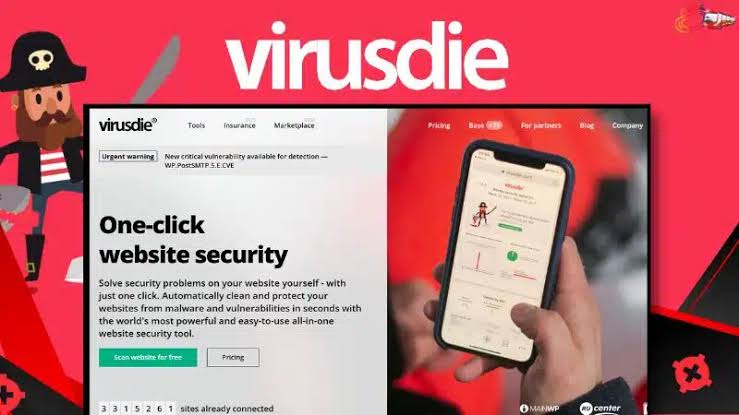
Virusdie takes the opposite approach to Burp Suite: one click, and the platform handles everything. Automatic cleanup removes malware and patches vulnerabilities in seconds, and a consolidated dashboard combines every hosting platform and security feature onto a single screen. For owners managing multiple sites across different hosts, that unified view saves real time.
The protection covers malware, XSS and SQL injections, dangerous code uploads, suspicious activity, and blocklist monitoring. Packages start at $15 per month, making Virusdie the most affordable tool on this list and a sensible entry point for small businesses and individual site owners who need competent protection without a learning curve.
The best website security tool in 2026 depends on what you're protecting. WordPress sites get the strongest value from Wordfence at $99 per year. Businesses that want cleanup handled for them should look at Sucuri or SiteLock. Enterprises running custom applications need Imperva, Invicti, or Acunetix in the pipeline. And Cloudflare remains the default network-layer defense for anyone who wants serious DDoS protection at $20 per month.
What's clear from the 2026 ratings is that the market has stratified. Cheap tools now handle basics competently, and the premium tier competes on validation accuracy, bot mitigation, and incident response rather than raw scanning. Matching the tool to the threat model matters more than chasing the highest rating.
Related Posts




0 Comments
Join the discussion and share your thoughts
No Comments Yet
Be the first to share your thoughts on this article!