Top 10 Best Threat Intelligence Services In USA 2026

Table of Contents
The threat intelligence market has matured considerably over the past several years. What was once a niche category reserved for government agencies and the largest financial institutions has become a core component of enterprise security operations. As of early 2026, organizations face a threat landscape defined by AI-generated phishing campaigns, increasingly sophisticated ransomware operations, and state-sponsored actors targeting critical infrastructure with greater frequency.
To build this ranking, we weighed several factors across the leading providers. We examined each platform's data collection capabilities, the depth and accuracy of its analysis, integration options with existing security tools, and real-world performance as reflected in user reviews on Gartner Peer Insights and other verified sources. We also considered each provider's track record in incident response engagements, the size and expertise of its analyst teams, and its ability to support both mature security operations centers and organizations still building out their threat intelligence capabilities. Pricing transparency and deployment flexibility factored into the rankings as well, particularly for organizations evaluating open-source alternatives.
This list reflects the providers we believe offer the strongest combination of intelligence quality, platform usability, and operational value for American enterprises, government agencies, and security teams of all sizes.
The Top 10 Best Threat Intelligence Services In USA 2026:
1. Recorded Future
Recorded Future holds the top position for good reason. The company's Intelligence Platform serves more than 1,800 organizations globally, and its 4.9 out of 5 average rating on Gartner Peer Insights reflects consistent user satisfaction across enterprise deployments. The platform combines machine learning with human analyst validation to deliver real-time intelligence on IPs, domains, threat actors, and emerging campaign activity.
What sets Recorded Future apart is the sheer breadth of its data collection. The platform indexes millions of sources across the open web, dark web, and technical sources, then applies natural language processing to extract structured intelligence from unstructured data. Users consistently highlight the accuracy of its malicious domain and IP identification, along with a watchlist function that requires minimal setup and delivers complete monitoring coverage.
For organizations with mature security operations centers, the Fusion module automates intelligence operations, enabling teams to route relevant threat data directly into their existing workflows. That automation capability, combined with the platform's scalability, makes Recorded Future particularly well suited for large enterprises and government agencies that need to operationalize intelligence at scale.
2. Mandiant (Google Cloud)

Mandiant brings something to the table that few other providers can match: direct visibility into active intrusions. With over 2,000 threat intelligence analysts and more than 500 incident responders on staff, the company builds its intelligence from real-world attack engagements rather than purely from external monitoring. Its attribution data on more than 1,000 threat actors is among the most comprehensive in the industry.
The Mandiant Advantage Platform provides a centralized interface for consuming intelligence, validating security controls, and managing attack surface exposure. Organizations that need to connect disparate attack campaigns to specific threat groups will find Mandiant's attribution analysis particularly valuable. The company's analysts tie together technical indicators, behavioral patterns, and geopolitical context to identify who is behind an attack and what they are likely to do next.
Native integration with Google Cloud Security services makes Mandiant an especially strong choice for organizations running cloud-native environments. And for agencies or enterprises that need surge capacity during an active incident, Mandiant's incident response and retainer services provide on-demand access to specialists who already understand the threat landscape.
3. CrowdStrike Falcon Intelligence
CrowdStrike's intelligence capabilities are built on an extraordinary data foundation. The Falcon platform processes more than 1 trillion events daily across 190 countries, giving CrowdStrike visibility into adversary activity that most providers simply cannot match. That telemetry feeds directly into Falcon Intelligence, which carries a 4.8 out of 5 average rating on Gartner Peer Insights.
The platform's strength lies in its integration between intelligence and endpoint protection. Falcon X automates malware analysis and links intelligence directly to endpoint activity, so security teams can see not just what indicators are relevant, but how those indicators relate to activity on their own systems. Attribution data and attacker behavior profiles are presented in context, reducing the time analysts spend correlating disparate data points.
For organizations that lack the internal resources for continuous threat hunting, Falcon OverWatch provides 24/7 managed hunting backed by the same intelligence that powers the broader Falcon platform. This combination of automated intelligence enrichment and human-led investigation makes CrowdStrike a compelling option for mid-sized and large enterprises alike.
4. Cyware Threat Intelligence Platform
Cyware takes a different approach than the traditional intelligence feed providers. Rather than simply delivering threat data, the Cyware Threat Intelligence Platform is designed to help CTI teams convert intelligence into actionable context that supports SOC investigations, threat hunting, incident response, and detection engineering. It earned the top spot in Cyware's own 2026 editorial shortlist of threat intelligence platforms, and it is widely used by intelligence-sharing communities.
The platform's core strength is its ability to connect intelligence management with security operations. Organizations can distribute intelligence among trusted participants, automate the flow of threat data into detection and response tools, and maintain a centralized repository of threat actor research and campaign analysis. Cyware supports malware analysis, cyber exposure analysis, strategic intelligence, and intelligence sharing across organizational boundaries.
Security teams that are drowning in alerts and manual correlation work will appreciate the platform's automation capabilities. Cyware helps focus limited analyst resources on the threats that matter most, rather than spending hours triaging low-fidelity indicators.
5. IBM X-Force Threat Intelligence
IBM X-Force combines one of the largest commercial security research teams in the world with deep incident response expertise. More than 200 analysts across 30 countries monitor over 100 billion security events daily, and the X-Force Exchange community connects more than 100,000 security professionals sharing threat data and intelligence.
The human element is where IBM differentiates itself. When evidence is incomplete or an organization needs help understanding what a particular threat means for its specific environment, IBM's analysts provide the context that automated platforms often miss. This makes X-Force a strong option for enterprises with limited internal CTI capacity that want analyst expertise alongside their existing security operations.
X-Force Exchange deserves particular mention. The collaborative platform allows security teams to share threat data while accessing curated intelligence from IBM's research team. That combination of community-driven intelligence and professional analysis creates a feedback loop that improves the quality of intelligence for all participants.
6. Anomali Threat Intelligence Platform
Anomali, headquartered in Redwood City, California, has built its reputation on intelligence management and automation. The platform monitors more than 500 million threat indicators daily, collecting and correlating data from open-source, commercial, and government feeds to provide a unified view of the threat landscape.
The Match engine is one of the platform's standout features. It enables real-time correlation of internal security events against known threat indicators, so organizations can immediately identify when activity on their networks matches known malicious behavior. This reduces the time between initial compromise and detection, which is critical given that the average dwell time for intrusions remains a significant concern across the industry.
Anomali supports both cloud and on-premises deployment models, with enterprise licensing that scales based on organizational size and automation requirements. That flexibility makes it a practical choice for organizations with specific data residency or compliance requirements.
7. ThreatConnect
ThreatConnect has established itself as a trusted platform for organizations that need to operationalize threat intelligence across complex security environments. More than 7,000 users globally, including over 40 Fortune 100 companies, rely on the platform, and it maintains a strong presence among government agencies and critical infrastructure providers.
The platform's security orchestration features enable automated threat intelligence distribution across security tool ecosystems while maintaining consistent data formats and attribution standards. Organizations can develop custom playbooks that incorporate threat intelligence directly into response workflows, enabling rapid containment and mitigation actions when an alert fires.
ThreatConnect's integration ecosystem is among the most extensive in the industry. The platform connects with hundreds of security tools through APIs, webhooks, and pre-built applications, so organizations can extend intelligence to their existing investments without rip-and-replace projects. For security teams that want to maximize the value of their current tool stack, ThreatConnect provides the connective tissue.
8. Kaspersky Threat Intelligence
Kaspersky's threat intelligence offering is built on one of the largest malware telemetry networks in the world. Data from more than 400 million devices feeds the company's research, providing visibility into malware distribution, exploit chains, and adversary infrastructure that few providers can replicate.
What distinguishes Kaspersky is the depth of its technical research. The company's analysts produce detailed reporting on advanced persistent threats, exploit chains, infrastructure mapping, and adversary attribution. Unlike basic IOC feeds that simply list indicators, Kaspersky provides technical context around malware behavior, campaign evolution, and the geopolitical motivations of threat actors.
The service provides real-time protection against malware and ransomware, detecting and mitigating threats through behavioral analysis and machine learning. For organizations that want intelligence grounded in deep reverse-engineering research, Kaspersky remains a formidable option.
9. Rapid7 Threat Command
Rapid7 Threat Command focuses on external threat intelligence and digital risk protection, monitoring more than 300,000 sources across the dark web, deep web, and clear web. The platform collects and analyzes threat data from hacker forums, marketplaces, paste sites, and other sources where attackers discuss their activities and trade stolen data.
For organizations concerned about data leaks, brand compromise, and emerging threats discussed in underground communities, Threat Command provides real-time alerts that enable rapid response. The platform's analytics capabilities also offer insights into threat intelligence effectiveness, helping security teams understand which intelligence is driving operational improvements.
Integration with existing security tools is straightforward through APIs and pre-built connectors. Rapid7 positions Threat Command as a complement to internal security operations, providing the external visibility that many organizations lack.
10. OpenCTI
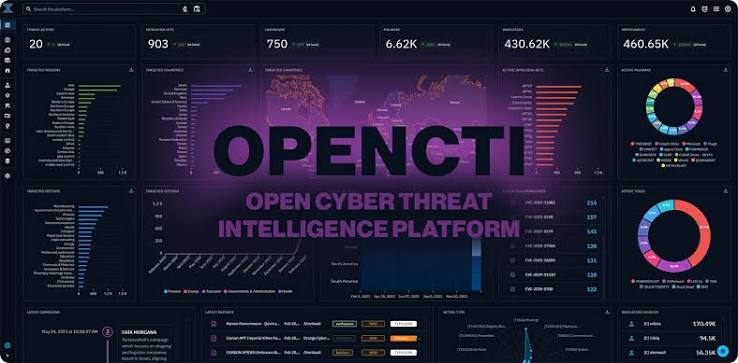
OpenCTI rounds out our list as the leading open-source threat intelligence platform. With more than 10,000 GitHub stars and an active community of contributors, the platform provides a comprehensive framework for managing threat intelligence data, including threat actors, campaigns, indicators, and attack patterns.
The platform supports STIX/TAXII standards for intelligence sharing and integrates with more than 100 security tools. Its intuitive interface and powerful search functions make it easy for users to extract valuable insights from stored data, and the flexibility of the open-source model allows organizations to customize the platform to their specific needs.
For organizations with technical expertise and limited budgets, OpenCTI offers a compelling alternative to commercial platforms. The tradeoff is that organizations must invest in the engineering resources to deploy, maintain, and customize the platform. But for those willing to make that investment, OpenCTI delivers enterprise-grade intelligence management at a fraction of the cost of commercial alternatives.
Selecting a threat intelligence provider is not a one-size-fits-all decision. Organizations with mature security operations centers and dedicated CTI teams may benefit most from platforms like Recorded Future or Cyware that emphasize automation and workflow integration. Government agencies and enterprises facing sophisticated, well-resourced adversaries should give serious consideration to Mandiant's attribution capabilities and incident response expertise.
Related Posts



0 Comments
Join the discussion and share your thoughts
No Comments Yet
Be the first to share your thoughts on this article!