Top 10 Best Kubernetes Tools In The World 2026

Table of Contents
The Kubernetes ecosystem in 2026 is vast, complex, and constantly shifting. For platform engineers, site reliability engineers, and DevOps teams, choosing the right tools is no longer a luxury; it is a prerequisite for maintaining velocity, reliability, and security at scale. We have surveyed the landscape, analyzing GitHub activity, community engagement, enterprise adoption rates, and real-world user feedback to identify the tools that have proven indispensable. This ranking takes into account not just raw popularity, but also each tool's ability to solve specific, persistent challenges in production environments. From monitoring and deployment to service mesh and management, these ten tools represent the current standard for operating Kubernetes effectively in 2026.
These Are The Top 10 Best Kubernetes Tools In 2026:
1. Prometheus
Prometheus remains the undisputed cornerstone of Kubernetes observability. With over 54,000 GitHub stars and a community of more than 900 contributors, it is the de facto standard for monitoring and alerting in cloud-native environments. Its strength lies in its purpose-built design for dynamic, containerized workloads. Prometheus collects time-series data from instrumented services, and its powerful PromQL query language allows teams to slice and dice that data for performance monitoring, capacity planning, and deep diagnostics. Its native integration with Kubernetes means it automatically discovers services and pods, scraping metrics without manual configuration. The built-in Alertmanager ensures that teams are notified the moment anomalies are detected, making it an essential component for any serious production cluster. In 2026, Prometheus is not just a tool; it is the foundation upon which most observability stacks are built.
2. Argo CD

Argo CD has become the standard-bearer for GitOps-driven continuous delivery on Kubernetes. Boasting over 29,000 GitHub stars and more than 850 contributors, it treats Git repositories as the single source of truth for application and infrastructure configurations. Argo CD continuously monitors the live state of a cluster against the desired state defined in Git. When discrepancies are detected, it can automatically sync the cluster to match the repository, providing a powerful mechanism for drift detection and correction. This declarative approach eliminates the risk of configuration drift and enables teams to manage multi-cluster deployments with confidence. Its support for multiple configuration formats and automated rollback capabilities makes it a critical tool for teams that have adopted a rigorous GitOps workflow. For organizations seeking to standardize and automate their deployment pipelines, Argo CD is the definitive choice.
3. k3s
K3s has carved out a unique and vital niche as the lightweight Kubernetes distribution for resource-constrained environments. With over 27,000 GitHub stars and an impressive 1,850 contributors, it dramatically reduces the footprint of a standard Kubernetes cluster without sacrificing essential functionality. Designed specifically for edge computing, IoT devices, and development environments with limited resources, k3s can run efficiently on a single Raspberry Pi or a small VM. Despite its smaller size, it maintains full compatibility with standard Kubernetes APIs and tools, meaning that applications and configurations designed for a full-scale cluster will work on k3s without modification. This makes it an ideal choice for development and testing scenarios, as well as for production deployments at the edge. In 2026, k3s is the go-to solution for teams that need Kubernetes where it was never thought possible.
4. Grafana
Grafana is the visualization layer that brings Kubernetes metrics to life. With over 10,000 GitHub stars and 350 contributors, it has become the de facto standard for building rich, interactive dashboards that make sense of the data collected by Prometheus and other data sources. Grafana enables teams to observe cluster statistics, application performance, and infrastructure health through a single, unified interface. Its extensive plugin ecosystem allows it to connect to a wide range of data sources, from time-series databases to cloud monitoring services. The alerting capabilities are deeply integrated, allowing teams to define complex notification rules based on dashboard queries. In 2026, no observability stack is complete without Grafana. It is the tool that transforms raw metrics into actionable insights, making it indispensable for anyone responsible for the health of a Kubernetes environment.
5. Helm
Helm is the original package manager for Kubernetes, and its importance has only grown as the ecosystem has matured. It provides a standardized way to define, install, and upgrade complex Kubernetes applications through reusable chart packages. Helm charts encapsulate all the YAML manifests, configuration options, and dependencies required to deploy an application. This enables teams to manage third-party software with a single command and provides versioned releases with straightforward rollback capabilities. The vast public chart ecosystem means that most popular open-source projects can be deployed with a single helm install command. For organizations that need to standardize deployments across multiple environments, Helm is the essential tool. It simplifies the management of application lifecycles and ensures consistency from development through production.
6. K9s
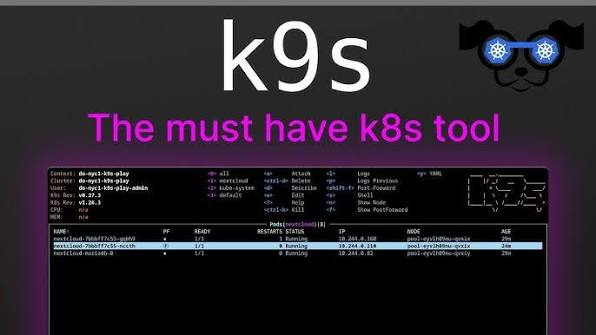
K9s is a terminal-based user interface that has become a favorite among engineers who live in the command line. It provides a fast, keyboard-driven way to navigate and troubleshoot Kubernetes clusters without typing complex kubectl commands. K9s offers real-time cluster visualization, pod metrics, log streaming, and one-click port-forwarding through a clean, intuitive interface. It is particularly valuable for rapid cluster state inspection during incident response. Instead of running multiple kubectl commands to find a pod, view its logs, and port-forward to it, an engineer can do all of that with a few keystrokes in K9s. In 2026, it remains a critical tool for developers and operators who need to move quickly and efficiently, making cluster management feel less like a chore and more like a fluid interaction.
7. Istio
Istio is the leading open-source service mesh for Kubernetes, providing a dedicated infrastructure layer for managing service-to-service communication. Built on the Envoy proxy, Istio abstracts the underlying networking environment and provides application-aware traffic management, security, and observability. It enables teams to implement fine-grained traffic routing, canary deployments, and circuit breaking without modifying application code. Istio also provides mutual TLS encryption between services, ensuring that all inter-service communication is secure. For organizations running complex microservices architectures, Istio offers a level of control and insight that is simply not possible with plain Kubernetes Services. In 2026, as microservices continue to proliferate, Istio is the standard choice for teams that need to manage traffic, enforce policies, and gain deep visibility into their service mesh.
8. Red Hat OpenShift
Red Hat OpenShift is the leading enterprise Kubernetes platform, delivering a hardened, production-ready environment that goes beyond the open-source Kubernetes distribution. It combines automated operations with robust security controls, integrated developer tools, and built-in CI/CD pipelines. OpenShift is designed for organizations that need to manage complex Kubernetes environments at scale, supporting hybrid cloud, on-premises, and edge deployments. Its security features include built-in role-based access control, security context constraints, and vulnerability scanning. With a G2 rating of 4.5 out of 5 and pricing ranging from $150 to $500 per core per year, it is a significant investment. However, for enterprises that require a complete, supported platform with a strong focus on security and developer productivity, OpenShift remains the gold standard.
9. Portainer
Portainer has emerged as a leading self-hosted Kubernetes management platform, providing engineers with a single pane of glass to manage Kubernetes, Docker, and Podman environments. Its intuitive interface and built-in guardrails reduce operational complexity, making Kubernetes more accessible to teams with limited experience. Portainer supports multi-cluster management with centralized RBAC, audit trails, and policy-driven access control. This unified approach simplifies the management of diverse container environments and accelerates Kubernetes adoption. With a G2 rating of 4.8 out of 5 and enterprise plans starting at $9,995 per year, it is a powerful tool for organizations that want to streamline container management without sacrificing control. In 2026, Portainer is the go-to solution for teams that need to manage multiple container platforms from a single, easy-to-use dashboard.
10. Lens
Lens is a client-side desktop IDE that provides developers and platform engineers with immediate, visual access to their Kubernetes clusters. It eliminates the need to type complex CLI commands for common tasks, offering pod metrics, live logs, cluster event streams, one-click port-forwarding, and direct shell access through a clean, modern interface. Lens makes multi-cluster context-switching practical and intuitive. It serves as an individual developer observability tool that complements server-side cluster managers, making Kubernetes more accessible for day-to-day development and troubleshooting. For engineers who want a visual, interactive way to work with Kubernetes without the overhead of a full web-based dashboard, Lens is the ideal solution. It remains a staple on the desktops of countless Kubernetes practitioners in 2026.
These ten tools represent the current state of the art for operating Kubernetes in 2026. From monitoring and deployment to service mesh and management, each addresses a specific pain point in the lifecycle of a cloud-native application. As the ecosystem continues to evolve, these tools have proven their value through sustained community support, enterprise adoption, and a clear focus on solving real-world problems. For any organization running Kubernetes at scale, investing in this toolchain is a strategic decision that pays dividends in reliability, velocity, and operational efficiency.
Related Posts


1 Comment
Join the discussion and share your thoughts