InsForge Review in 2026: Pricing, Funding, Logo, Alternatives, & FAQs

Table of Contents
If you have spent any time on Hacker News, Product Hunt or Twitter in the last few months, you have probably seen the name InsForge popping up beside conversations about Cursor, Claude Code, Windsurf and the whole vibe coding movement. The pitch is simple. Build a backend that AI coding agents can actually configure on their own, the way Supabase did for human developers a few years ago. We at Nubia Magazine spent several weeks digging into the platform, talking to early users, reading the GitHub issues, testing the cloud version and comparing it side by side with the giants in the space.
This is our honest, no nonsense review of InsForge as it stands in 2026. We covered the pricing, the funding history, the logo and brand positioning, the credible alternatives, the user experience, and we ended with the most common questions people are typing into Google about the brand right now. Settle in, because there is a lot to unpack.
What Is InsForge?
InsForge is an open source backend development platform built specifically for AI coding agents and AI code editors. Most existing backend tools, including the popular ones like Supabase and Firebase, were designed to be used by humans clicking through dashboards. InsForge flips that idea on its head. The platform exposes its core services, which include a Postgres database, authentication, file storage, edge functions and a model gateway, through a semantic layer that AI agents can read, reason about and operate end to end.
In practice, this means a developer using Cursor, Claude Code or Windsurf can describe an application in plain English and the agent will provision the database, set up authentication, configure storage buckets and wire everything together without the human ever touching a dashboard. The platform connects to these editors through what is known as a Model Context Protocol server, often shortened to MCP. The MCP server has become something of a standard since Anthropic released the protocol in late 2024, and InsForge has built its entire architecture around it.
The company describes itself as the backend for AI native builders, and that tagline captures the philosophy. InsForge is not trying to be the best backend for senior engineers who want fine grained control. It is trying to be the easiest backend for a generation of developers who treat coding agents as their primary collaborator.
InsForge Company Profile Table
Before we go any further, here is the snapshot of the brand as of 2026, pulled from public records, the official site, Crunchbase, PitchBook and Y Combinator filings.
Company Name | InsForge AI, Inc. |
Founded | 2025 |
Founders | Hang Huang (CEO) and Tony Chang (CTO) |
Headquarters | San Francisco, California, USA (with Seattle ties) |
Industry | Backend-as-a-Service (BaaS), AI Infrastructure |
Y Combinator Batch | Spring 2026 (P26) |
Funding Raised | Approximately 1.5M to 2M (Pre-Seed) |
Notable Investor | Baidu Ventures (among others, undisclosed) |
Team Size | Around 6 to 8 employees |
Open Source License | Apache 2.0 |
Free Plan | Yes (paused after 1 week of inactivity) |
Pro Plan | $25 per month |
Enterprise Plan | Custom pricing (SOC2, HIPAA, SSO) |
Website | insforge.dev |
Nubia Magazine Rating | 2.7 out of 5 |
InsForge Logo and Brand Identity
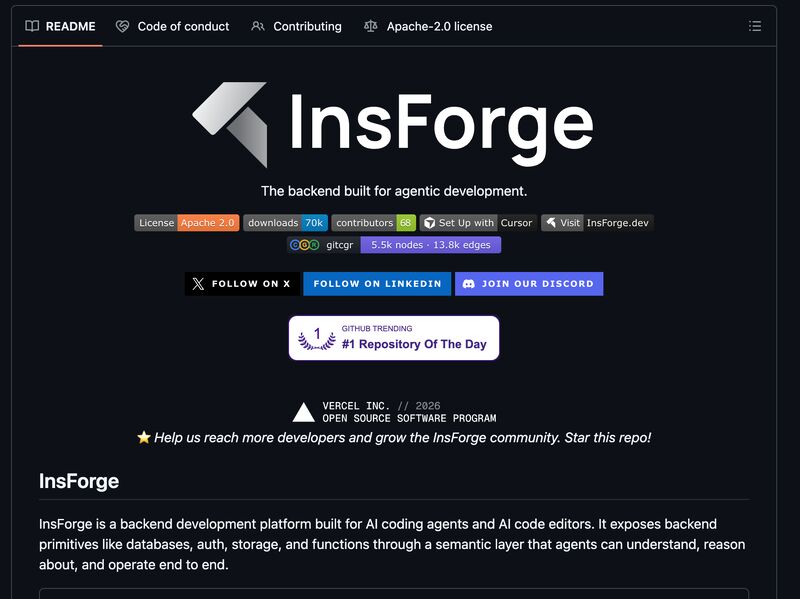
The InsForge logo is clean, minimal and clearly aimed at a developer audience. It uses a simple wordmark style, with the brand name rendered in a modern sans serif font alongside a small geometric mark. The colour palette leans toward a soft purple and dark navy combination on the marketing site, which gives the brand a slightly futuristic but not overly aggressive feel. There is no flashy mascot, no animated icon, just a quietly confident logo that fits the kind of infrastructure tool serious developers expect.
Honestly, this is one of the areas where the brand still has room to grow. The logo is functional but does not have the instant recognisability of a Supabase green or the Firebase flame. For a young startup, that is not unusual, and it may be a deliberate choice to keep things low key while the product matures. Our take is that the brand identity is competent but forgettable. It does not hurt the company, but it also does not help it stand out in a crowded developer tools market.
Founding Story and Funding History
InsForge was founded in 2025 by two co-founders with very different backgrounds. Hang Huang serves as the Chief Executive Officer. He is a former Amazon product manager and Yale MBA graduate who, in a fun side note, was once a professional League of Legends player. Tony Chang serves as the Chief Technology Officer. He came from Databricks where he worked on networking infrastructure, and before that he interned on machine learning infrastructure teams at Meta and on backend infrastructure at Amazon. He is also, by his own admission, something of a hackathon addict with multiple wins under his belt.
The company is part of the Y Combinator Spring 2026 batch, often referred to in YC shorthand as P26. In terms of funding, the public picture is a little mixed depending on which database you check. Public reporting and the founders' own statements indicate a Pre-Seed round of around 1.5 million dollars, with Crunchbase listing Baidu Ventures as one of the investors. PitchBook puts the total raised at closer to 2 million dollars, which likely includes the YC investment that comes standard with the batch.
Either way, this is a small, focused team operating on a tight runway. The team size sits at about six to eight people, and they are based primarily in San Francisco with some Seattle connections. This is a David versus Goliath story, and the team is fully aware of it. Supabase, the company most people compare them to, is valued at over 20 billion dollars and has hundreds of employees. InsForge is betting that being small and agent-native is an advantage rather than a weakness.
InsForge Pricing in 2026
Pricing is one of the cleanest parts of the InsForge experience. The company offers three tiers, and the structure is easy enough that you can decide which one fits your project in about two minutes.
Plan | Price | Best For | Key Limits |
Free | $0 / month | Prototypes and side projects | 500MB DB, 5GB bandwidth, 1GB storage, paused after 1 week idle |
Pro | $25 / month | Production apps that scale | 8GB DB, 250GB bandwidth, 100GB storage, $10 AI credits monthly |
Enterprise | Custom | Teams with compliance needs | SOC2, HIPAA add-on, SSO, dedicated support |
The Free Plan
The Free plan is genuinely free, which is rare enough in 2026 to be worth pointing out. You get 500MB of database storage, 5GB of bandwidth, 1GB of file storage and one dollar in AI model credits to play around with the model gateway. The catch, and there is always a catch, is that free projects are paused after one week of inactivity. For a hobby project or a weekend hackathon, that is fine. For anything you want to leave running quietly in the background, you will be poked into upgrading.
The Pro Plan
At 25 dollars per month, the Pro plan is positioned as the sweet spot for production apps. You get 8GB of database storage, 250GB of bandwidth, 100GB of file storage and 10 dollars worth of AI credits each month. After you exceed the included limits, the platform charges per use. The pricing for additional usage is reasonable, with bandwidth at about 9 cents per gigabyte and additional database storage at 12.5 cents per gigabyte. One thing worth noting, the Model Gateway, which routes requests to AI providers like OpenAI and Anthropic, is billed at cost with zero markup. That is a developer friendly choice that we appreciated.
The Enterprise Plan
Enterprise pricing is custom and aimed at teams that need SOC2 compliance, HIPAA support as a paid add-on, single sign on and unlimited projects. There is also dedicated technical support, which is increasingly important for teams running mission critical workloads on a young platform. The pricing is not published, which is normal for this tier, but expect to talk to sales and negotiate based on usage.
User Experience and Real World Impressions
This is the section where we have to be a little more critical, because the InsForge experience is genuinely interesting but it is not all roses. We tested the cloud version with both Cursor and Claude Code, and we also tried the self-hosted Docker setup.
What Works Well
When the agent integration works, it feels almost magical. We asked Claude Code to build a task management application with real time updates, image storage and OAuth login. The agent fetched the InsForge documentation through the MCP server, configured the database schema, set up authentication with Google as a provider, created a storage bucket for images and wired everything to the React frontend. The whole thing took about twenty minutes from prompt to working application. For the kind of developer who wants to ship fast without becoming a Postgres expert, this is a powerful experience.
The benchmarks back up the developer testimonials. InsForge published a study using the open source MCPMark benchmark which showed the platform completing database tasks 1.6 times faster than Supabase MCP, using about 30 percent fewer tokens, and hitting a Pass at 4 accuracy of 47.6 percent compared to 28.6 percent for Supabase. Now, we have to flag the obvious. This benchmark was created by InsForge to test InsForge, and the sample size of 21 tasks is small. Treat the numbers as directional rather than gospel. Still, the gap is wide enough to be meaningful.
What Falls Short
Setup for the self-hosted version is more complex than the marketing suggests. You need Docker, Node.js, an understanding of environment variables and the patience to read the GitHub repository when things go wrong. Several early adopters reported friction here, and InsForge has acknowledged this by pushing the cloud version as the recommended path for most users.
The community is also still small. Compared to Supabase with its 99,000 plus GitHub stars, thousands of tutorials and active Discord, InsForge has roughly 2,500 stars and a much thinner ecosystem of community resources. If you run into a strange bug at 2 in the morning, you may find yourself reading source code rather than Stack Overflow answers. The team is responsive on Discord, but a six person team can only do so much.
Documentation has gaps. We hit several spots where the docs assumed familiarity with Postgres internals or with the MCP protocol that newer developers will not have. The team is iterating on this, and the pace of updates is impressive, but it is a real concern today.
Finally, the platform is young enough that some features feel rough around the edges. Backend branching, project memory, the AI Backend Advisor and multi region support were all promised on the roadmap for early 2026 and some are still rolling out. If your project depends on any of those, you may want to wait.
InsForge Alternatives Worth Considering
InsForge is one player in an increasingly crowded category. Depending on what you are building and what tradeoffs matter to you, here are the main alternatives to weigh.
Supabase
The obvious comparison. Supabase is the open source Firebase alternative that pioneered the Postgres backed BaaS model. It has a massive community, a polished dashboard, deep PostgreSQL extension support including pgvector for embeddings, and a mature MCP server that was added on top of its existing architecture. If you want a battle tested platform with a proven track record, Supabase is hard to beat. The trade off is that it was designed for humans first, and agents second.
Firebase
Google's proprietary BaaS is still a strong choice for mobile apps and prototypes that need real time NoSQL synchronisation and social authentication. It has a generous free tier and a mature SDK ecosystem. The downsides are vendor lock in, NoSQL constraints and pricing that can balloon at scale due to read and write charges plus egress fees.
Convex
Convex offers a different take on the AI ready backend, with a reactive database and serverless functions written in TypeScript. It has been gaining traction with developers who want strong type safety and real time queries baked into the data layer. It is closed source, which is a deal breaker for some teams.
Appwrite
An open source alternative with strong Docker based self-hosting and a clean dashboard. Appwrite is human centric like Supabase, without an agent native architecture. If you prioritise self-hosting simplicity over AI integration, it deserves a look.
Xano and Backendless
Both are no code or low code BaaS platforms aimed at non-developers and citizen builders. They are not direct competitors to InsForge in terms of philosophy, but they are alternatives if you want a visual logic builder rather than agent-driven development.
Nhost
Nhost is a GraphQL first BaaS built on Postgres and Hasura. If your team prefers GraphQL over REST, this is a strong open source option.

Frequently Asked Questions About InsForge in 2026
These are the questions we saw coming up most often across Reddit, Hacker News, Quora, X, Discord and Google search trends as of May 2026.
1. Is InsForge actually free to use?
Yes, the Free plan is genuinely free with no credit card required, and it includes 500MB of database storage, 5GB of bandwidth, 1GB of file storage and one dollar in AI credits. The main catch is that free projects are paused after one week of inactivity. For active hobby projects this is rarely a problem, but for anything you want to set and forget, you will need the Pro plan at 25 dollars per month.
2. Who founded InsForge and where is the company based?
InsForge was founded in 2025 by Hang Huang and Tony Chang. Hang serves as Chief Executive Officer and previously worked as a product manager at Amazon. He also has a Yale MBA. Tony serves as Chief Technology Officer and previously worked as a software engineer at Databricks on networking infrastructure. The company is headquartered in San Francisco and is part of the Y Combinator Spring 2026 batch.
3. How much funding has InsForge raised?
Public sources put the total raised at between 1.5 million and 2 million dollars in a Pre-Seed round. Crunchbase lists Baidu Ventures as one of the disclosed investors, and the rest of the round details remain undisclosed. The Y Combinator standard investment is also part of the total. This is a small runway by Silicon Valley standards, and observers have flagged it as one of the key risks for the company.
4. Is InsForge actually open source?
Yes, the platform is licensed under Apache 2.0, and the full source code is available on GitHub. You can self-host the entire platform using Docker Compose, with one click deployment options on Railway and Zeabur. The cloud version at insforge.dev is the managed offering that the company sells, but you are not locked into it.
5. How does InsForge compare to Supabase in 2026?
The short answer is that they are built for different workflows. Supabase is the more mature, more popular and more battle tested platform, with a polished dashboard designed for humans. InsForge is younger, smaller and built from the ground up for AI coding agents through a native MCP server. If you operate your backend manually, Supabase is the safer choice. If your AI agent operates the backend on your behalf, InsForge is built for that exact workflow and benchmarks suggest it performs noticeably better in agent driven tasks. Both run on Postgres.
6. What AI coding agents work with InsForge?
InsForge integrates with any AI coding agent or editor that supports the Model Context Protocol. As of 2026, this includes Cursor, Claude Code, Windsurf, OpenAI Codex, GitHub Copilot CLI, Gemini CLI and Antigravity. The setup involves running the InsForge MCP server locally or in the cloud, then connecting your editor of choice through a standard configuration. The official documentation walks through each editor in detail.
7. Is InsForge safe to use in production?
Cautiously yes, with some caveats. The platform encrypts authentication data, enforces Row Level Security policies on database access, validates sensitive operations on the server rather than trusting client input, and uses presigned URLs for storage. SOC2 compliance is available on the Enterprise plan, and HIPAA is offered as a paid add-on. The main caveat is that this is still a very young platform from a six to eight person team. For mission critical production workloads, evaluate carefully and consider running important services on more established infrastructure until InsForge matures further.
8. What are the biggest weaknesses of InsForge today?
Three things stand out. First, the team is tiny and the funding runway is short, which raises legitimate questions about long term sustainability. Second, the community and ecosystem are much smaller than Supabase or Firebase, so you will find fewer tutorials and Stack Overflow answers when you get stuck. Third, the self-hosted setup is more complex than the marketing suggests, and several features on the roadmap are still rolling out. None of these are dealbreakers, but they are real and worth knowing before you commit a large project.
9. Does InsForge support real time updates and websockets?
Yes. Real time subscriptions are a first class feature, and they are exposed to AI agents through the same semantic layer as the rest of the backend. In our testing, agents were able to wire up real time updates between connected clients without any manual websocket configuration. The feature works well for chat applications, collaborative tools and live dashboards.
10. Where can I get help and support if I run into trouble?
The primary community channels are the InsForge Discord server and the GitHub Discussions section on the official repository. The team also accepts direct emails at [email protected]. For Enterprise customers, dedicated technical support is included. Response times on Discord have been reasonable in our experience, though as with any small team, expect occasional delays during off peak hours.
Nubia Magazine Verdict
InsForge is one of the most interesting young startups in the developer tools space right now. The agent native philosophy is a genuine bet on where software development is heading, and the team is shipping at an impressive pace. The pricing is fair, the open source license is real, and the early benchmarks suggest the platform actually delivers on its core promise.
That said, it is still early days. The team is small, the runway is tight, the community is thin, and the documentation has gaps. For a hobby project, a hackathon or a startup willing to bet on a young platform, InsForge is a solid pick. For a mission critical production system at a larger company, we would recommend keeping a close eye on the roadmap and waiting another six to twelve months for the platform to mature, or sticking with Supabase or Firebase for now.
Our final rating, based on product quality, pricing, user experience, ecosystem maturity and overall risk, is 2.7 out of 5. That is not a bad score for a startup that is barely a year old. It reflects strong potential held back by the very real growing pains of an early stage company. If InsForge raises a stronger round, expands the team and continues to ship at this pace, we fully expect that score to climb in our next review.
Related Posts




1 Comment
Join the discussion and share your thoughts