Top 10 Best Low Code Development Platforms In The World 2026


Table of Contents
To identify the top low-code development platforms for 2026, we evaluated each tool across five dimensions: enterprise readiness, user satisfaction (based on verified G2 ratings), breadth of use cases, pricing accessibility, and community strength. We weighted governance depth and scalability most heavily for enterprise buyers while also considering specialized platforms that excel in narrower domains like internal tooling or process automation. The resulting list reflects a mix of full-stack enterprise suites and purpose-built tools that lead their respective categories.
The List Of The Top 10 Best Low Code Development Platforms In The World 2026:
1. OutSystems
OutSystems remains the benchmark for enterprise-scale low-code development. With a 4.6 out of 5 rating on G2, it consistently ranks as the top choice for organizations building mission-critical applications that demand full-stack capabilities, rigorous governance, and enterprise-grade security. The platform combines visual development with workflow automation, allowing teams to deliver complex applications while maintaining control over deployment standards and compliance requirements.
What sets OutSystems apart in 2026 is its ability to handle the full lifecycle of enterprise software delivery. Organizations using OutSystems report faster time-to-market for internal and customer-facing applications without sacrificing the architectural control that large IT departments require. The platform supports everything from simple forms to sophisticated systems that integrate with existing ERP and CRM infrastructure. For companies that need a single platform to govern their entire application portfolio, OutSystems offers the deepest set of enterprise controls available.
2. Mendix
Mendix holds a 4.4 out of 5 G2 rating and starts at roughly $60 per month for its basic tier, making it a direct enterprise competitor to OutSystems. The platform is built around a model-driven approach that encourages collaboration between business analysts and professional developers. This structure allows organizations to maintain governed application portfolios while enabling non-technical stakeholders to participate in the development process.
The platform excels in environments where structured development lifecycle management matters. Mendix provides strong version control, testing frameworks, and deployment automation that align with enterprise IT standards. While OutSystems edges ahead on overall governance depth in 2026 comparisons, Mendix remains a top choice for companies that want a balance between developer control and business-user accessibility. Its pricing model also makes it more approachable for mid-market organizations that need enterprise features without the highest-tier investment.
3. Microsoft Power Apps
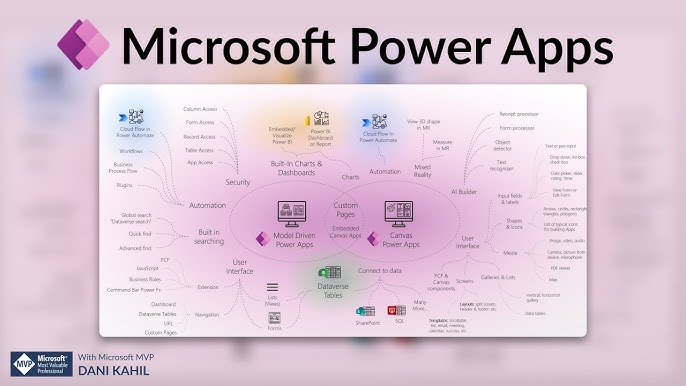
Microsoft Power Apps carries a 4.3 out of 5 G2 rating and offers premium plans at $20 per user per month. For organizations already invested in the Microsoft ecosystem, Power Apps is the most natural low-code choice available. It integrates directly with Microsoft 365, Dynamics 365, and Azure, allowing teams to build apps that pull data from SharePoint, Teams, and other Microsoft services without complex API configuration.
The platform is best suited for internal business applications such as approval workflows, data entry forms, and department-specific dashboards. Organizations standardized on Microsoft infrastructure find Power Apps dramatically reduces development time compared to traditional coding approaches. However, the platform's value is strongest within the Microsoft ecosystem. Companies using diverse technology stacks may find the integration benefits less compelling than the broader capabilities offered by OutSystems or Mendix. For Microsoft-centric organizations, though, Power Apps delivers exceptional productivity gains with minimal learning curve.
4. Appian
Appian achieves a 4.5 out of 5 G2 rating and is specifically positioned for process automation and regulated workflows. The platform differentiates itself by combining low-code application development with business process management and case management capabilities. This makes it a strong choice for enterprises in financial services, healthcare, insurance, and government sectors where compliance and audit trails are non-negotiable.
Appian's process orchestration engine allows organizations to model complex workflows that span multiple systems and departments. The platform handles decision logic, document management, and task routing within a single environment. While Appian is more specialized than the top three platforms for general application development, it offers unmatched depth for organizations that need to automate heavily regulated business processes. Companies evaluating Appian should consider it primarily for process-centric use cases rather than as a general-purpose app builder.
5. Appsmith
Appsmith earns a 4.6 out of 5 G2 rating and stands out as an open-source platform with self-hosting support. Unlike the enterprise suites ranked above it, Appsmith is built specifically for engineering teams that need to create internal tools, dashboards, and admin panels quickly. It connects directly to existing databases and APIs, allowing developers to build functional interfaces without starting from scratch.
The open-source model gives teams code-level control and infrastructure flexibility that proprietary platforms cannot match. Organizations can host Appsmith on their own servers, integrate it into existing CI/CD pipelines, and customize the platform to fit specific security requirements. This makes Appsmith especially attractive for startups and engineering organizations that want to maintain full ownership of their tooling stack. However, Appsmith is not designed as a general enterprise application platform. It excels at internal tooling but lacks the governance, scalability, and breadth of the platforms ranked above it for customer-facing or mission-critical enterprise applications.
6. Retool
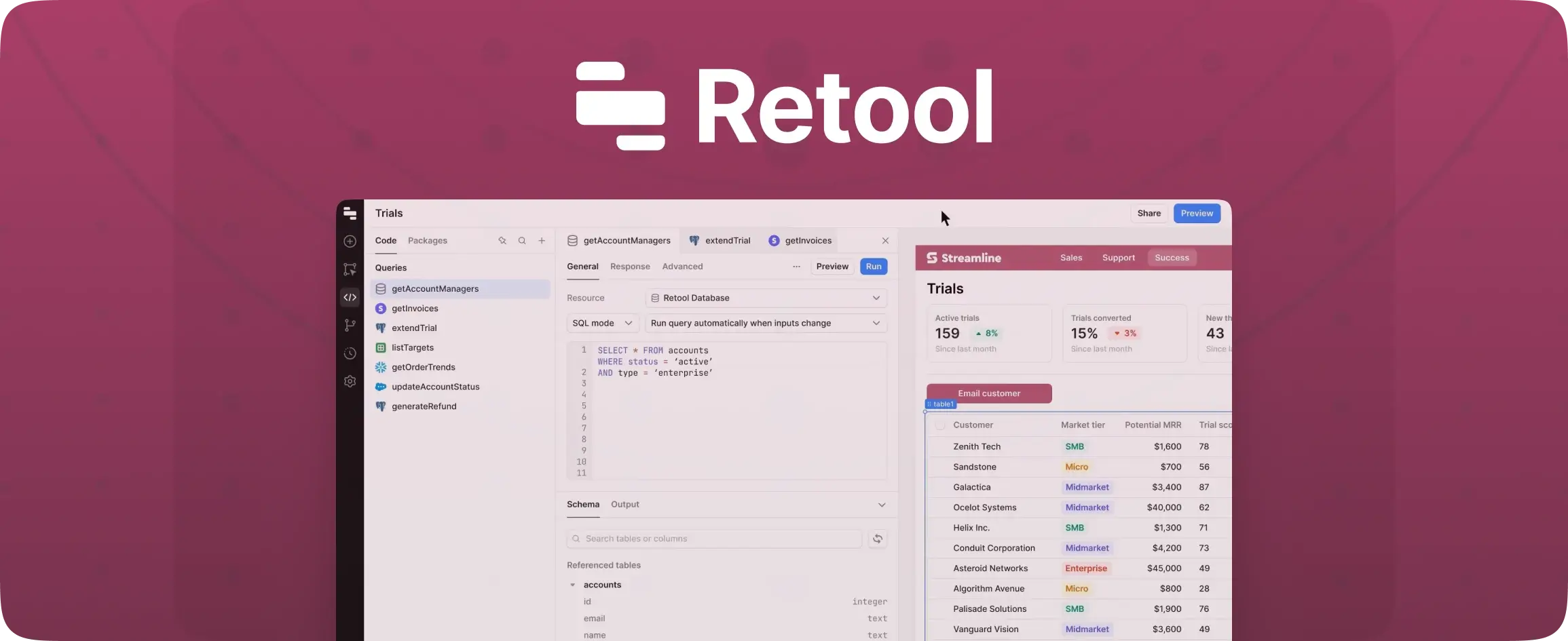
Retool holds a 4.6 out of 5 G2 rating and offers Team plans starting at $10 per builder per month. Like Appsmith, Retool focuses on internal tools, but it takes a different approach by emphasizing rapid connection to databases and APIs through a visual interface. Engineering teams use Retool to build CRUD applications, operational dashboards, and admin interfaces in hours rather than days.
The platform supports connections to PostgreSQL, MySQL, MongoDB, REST APIs, GraphQL, and dozens of other data sources out of the box. This connectivity, combined with a drag-and-drop UI builder, makes Retool one of the fastest ways to ship operational software. It is particularly popular among mid-sized technology companies and internal tool teams at larger enterprises. While Retool is not a full low-code platform for building customer-facing applications, it is arguably the best tool available for internal operational software. Organizations that need to rapidly build and iterate on back-office tools will find Retool hard to beat.
7. Bubble
Bubble achieves a 4.4 out of 5 G2 rating and starts at $59 per month for its Starter plan. It is a full-stack no-code platform designed for founders, product managers, and entrepreneurs who want to build web applications and native mobile experiences without writing code. Bubble has been one of the most established visual development platforms for over a decade, with a large community and extensive plugin ecosystem.
The platform supports complex logic, database management, user authentication, and third-party integrations entirely through a visual editor. This makes it ideal for rapid prototyping and MVP development. Many successful startups have launched their first product on Bubble before transitioning to traditional engineering teams. However, Bubble is less suited for enterprise environments that require strict governance, audit trails, and compliance controls. Its strength lies in speed and accessibility for product teams, not in the structured delivery standards that large organizations demand. For founders and product teams shipping customer-facing applications quickly, Bubble remains one of the best options available.
8. Zoho Creator
Zoho Creator is priced at $8 per user per month for its Standard plan, making it one of the most affordable low-code platforms on this list. It is designed for small and medium-sized businesses, particularly those already using the broader Zoho ecosystem of business applications. The platform focuses on workflow automation and practical business applications that can be deployed without significant development overhead.
Organizations use Zoho Creator to build inventory management systems, customer relationship tools, expense tracking applications, and other operational software. The platform integrates natively with Zoho CRM, Zoho Books, and other Zoho products, creating a cohesive environment for businesses that have standardized on the suite. While Zoho Creator lacks the enterprise scalability and governance features of platforms like OutSystems or Mendix, it offers exceptional value for SMBs. The combination of low cost, ease of use, and ecosystem integration makes it a practical choice for organizations that need to automate business processes without enterprise-level investment.
9. Quickbase

Quickbase offers a Team plan starting at $35 per user per month and is specifically focused on operational work management. The platform is designed for teams that want to replace spreadsheets with custom operational applications. It is commonly used for project tracking, process management, and cross-functional workflows where flexibility matters more than deep software engineering capabilities.
Quickbase allows non-technical users to build applications that manage data, automate notifications, and track progress across teams. Its strength is in enabling business users to create solutions for their own operational challenges without waiting for IT resources. Organizations in construction, professional services, manufacturing, and other operations-heavy industries find Quickbase particularly valuable. However, the platform is more specialized than the higher-ranked options. It excels at operational work management but is not designed for building complex customer-facing applications or enterprise-wide systems. For teams that need to move beyond spreadsheets quickly, Quickbase is a reliable choice.
10. Pega Platform
Pega Platform is recognized for enterprise business process management, case handling, and decision automation. Pricing is custom and typically targeted at large organizations with complex process requirements. Pega has a long history in the BPM space and remains a strong choice for enterprises that need sophisticated rules engines, workflow logic, and case management capabilities.
The platform is frequently deployed in financial services, insurance, healthcare, and government organizations where process complexity and regulatory compliance are central concerns. Pega's decision management capabilities allow organizations to automate complex business rules that would be difficult to implement on other platforms. Despite these strengths, 2026 comparisons place Pega behind more versatile low-code leaders for most buyers. The platform is exceptionally powerful for its specific domain but less flexible for general application development than OutSystems, Mendix, or Microsoft Power Apps. Organizations evaluating Pega should do so specifically for process automation and case management use cases where its specialized capabilities provide clear advantages.
The low-code market in 2026 offers a platform for nearly every development scenario. Enterprise organizations with complex governance requirements will find the strongest options in OutSystems, Mendix, and Microsoft Power Apps. Teams focused on process automation should evaluate Appian and Pega. Engineering groups building internal tools will get the most value from Appsmith and Retool. Founders shipping customer-facing products should consider Bubble. And organizations looking for affordable operational solutions have strong choices in Zoho Creator and Quickbase.
The key is matching the platform to the specific job it needs to do. No single low-code tool dominates every category. Organizations that take the time to evaluate their primary use cases, existing technology investments, and governance requirements will find a platform that delivers real productivity gains. The best low-code platform in 2026 is the one that fits your organization's specific needs, not the one with the highest rating in a general comparison.
Related Posts


0 Comments
Join the discussion and share your thoughts
No Comments Yet
Be the first to share your thoughts on this article!