Top 10 Largest Aircraft Carriers In The World 2026: Unveiling Maritime Giants

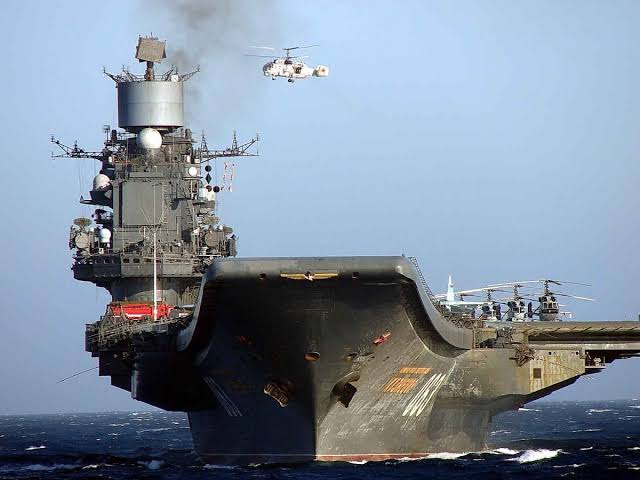
Table of Contents
Aircraft carriers stand as the most formidable and complex naval vessels ever constructed, embodying a nation's capacity for global power projection. These floating airbases extend a country's reach far beyond its shores, enabling rapid response and sustained air operations in any theater. As of 2026, the global fleet of these maritime giants continues to evolve, with nations investing heavily in advanced designs and technologies. Our analysis identifies the Top 10 Largest Aircraft Carriers In The World 2026, a list dominated by the sheer scale and technological prowess of the United States Navy, yet also reflecting the significant advancements made by China and the sustained capabilities of other naval powers. This ranking considers factors such as full load displacement, overall length, and the sophistication of their aircraft launch and recovery systems, which collectively define their strategic importance.
Methodology for Ranking
Our ranking of the world's largest aircraft carriers for 2026 is based on a comprehensive assessment of key naval metrics. We prioritize overall length as the primary criterion, as it directly correlates with flight deck area and the operational capacity for fixed-wing aircraft. Full load displacement, representing the total weight of the ship and its contents, serves as a crucial secondary metric, indicating endurance, survivability, and the ability to carry a substantial air wing. In cases of similar length, displacement and flight deck area act as tiebreakers. This approach synthesizes data from naval analyses provided by sources such as ssbcrack.com, nationalsecurityjournal.org, thedefensewatch.com, and naval-technology.com. We include only operational or near-operational vessels, specifically those commissioned by March 2026, excluding retired ships or those in purely conceptual stages. While our data reflects publicly available disclosures, we acknowledge that exact specifications and ongoing refit details may vary.
Key Subtopics for Comprehensive Analysis
Understanding the strategic value of these carriers requires examining several essential aspects. We focus on their physical dimensions, including length, beam, and displacement, which dictate their footprint and operational capabilities. Aircraft capacity, specifying the number and types of fighters and helicopters they can deploy, is another critical factor. Propulsion and speed, differentiating between nuclear and conventional systems, affect a carrier's range and sustained operational tempo. We also detail the nation of origin, class designation, and commissioning status for each vessel. Unique features, such as electromagnetic aircraft launch systems (EMALS) versus traditional steam catapults or ski-jump ramps, highlight technological edges. Beyond technical specifications, our analysis touches upon the geopolitical implications, such as the United States' continued naval dominance versus China's rapid expansion, and future trends like the integration of unmanned aerial systems. This holistic view provides a deeper insight into global naval power shifts.
The Top 10 Largest Aircraft Carriers In The World 2026:
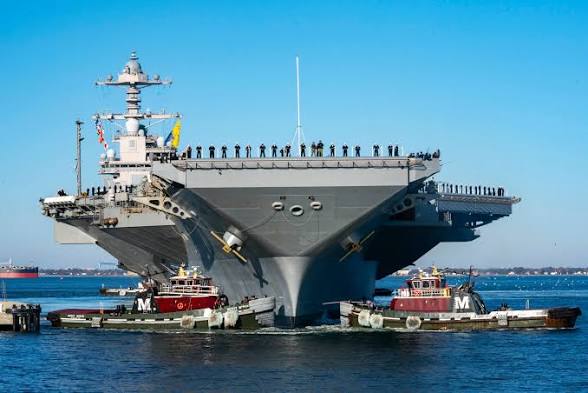
The Gerald R. Ford class represents the pinnacle of modern naval engineering and the newest generation of supercarriers for the United States Navy. With a full load displacement of approximately 100,000 long tons, these nuclear-powered warships are the largest military vessels ever constructed. The lead ship, USS Gerald R. Ford (CVN 78), was commissioned in 2017 and measures an impressive 1,106 feet (337 meters) in length, setting a new standard for carrier operations.
These carriers incorporate revolutionary technologies designed to enhance operational efficiency and sortie generation. Key innovations include the Electromagnetic Aircraft Launch System (EMALS) and Advanced Arresting Gear (AAG). EMALS allows for a 33% higher sortie generation rate compared to previous classes while reducing airframe stress. Each vessel is powered by dual A1B nuclear reactors, enabling speeds exceeding 30 knots and extended periods of operation without refueling. By 2026, the USS Gerald R. Ford has completed multiple deployments, integrating AI-driven damage control systems and preparing for future laser weapon integration, solidifying the United States' naval supremacy.
2. Nimitz Class (United States)
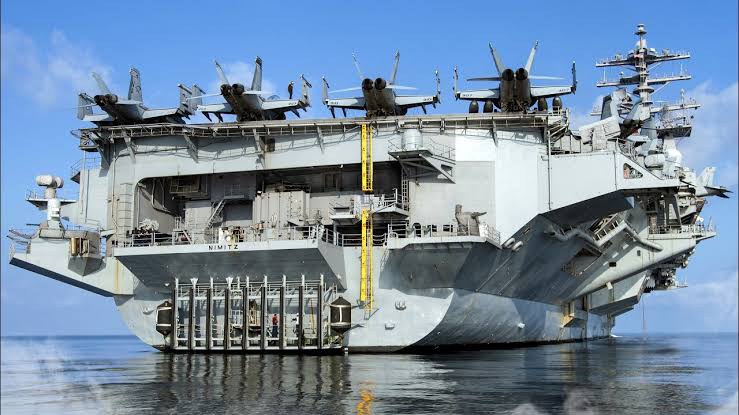
The Nimitz class comprises ten nuclear-powered aircraft carriers that have been a cornerstone of the U.S. Navy's global presence for decades. With a full load displacement of around 97,000 long tons, these carriers are among the most powerful warships ever built. The first ship, USS Nimitz (CVN 68), was commissioned in 1975, initiating a class known for its long service life and robust capabilities. Each Nimitz-class carrier is designed to operate for approximately 50 years with only one mid-life overhaul and can go 20 years without requiring refueling.
These vessels are capable of carrying an extensive air wing of 85-90 aircraft, including F/A-18 Super Hornets, E-2 Hawkeye early warning aircraft, and various helicopters for anti-submarine warfare and search and rescue. Their flight decks support full CATOBAR (Catapult Assisted Take-Off Barrier Arrested Recovery) operations, allowing for the launch and recovery of heavy, fixed-wing aircraft. Equipped with advanced radar and defensive missile systems, the Nimitz-class carriers have maintained their relevance through continuous upgrades, ensuring their continued role in global naval operations.
3. Type 003 Fujian (China)
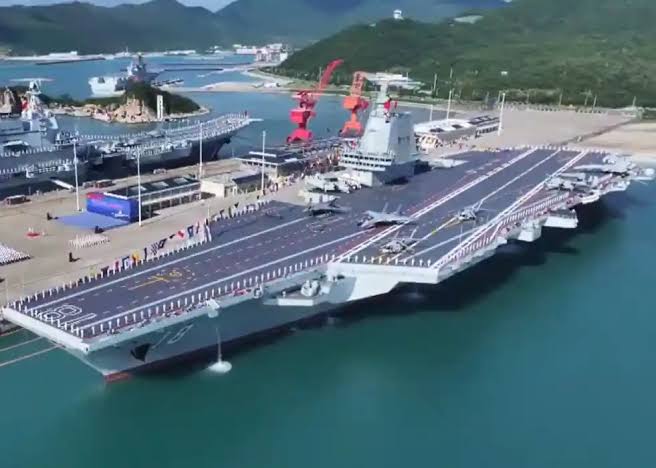
The Type 003 Fujian represents China's most advanced and largest aircraft carrier to date, marking a significant leap for the People's Liberation Army Navy (PLAN). Launched in 2022 and currently undergoing extensive trials, this carrier has a full load displacement estimated between 80,000 and 85,000 tonnes. The Fujian is China's first carrier designed from the outset with electromagnetic catapults (EMALS), a technology similar to that found on the United States' Gerald R. Ford class.
The implementation of a CATOBAR (Catapult Assisted Take-Off Barrier Arrested Recovery) system will allow the Fujian to operate heavier aircraft with greater range and payload capacity compared to China's earlier ski-jump equipped carriers. This capability is crucial for projecting power further from mainland China. Expected to be fully operational by 2026, the Fujian is anticipated to carry 50-60 aircraft, including the J-35 stealth fighter, signaling the PLAN's growing blue-water ambitions and its commitment to developing a world-class carrier fleet.
4. Queen Elizabeth Class (United Kingdom)
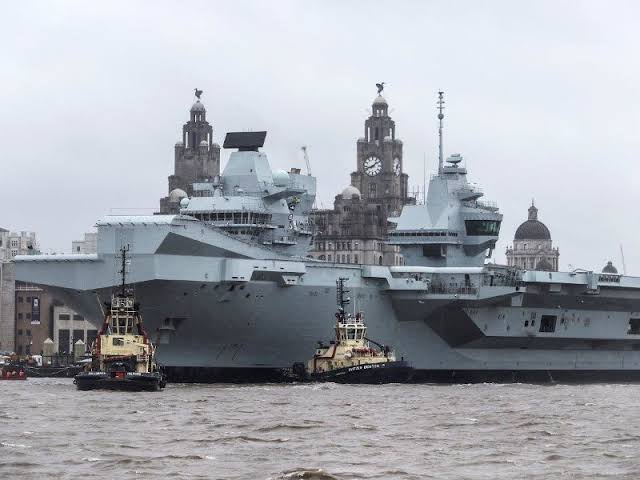
The Queen Elizabeth class consists of two aircraft carriers, HMS Queen Elizabeth and HMS Prince of Wales, representing the largest warships ever constructed for the Royal Navy. HMS Queen Elizabeth was commissioned in 2017, followed by HMS Prince of Wales in 2019. These carriers can reach a full load displacement of up to 80,600 tonnes, demonstrating a substantial increase in the United Kingdom's naval capabilities.
A distinctive feature of these carriers is their unique twin-island design, which optimizes flight deck operations and command functions. They utilize a ski-jump ramp for launching F-35B Lightning II stealth fighters, classifying them as STOVL (Short Take-Off and Vertical Landing) capable vessels. Each carrier can accommodate up to 72 aircraft, although a typical air group consists of 36-40 jets. With gas turbine and electric propulsion, they achieve speeds over 25 knots. The Queen Elizabeth class plays a crucial role in NATO operations and the United Kingdom's global power projection strategy, particularly in supporting expeditionary forces.
5. Type 002 Shandong (China)
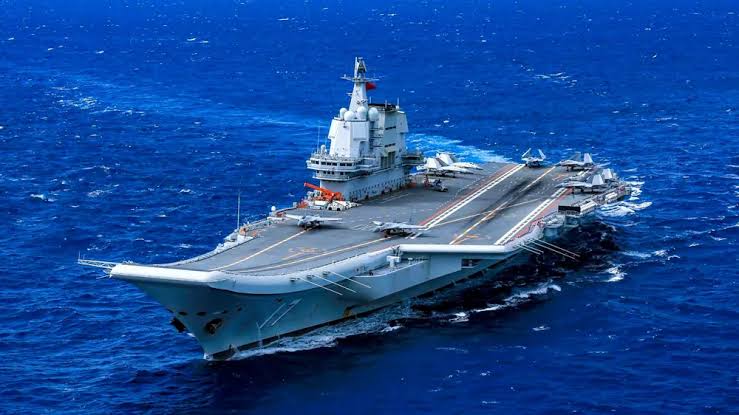
The Type 002 Shandong is China's second aircraft carrier and holds the distinction of being the first to be domestically designed and built entirely within the country. Commissioned in December 2019, the Shandong represents a significant step in China's indigenous naval shipbuilding program. It is based on the design of the Type 001 Liaoning but incorporates several improvements, resulting in a full load displacement of approximately 70,000 tons.
This carrier features a larger flight deck and enhanced capacity for around 44 aircraft, including J-15 fighters and various helicopters. The Shandong operates with a ski-jump ramp for STOBAR (Short Take-Off But Arrested Recovery) operations, similar to its predecessor. Its deployment signifies China's expanding naval presence, particularly within the Pacific and Indian Oceans, serving as a vital component of the People's Liberation Army Navy's growing fleet and its strategic interests in the region.
6. Type 001 Liaoning (China)
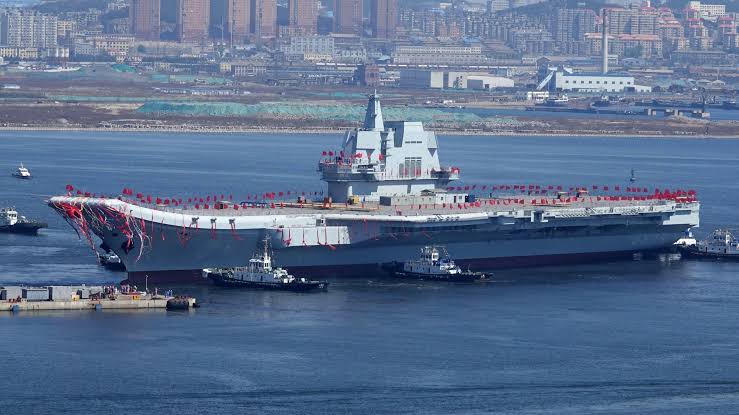
The Type 001 Liaoning holds historical significance as China's first aircraft carrier, commissioned into service in 2012. This vessel began its life as the unfinished Soviet carrier Varyag, which China acquired from Ukraine in 1998. Following extensive refitting and modernization, the Liaoning became a crucial training and operational platform for the People's Liberation Army Navy (PLAN). It has a full load displacement of 60,900 tons.
Operating with a STOBAR (Short Take-Off But Arrested Recovery) configuration, the Liaoning uses a ski-jump for aircraft launch. Its primary air wing consists of J-15 fighter jets along with various helicopters. The carrier serves as a vital training platform for China's rapidly expanding carrier fleet, allowing the PLAN to gain experience in carrier-based aviation and complex naval operations. The Liaoning has played a key role in projecting China's naval power and asserting its maritime interests.
7. Admiral Kuznetsov (Russia)
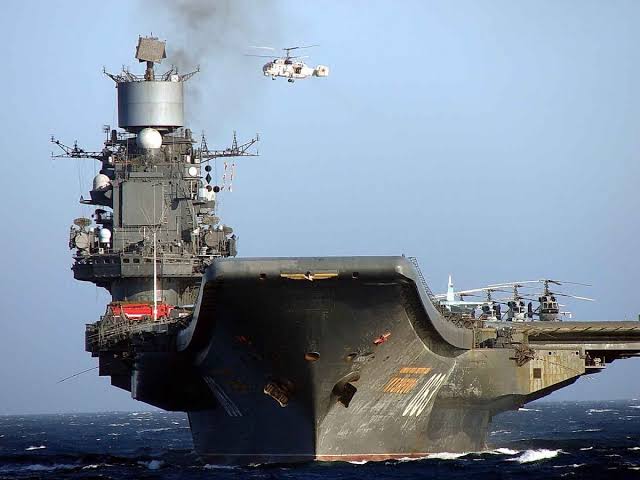
The Admiral Kuznetsov is the sole operational aircraft carrier of the Russian Navy, commissioned in 1991. With a full load displacement of 58,600 tonnes, it is a heavy aircraft-carrying cruiser, a designation that reflects its significant offensive and defensive armament beyond its air wing. The vessel features a distinctive 14,700 square meter flight deck, designed to accommodate Su-33, MiG-29K, and Su-25UTG/UBP STOVL fighters, as well as a range of helicopters.
The carrier utilizes a ski-jump ramp for aircraft launch, enabling STOBAR operations. It is equipped with a formidable array of weaponry, including anti-ship missiles, in addition to its air complement of up to 24 aircraft. While plagued by various incidents and extended refit periods, the Admiral Kuznetsov remains an important asset for the Russian Navy. Efforts continue to return it to full operational readiness by 2026, aiming to restore its presence in strategic areas like the Black Sea.
8. INS Vikramaditya (India)
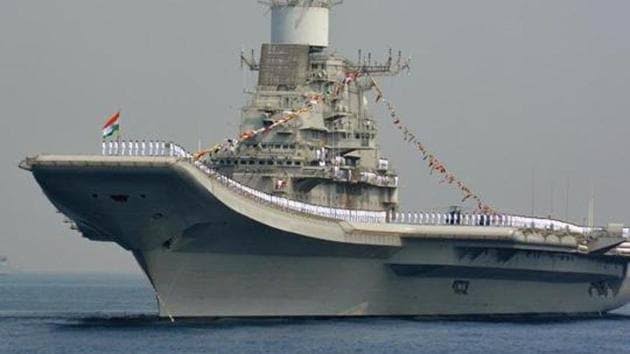
INS Vikramaditya stands as India's largest warship and its primary aircraft carrier, a vital asset for the Indian Navy's maritime defense and power projection capabilities. This modified Kiev-class carrier was acquired from Russia and underwent extensive refitting before its commissioning in November 2013. Measuring 284 meters long and 60 meters wide, it boasts a full load displacement of 45,000 tonnes.
The Vikramaditya features a STOBAR (Short Take-Off But Arrested Recovery) flight deck equipped with a ski-jump ramp. It is capable of carrying an air wing of over 30 aircraft, primarily comprising MiG-29K fighters, which are crucial for air defense and strike missions. Additionally, it deploys various helicopters for anti-submarine warfare, reconnaissance, and search and rescue operations. This carrier significantly enhances India's ability to operate as a blue-water navy, extending its influence across the Indian Ocean region.
9. INS Vikrant (India)
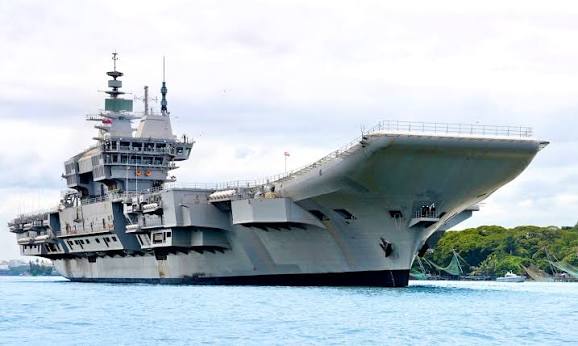
INS Vikrant represents a landmark achievement for India's defense manufacturing capabilities, as it is the nation's first indigenously designed and built aircraft carrier. Commissioned in 2022, the Vikrant signifies India's growing self-reliance in defense production and its ambition to maintain a powerful naval presence. It shares a similar full load displacement of 45,000 tonnes with INS Vikramaditya, making it a significant addition to the Indian Navy's fleet.
Operating with a STOBAR (Short Take-Off But Arrested Recovery) configuration, the INS Vikrant is capable of deploying approximately 30 aircraft. Its air wing includes MiG-29K fighter jets, along with various helicopters for diverse roles such as anti-submarine warfare and maritime surveillance. Equipped with modern radar and weapon systems, the Vikrant enhances India's operational flexibility and strategic reach, reinforcing its position as a key maritime power in the Indo-Pacific.
10. Charles de Gaulle (France)
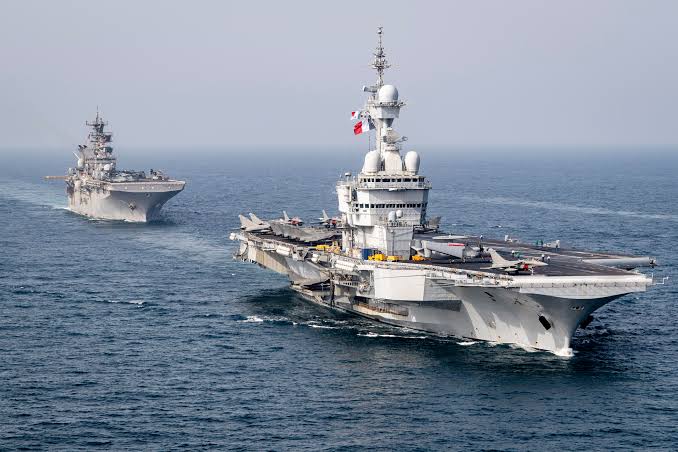
The Charles de Gaulle (R91) is the flagship of the French Navy and holds the unique distinction of being the only nuclear-powered aircraft carrier outside of the United States Navy. Commissioned in 2001, this carrier, with a full load displacement of 42,500 tonnes, provides France with substantial power-projection capabilities despite being smaller than the U.S. supercarriers. Its nuclear propulsion offers extended range and endurance, allowing for prolonged deployments without the need for frequent refueling.
The Charles de Gaulle operates a CATOBAR (Catapult Assisted Take-Off Barrier Arrested Recovery) system, enabling it to launch and recover heavier, more capable aircraft. Its air wing typically consists of around 40 aircraft, primarily including Rafale M fighters and E-2C Hawkeye early warning aircraft. The carrier has been extensively utilized in combat operations in the Middle East and other conflict zones, demonstrating its vital role in Franco-European defense and international security missions by 2026.
The Largest Aircraft Carriers In The World 2026 underscore the ongoing global investment in naval air power and the strategic importance of these vessels. While the United States maintains a clear lead with its nuclear-powered supercarriers, evidenced by the Gerald R. Ford and Nimitz classes, emerging naval powers like China are rapidly closing the technological gap with ships such as the Type 003 Fujian. Our analysis of dimensions, aircraft capabilities, and propulsion systems provides a comprehensive insight into these formidable assets. The continued development and deployment of these advanced carriers, alongside the integration of new technologies like hypersonic missiles and drones, will undoubtedly reshape global naval power dynamics for years to come.
Related Posts

Top 10 Richest Chefs in USA 2026: How They Built Culinary Empires
In recent years, the world of celebrity chefs has developed into a multi-billion dollar industry that combines culinary expertise with media savvy, entrepreneurialism, and the development of distinctive brands. In the year 2026, a number of the wealthiest chefs in the United States have not only established themselves as influential figures in the kitchen, but […] More

Top 10 Best Skaters in the World 2026: The Ultimate Showdown Awaits
As we move through 2026, a few skaters stand out for their extraordinary skills, creativity, and contributions to the sport. Here’s a look at the top 10 skaters in the world right now, each pushing the boundaries of skateboarding in their own unique way. Skateboarding has evolved into a highly dynamic sport, showcasing remarkable talent […] More

Top 10 Highest Paid Female Footballers In The World 2026: Salaries That Shocked the Industry
Top 10 Highest Paid Female Footballers In The World 2026 1. Sam Kerr One of the most notable players in women’s football is Sam Kerr, who hails from Australia and operates as a striker. Kerr has emerged as a significant personality in the sport as a result of her remarkable speed, her extraordinary ability to […] More

The Largest Oil Refineries In The World 2026: Essential Insights for Energy Stakeholders
As of the year 2026, the following is a list of the top ten largest refineries in the world, which are known for their enormous processing capacities and strategic significance. Refineries play an important part in the global energy sector because they convert crude oil into valuable products such as gasoline, diesel, and other petrochemicals. […] More
1 Comment
Join the discussion and share your thoughts