Top 10 Best Public Transit Navigation Apps In Germany 2026

Table of Contents
Germany runs one of the densest public transport networks on earth, and the right app is the difference between a smooth connection and a missed one. We ranked the 10 best public transit navigation apps in Germany for 2026 based on national coverage, real-time data accuracy, ticketing integration, and how well each handles the country's fragmented mix of regional operators. Deutsche Bahn's official tool sits at the top, but the strongest regional apps are close behind, and several of them now do things the national app can't.
How We Ranked These
We weighed four factors: geographic coverage, quality and latency of real-time data, mobile ticketing and Deutschlandticket support, and user feedback across app stores and transit forums. Official operator apps got credit for data accuracy since they draw directly from the source. National and international apps were judged on breadth rather than depth. We did not assign weighted percentages or run a scoring matrix. The order reflects how essential each app is to a typical traveler in Germany in 2026, from daily commuters to first-time visitors.
The Top 10 Best Public Transit Navigation Apps In Germany 2026:
1. DB Navigator
DB Navigator is the official app of Deutsche Bahn and the closest thing Germany has to a universal transit tool. It covers the entire national rail network plus most regional and local transport associations, which means a single search can return an ICE connection, a connecting S-Bahn, and the bus at the other end. Coverage is effectively 100% of the DB network as of 2026.
The app handles real-time platform changes, delay alerts, seat reservations, and mobile ticketing for ICE, IC, EC, regional trains, and S-Bahn services. It also supports the Deutschlandticket, the flat-rate nationwide pass introduced in 2023 that now covers regional trains, buses, trams, and U-Bahn across the country. Cross-border journeys into Austria, Switzerland, France, and Poland are bookable inside the same interface.
Nothing else in Germany matches its scope. For anyone moving between cities or between states, DB Navigator is the starting point, and it's usually the ending point too.
2. BVG FahrInfo
Berlin's transit network is the largest and most complicated in Germany, and BVG FahrInfo is the official app built for it. It covers U-Bahn, S-Bahn, tram, bus, and ferry across the Berlin-Brandenburg region, with real-time departures, disruption alerts, and mobile ticket purchase valid across the entire VBB transport association area.
The FahrInfo Plus upgrade adds live vehicle tracking on a map and a personal dashboard for saved routes. What sets it apart from generic apps is accuracy: because BVG operates the network, its departure data tends to update faster than third-party feeds during disruptions. The app also links directly into Jelbi, BVG's multimodal platform, which we cover separately below.
For daily Berlin commuters, this is the default. Tourists often pair it with DB Navigator for intercity legs.
3. Jelbi
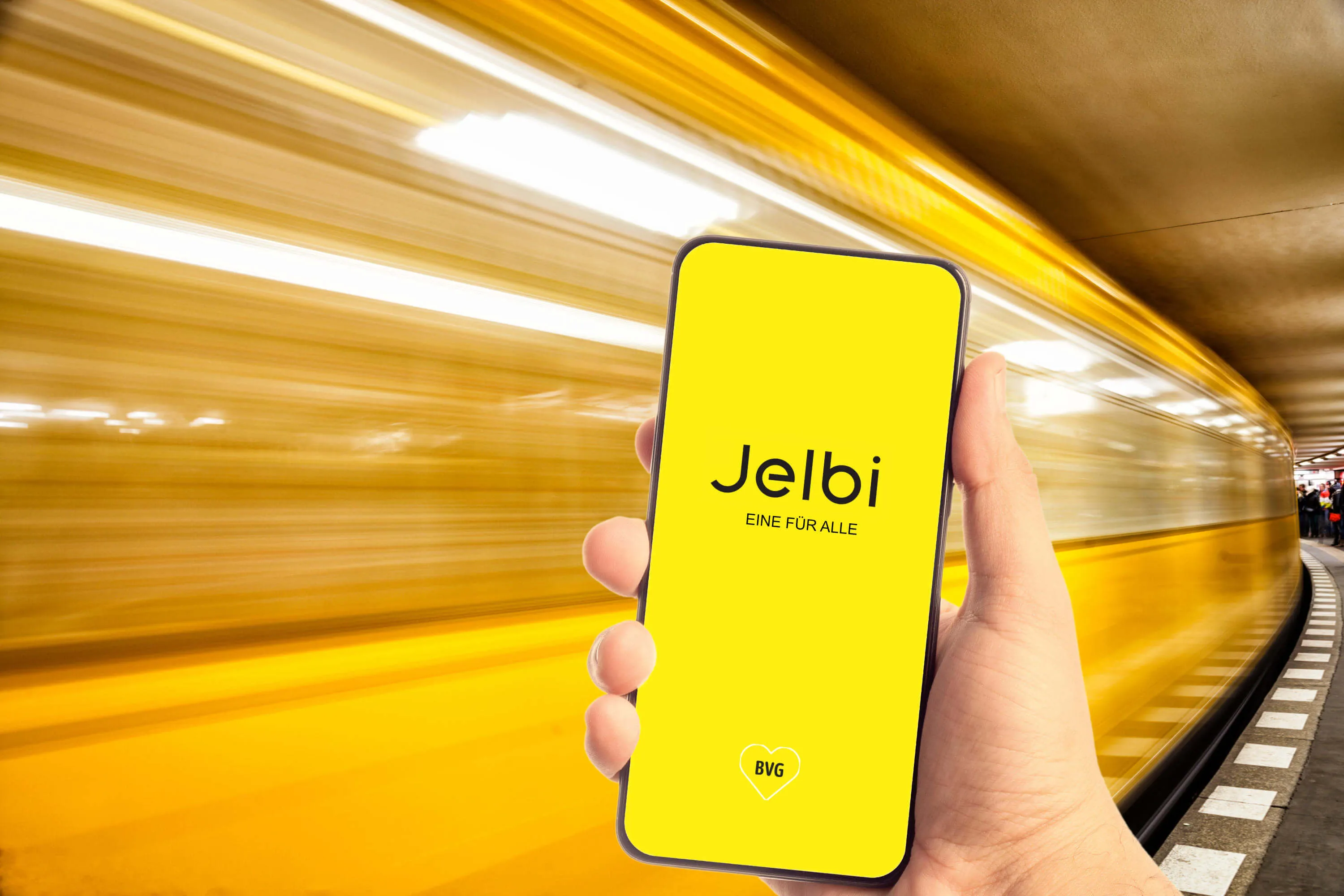
Jelbi is Berlin's answer to the question of what happens when public transit stops being the only option. Operated by BVG in partnership with the technology firm Trafi, it bundles U-Bahn and bus routes together with e-scooters, e-bikes, car-sharing, and ride-hailing into a single app. Users plan, book, and pay for an entire journey across multiple modes without switching apps.
The platform shows real-time availability of shared vehicles and supports the Deutschlandticket for the transit portion of a trip. Industry observers regularly describe Jelbi as one of Europe's most advanced Mobility-as-a-Service platforms, a category that has struggled to deliver on its promises in most cities. Berlin's version works because BVG controls the transit data and the ticketing rails underneath it.
If you live in Berlin and occasionally rent a scooter or a shared car, Jelbi can replace three or four separate apps.
4. Google Maps
Google Maps isn't a transit app in the way the others on this list are, but its German transit coverage is good enough to rank here. The platform, which passed 2 billion monthly users worldwide, provides real-time transit directions for U-Bahn, S-Bahn, tram, bus, and regional train routing in every major German city as of 2026.
Its strengths are familiarity, multilingual support, and integration with the rest of Google's services. If you already use Maps to find a restaurant, using it to find the U-Bahn platform is frictionless. Disruption notifications and walking directions to and from stops are included.
The gap is ticketing. Google Maps does not sell German transit tickets and does not integrate with the Deutschlandticket or regional fare systems, so you'll still need an operator app to actually pay and board in most cases. For orientation and trip planning, though, it's hard to beat.
5. Citymapper
Citymapper is the app transit enthusiasts recommend when someone asks for something better than Google Maps. It covers Berlin, Hamburg, Munich, and Frankfurt in Germany, with a clean interface built around route comparison rather than a single suggested journey. Real-time departures, multi-modal routing, and fare estimates are all included, and the app's "rain-safe" route suggestions favor connections that keep you under cover.
The "Go" mode provides live turn-by-turn guidance during a journey, which is genuinely useful when navigating an unfamiliar U-Bahn interchange. App store ratings sit around 4.7 out of 5 as of 2026.
The limitation is coverage. Citymapper's German footprint is four metropolitan areas, so it's a supplement to DB Navigator rather than a replacement. Outside those cities, it won't help.
6. FlixBus / FlixTrain App

FlixBus and FlixTrain operate over 400,000 daily connections across more than 40 countries, and in Germany they are the leading long-distance alternative to Deutsche Bahn. The combined app handles search, booking, and ticket management for both the green buses and the trains, with live tracking and mobile boarding passes.
FlixTrain runs key German routes including Berlin to Cologne, Hamburg to Stuttgart, and Munich to Frankfurt, often at prices well below equivalent ICE fares. The trade-off is frequency and speed: FlixTrain has fewer departures and longer journey times than DB's high-speed services.
For budget travelers and students, this app is close to essential. It also fills gaps where DB connections are awkward or expensive, particularly on north-south routes booked at short notice.
7. RMV-App
The Rhine-Main region around Frankfurt is one of Germany's economic engines, and the RMV-App is its official transit tool. It covers the Rhine-Main Transport Association, a network of more than 150 operators spanning Frankfurt, Wiesbaden, Mainz, Darmstadt, and the surrounding area, with real-time schedules, route planning, and mobile ticketing across buses, trams, U-Bahn, S-Bahn, and regional trains.
The standout feature is "Bestpreis," which automatically calculates the cheapest valid fare for a given journey. For anyone unfamiliar with German fare zones, which vary by association and can be genuinely confusing, this removes a real source of stress. The app supports the Deutschlandticket and has a reputation for reliability that regional apps elsewhere sometimes lack.
Frankfurt Airport sits inside the RMV network, so arriving travelers can use it immediately.
8. MVG-App (Munich)
Munich's MVG network moves more than 1.5 million passengers daily, and the MVG-App is the official tool for navigating it. It covers U-Bahn, S-Bahn within Munich, tram, and bus services, with real-time departure boards, route planning, and mobile ticketing including the Deutschlandticket.
Two features stand out. MVG Rad integration lets users book the city's bike-sharing fleet from inside the same app, and the "Favoriten" function saves frequent routes for one-tap access. Users consistently praise the app's accuracy, which matters in a city where U-Bahn and S-Bahn connections at stations like Marienplatz and Hauptbahnhof run on tight timings.
Munich is Germany's third-largest city and a major tourist destination, so this app serves both residents and visitors. Coverage is regional, so pair it with DB Navigator for trips beyond Bavaria.
9. HVV-App (Hamburg)
Hamburg's transit system is unusual among German cities because of its ferries. The HVV-App covers more than 10,000 stops and 700 lines, including the harbor ferries that function as genuine commuter routes rather than tourist attractions. Real-time schedules, route planning, and mobile ticketing are included for U-Bahn, S-Bahn, bus, and ferry services.
The app's "HVV Anywhere" feature handles on-demand shuttle services in areas with thinner fixed-route coverage, and the Deutschlandticket is supported throughout. Real-time data precision is a common theme in user reviews, which matters in a city where weather-related disruptions on the harbor are routine.
For anyone living in or visiting Hamburg, this is the definitive app for the network, though like the other regional tools it won't help once you leave the association's area.
10. VBB-App (Berlin-Brandenburg)
The VBB-App covers Berlin and Brandenburg with more than 1,000 lines and 12,000 stops, making it the broader regional counterpart to BVG FahrInfo. It handles real-time schedules, route planning, and mobile ticketing across S-Bahn, regional trains, buses, and trams in both the city and the surrounding state.
Its main audience is commuters who live outside Berlin's city limits and travel in daily. Cross-network journey planning is where it earns its place, since BVG FahrInfo is optimized for urban journeys and the VBB-App picks up where the city boundary ends. The Deutschlandticket is supported, as it is across the other official apps on this list.
There's real overlap with BVG FahrInfo inside the city center, and most Berliners keep both installed. For suburban and Brandenburg travel, the VBB-App is the one that works.
The best public transit navigation apps in Germany in 2026 split into two categories: national tools and regional specialists. DB Navigator covers the country end to end and remains the single app no traveler should go without. The regional apps, from BVG FahrInfo in Berlin to the MVG-App in Munich and the HVV-App in Hamburg, deliver deeper accuracy and tighter ticketing integration within their own networks. Google Maps and Citymapper fill the orientation and route-comparison roles, while FlixBus and FlixTrain cover the long-distance budget segment. Most Germans keep three or four of these installed at once, and for good reason.
Related Posts


0 Comments
Join the discussion and share your thoughts
No Comments Yet
Be the first to share your thoughts on this article!